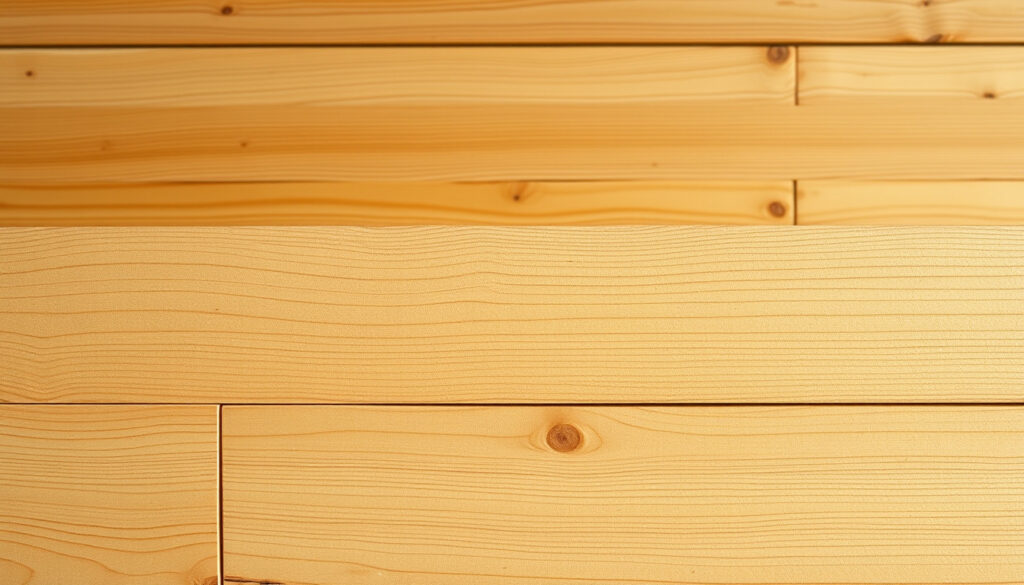
Tongue and Groove Timber: Thickness, Cladding Choices & Costs
Anyone who has stared at a rain-streaked wall and wondered whether the boards behind it are quietly wicking moisture knows the anxiety of choosing exterior cladding. The decision between tongue-and-groove, shiplap, plywood, or composite rarely comes down to looks alone — it is a gamble on thickness, species, and how well the whole system breathes, but framing the choice around a few technical benchmarks makes the risk manageable and the budget realistic.
T&G joint: Tongue on one edge, groove on the other ·
Exterior thickness: 18–28 mm typical for timber boards ·
Durable species: Cedar, larch, oak, Douglas fir ·
Untreated plywood outdoors: High-risk; exterior-grade required
Quick snapshot
- T&G boards interlock via tongue and groove edges. (TTF Handbook)
- Cedar and larch are recognised naturally durable exterior cladding species. (COFORD)
- Best thickness depends on project species, fixing, and wind exposure.
- Cheapest cladding depends on local material prices and labour.
- Membrane requirements vary by composite cladding manufacturer.
- Choose species, spec thickness, and verify support centres before ordering.
- Confirm whether an underlay membrane is required by the cladding manufacturer.
These six facts summarise the core identifiers of T&G timber.
| Label | Value |
|---|---|
| T&G abbreviation | Tongue and groove |
| Edge profile | One board’s tongue fits into the next board’s groove |
| Common uses | Walls, ceilings, floors, exterior cladding |
| Naturally durable cladding woods | Cedar, larch, oak, Douglas fir |
| Untreated plywood | Not suitable for long-term exposed outdoor use |
| Composite cladding membrane | Check the manufacturer’s specification before fixing |
What is T&G timber?
How does a tongue and groove joint work?
- The tongue protruding from one board fits into the groove cut into the next.
- The joint aligns the boards and allows secret nailing through the tongue.
- COFORD guidance specifies a minimum joint clearance of 2 mm to accommodate moisture-related movement (COFORD National Council for Forest Research and Development).
The clearance ensures the boards can expand and contract seasonally without buckling the wall. The Timber Trade Federation handbook recommends a minimum tongue size of 10 mm, ideally 12 mm, for boards up to 95 mm wide (Timber Trade Federation Cladding Handbook).
Where is T&G timber commonly used?
- Internal wall linings, ceilings, and flooring.
- Exterior cladding, provided it is treated as a full Use Class 3 application, comparable to external joinery (COFORD).
The implication: T&G is less a single profile and more a precision fitting. The joint’s clearance and tongue geometry determine whether the system sheds water effectively — which is why thickness and movement allowances are the real specs to watch.
What thickness does a tongue and groove come in?
What is the recommended thickness for timber cladding?
Two standard batten spacings, two minimum thicknesses — the gap between supports dictates the board depth.
| Support centre | Minimum T&G thickness |
|---|---|
| 400 mm or less | 19 mm |
| 600 mm | 25 mm |
| Diagonal fixing | 20 mm typical |
The COFORD guide sets 25 mm as the minimum for 600 mm centres and 19 mm for 400 mm centres (COFORD). The Timber Trade Federation handbook gives 20 mm as the typical minimum for diagonal T&G cladding.
How do nominal and finished thickness differ?
- Boards are often sold by a nominal dimension that exceeds the finished thickness.
- Always specify finished thickness and verify it at the board’s thinnest point.
- The width-to-thickness ratio should generally stay between 4:1 and 6:1 for stability (Timber Trade Federation Handbook).
The pattern: specifiers who ignore the 19 mm vs 25 mm distinction, or who assume a nominal dimension is the real one, risk boards that oil-can or split tongues.
Cladding material comparison
Four exterior cladding materials, two criteria that govern the choice.
| Material | Min thickness | Natural durability | Maintenance level | Relative cost |
|---|---|---|---|---|
| T&G Cedar | 19–25 mm | High | Low-Med | Medium-High |
| T&G Larch | 19–25 mm | High | Low-Med | Medium |
| T&G Softwood (PT) | 19–25 mm | Treated | High | Low |
| Composite | Manufacturer spec | High | Very low | Medium-High |
Which material you choose depends on your budget and desired maintenance.
T&G board specifications
Dimensional rules from COFORD and the Timber Trade Federation.
| Parameter | Value | Source |
|---|---|---|
| Min thickness (400 mm centres) | 19 mm | COFORD |
| Min thickness (600 mm centres) | 25 mm | COFORD |
| Feather-edged board min thin edge | 8 mm | COFORD |
| Min tongue size (board <95 mm) | 10 mm (12 mm ideal) | TTF |
| Max face width (horizontal, Ireland) | 125 mm | COFORD |
| Max face width (general external) | 120 mm (175 mm small-mvt) | TTF |
| Width:Thickness ratio | 4:1 to 6:1 | TTF |
| Joint clearance for movement | 2 mm | COFORD |
| Installation moisture content | ~16 % (± 3 %) | COFORD |
These parameters ensure the cladding performs structurally and aesthetically.
Pros & Cons of T&G timber cladding
Upsides
- Mechanical joint prevents panel gaping as the timber seasons.
- Secret nailing through the tongue gives a clean face.
- Broad species and thickness range fit most budgets.
Downsides
- Correct thickness is directly tied to support spacing — guess wrong and boards deflect.
- Timbers require moisture content verification at installation.
- Tongue can split if over-driven or if the board is too dry.
Thickness delivers rigidity. But thicker boards cost more, weigh more, and require longer fixings. A 25 mm board on 600 mm centres is structurally sound; a 19 mm board on the same spacing will likely deflect.
The right choice balances these trade-offs.
Steps
- Determine support centres. Measure the batten spacing — 400 mm or 600 mm will dictate the rest.
- Select species and treatment. Naturally durable species (cedar, larch, oak) or pressure-treated softwood (Use Class 3).
- Choose finished thickness. 19 mm for close centres, 25 mm for wider spans.
- Plan for 2 mm joint clearance. Mark the take-off at the groove side.
- Verify moisture content. Target ~16 % (± 3 %).
- Fix tongue uppermost for horizontal boards so the profile sheds water away from the joint (COFORD).
A beautiful T&G board on 600 mm centres at 19 mm thickness will oil-can in direct sun. The saving on wood is lost to deflection and wind-noise.
Following these steps reduces the risk of installation errors.
What type of timber is best for exterior cladding?
What is the best exterior wall cladding material?
Four species, one consistent pattern: natural durability reduces maintenance.
| Species | Durability class | Maintenance | Relative cost |
|---|---|---|---|
| Western red cedar | Natural high | Low | Medium-High |
| European larch | Natural high | Low-Med | Medium |
| Oak | Natural very high | Low | High |
| Douglas fir | Moderate | Medium | Medium |
Cedar, larch, and oak are recognised naturally durable exterior cladding species. The Timber Trade Federation notes that the best material depends on budget, climate, and maintenance willingness.
What is the best low maintenance exterior cladding?
- Naturally durable hardwoods require the least ongoing treatment.
- Pressure-treated softwood needs periodic re-coating to maintain the protective layer.
- Composite cladding offers very low maintenance but carries a higher upfront material cost.
The implication: low maintenance and low cost are usually trade-offs. Cedar or larch cladding, properly detailed, can reach a 40-year service life with minimal intervention.
What is the cheapest exterior cladding option?
What is the cheapest way to clad an exterior wall?
- Softwood T&G is the cheapest board option, often half the material cost of larch or cedar.
- Installation costs — battens, fixings, finishing — can erase the material gap between softwood and a mid-range durable hardwood.
What is the cheapest exterior wall material?
- Untreated plywood is the cheapest panel in absolute terms.
- Its rapid failure outside (delamination and rot within months) pushes the real cost above a correctly specified T&G board.
- Exterior-grade plywood is comparable in price to a mid-range T&G softwood.
Cheapest upfront may not be cheapest long-term.
Can you use plywood as cladding?
How long will untreated plywood last outside?
- Plywood can be used as cladding only if it is exterior grade and properly treated or sealed.
- Untreated plywood exposed to weather can wet, wick, delaminate, or rot within a single season.
- Plywood cladding needs a different maintenance routine than T&G timber — frequent painting and edge sealing are essential.
Plywood requires careful detailing and maintenance to last.
Do I need a membrane under composite cladding?
What does the membrane do?
Composite cladding manufacturers often specify an underlay or membrane to protect the wall behind from moisture that gets past the boards.
When should cladding be installed over a drained cavity?
- Ventilation and drainage behind cladding help keep the timber frame dry.
- A drained cavity is recommended unless the manufacturer’s technical manual explicitly states a direct-fix system.
- Always follow the cladding manufacturer’s installation instructions — self-inventing a system voids the warranty and risks hidden rot.
Membrane requirements vary by manufacturer. Never assume one spec fits all composites.
Always verify the manufacturer’s requirements for your specific composite cladding.
Clarity check
Confirmed facts
- T&G boards interlock via tongue and groove edges. (TTF Handbook)
- Cedar, larch, and oak are recognised naturally durable exterior cladding species. (COFORD)
- External T&G boards require 2 mm joint clearance for movement. (COFORD)
- Horizontal boards should be fixed with the tongue uppermost. (COFORD)
What’s unclear
- Best thickness depends on species, fixing schedule, and wind exposure.
- Cheapest exterior cladding depends on local material prices and installation labour.
- Membrane requirements vary by composite cladding manufacturer.
- Untreated plywood lifespan depends on climate, exposure, and maintenance.
Expert perspectives
External tongue-and-groove joints should provide at least 2 mm clearance to accommodate moisture-related movement.
— COFORD National Council for Forest Research and Development (Timber Cladding Guide)
For external tongue-and-groove boards, a minimum thickness of 25 mm is recommended at support centres of 600 mm, and 19 mm where support centres are 400 mm or less.
— COFORD Technical Guide
The Timber Trade Federation handbook recommends a minimum tongue size of 10 mm, ideally 12 mm, for boards up to 95 mm wide.
Summary
Ultimately, informed choices based on these specifications lead to durable cladding.
coford.ie, newtechwood.com, vastern.co.uk, groupesidex.com, fwpa.com.au, sculptform.com, glaciermillworks.com
Frequently asked questions
Does tongue and groove timber need to be sealed before fitting?
Not necessarily. The critical check is moisture content at installation (~16 % ± 3 %). Sealing is often done after fitting, depending on the finish specified. Check the timber supplier’s recommendation.
Can tongue and groove timber be used for both internal and external walls?
Yes, but the specification differs. External use requires a full Use Class 3 treatment or a naturally durable species. Internal lining boards can be lower density and do not need the same clearance or treatment depth.
What is the difference between tongue and groove and shiplap?
Tongue and groove interlocks mechanically — one board’s tongue fits into the next board’s groove. Shiplap overlaps and does not lock, leaving a visible shadow line. T&G provides a tighter, more weather-resistant joint.
Should tongue and groove boards be installed vertically or horizontally?
Both orientations are possible. For horizontal installation, COFORD recommends the tongue uppermost so the profile sheds water away from the joint. Vertical installation follows different wind-driven rain rules.
What finish lasts longest on exterior timber cladding?
Microporous paints or natural oils, applied according to the manufacturer’s schedule, give the longest service interval. Untreated plywood fails rapidly. A well-maintained cedar or larch cladding can outlast a painted softwood by decades.
Related reading
These related articles provide further context on home improvement costs.
More related posts
 Punjab Kings vs Delhi Capitals: Record Chase Scorecard
 Weather in My Location: Live, Hourly, Tomorrow, Warnings
 Ozzy Osbourne Cause of Death – Official Details Confirmed
 The Tuning Fork Auckland: Capacity, Events & Visitor Guide
 Sterling Cars Sylvia Park: Used Cars, History & Location
 Normal Temperature for Child – Ranges by Age and Method
 Best Body Wash for Men: Ireland Picks from Boots, Arnotts
 NZD to CNY Exchange Rate: Live Rates, Forecast & Tips
