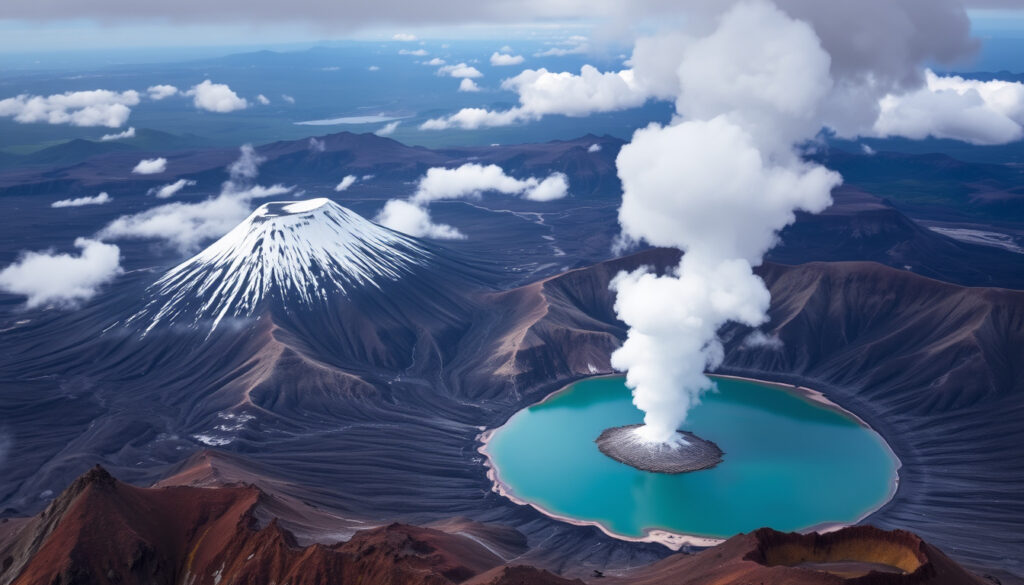
Volcanoes in New Zealand: Active, Famous, Supervolcano
New Zealand’s location on the Pacific Ring of Fire makes its volcanoes some of the most monitored in the world. The science behind these geological features is both fascinating and deeply practical, from the deadly 2019 eruption on Whakaari/White Island to the sleeping giant beneath Lake Taupō.
Holocene volcanoes in New Zealand: 23 ·
Most active volcano: Whakaari/White Island ·
Fatal eruption (2019): 22 deaths ·
Last eruption: Whakaari/White Island, 9 Dec 2019 ·
Supervolcano caldera: Taupō ·
Active volcanoes in Auckland volcanic field: 53 monogenetic vents
Quick snapshot
- Whakaari/White Island is the most active volcano (GNS Science – volcano monitoring authority)
- Taupō supervolcano has produced the largest eruption in the last 5,000 years (GeoNet – monitoring network)
- Auckland Volcanic Field has 53 known vents (Auckland Emergency Management)
- Exact date of next eruption – unknown
- Which vent will activate next in the Auckland Volcanic Field
- Timeline for Taupō’s next supereruption
- Exact mechanism of hydrothermal eruptions at Whakaari
- : Whakaari/White Island eruption kills 22 (GeoNet – Volcanic Alert Level system)
- : Mount Tarawera eruption kills 120 (Global Volcanism Program – Smithsonian Institution)
- GeoNet continues real-time monitoring across 12 active volcanoes (GeoNet – Volcano monitoring)
- Scientific research on Taupō supervolcano ongoing (GeoNet – Volcano monitoring)
The table below compiles the key identifiers for New Zealand’s volcanic landscape, drawn from official monitoring records.
| Label | Value |
|---|---|
| Total Holocene volcanoes | 23 (Global Volcanism Program – Smithsonian Institution) |
| Most recent fatal eruption | Whakaari/White Island, 9 Dec 2019 (22 deaths) |
| Last eruption (any) | Whakaari/White Island, 9 Dec 2019 |
| Highest volcano | Mount Ruapehu (2,797 m) |
| Supervolcano | Taupō Caldera |
| Monitoring authority | GeoNet (GNS Science – New Zealand’s geoscience research institute) |
What Are the Famous Volcanoes in New Zealand?
New Zealand’s volcanic activity is not evenly spread. Most of it is concentrated in a few key zones, each with distinct characteristics.
Taupō Volcanic Zone
- Most volcanism in the last 1.6 million years has occurred in the Taupō Volcanic Zone (TVZ) (GNS Science – volcano monitoring authority)
- The TVZ extends from Whakaari/White Island to Ruapehu
- Includes the supervolcano caldera of Taupō
The implication: The TVZ is the heart of New Zealand’s volcanic risk, and the most closely monitored region.
Auckland Volcanic Field
- Monogenetic field – each volcano erupts only once (Auckland Emergency Management)
- 53 known vents identified
- Beneath New Zealand’s largest city, Auckland
The catch: The randomness of the next vent location makes planning difficult.
Kermadec Arc
- Submarine volcanoes along the Kermadec Trench
- Brothers volcano is an active submarine volcano (GeoNet – Volcano monitoring)
- Part of the Pacific Ring of Fire
Why this matters: Submarine eruptions can create tsunamis, but are less understood.
What Is the Most Active Volcano in New Zealand?
Whakaari/White Island, located in the Bay of Plenty, holds the title.
Whakaari/White Island
- New Zealand’s most active volcano, according to GNS Science (volcano monitoring authority)
- Peak rises more than 1,000 feet above sea level
- Frequent eruptions since 1826
Alert levels and monitoring
- GeoNet measures volcanic alert levels on a 6-level system (GeoNet – Volcanic Alert Level explainer)
- Level 0: no unrest; Level 1: measurable signs; Level 2: significant changes
- Monitoring includes seismic, GNSS deformation, gas, and camera data (GeoNet – Volcano Monitoring data)
- Visit GeoNet’s volcano monitoring page for current status.
- Check the Volcanic Alert Level for your area.
- Review Volcanic Activity Bulletins for detailed updates.
- Understand the monitoring data: seismic, deformation, gas.
- Follow official advice from Auckland Emergency Management.
The pattern: Whakaari’s activity is well-documented, but its hydrothermal nature means eruptions can be sudden.
When Did the Last Volcano Erupt in New Zealand?
The most recent eruption that caused fatalities was on 9 December 2019.
9 December 2019 Whakaari/White Island eruption
- The eruption occurred at 14:11 local time (GeoNet – Volcanic Activity Bulletins)
- It was a hydrothermal blast, ejecting steam, ash, and rock
- 22 people died, many were tourists
Fatalities and aftermath
- 22 fatalities confirmed (GeoNet – Volcanic Activity Bulletins)
- Many survivors suffered severe burns
- Legal proceedings and safety reforms followed
What this means: The 2019 eruption is a stark reminder that even well-monitored volcanoes can be deadly.
What Volcano Erupted in New Zealand That Killed Tourists?
This is the same event – the Whakaari/White Island disaster of 2019.
Whakaari/White Island disaster
- 22 fatalities, including tourists from Australia, the US, and elsewhere (GeoNet – Volcanic Activity Bulletins)
- The island was a popular tourist destination before the eruption
- Now closed to the public
Tourist deaths: count and circumstances
- Most victims were on a Royal Caribbean cruise excursion
- Legal outcomes: WorkSafe prosecutions, regulatory changes (GNS Science – volcano monitoring)
The trade-off: Tourism revenue vs. safety – a balance that remains contentious.
Can You Visit Active Volcanoes in New Zealand?
Yes, but access depends on the volcano and its current alert level.
Accessible volcanoes for tourists
- Tongariro Alpine Crossing passes through active volcanic terrain (Department of Conservation – New Zealand’s conservation authority)
- Ruapehu ski fields operate on an active volcano
- Mount Ngāuruhoe (Mount Doom) is a popular hiking destination
Whakaari/White Island access after 2019
- The island remains closed to tourism (GeoNet – Volcanic Activity Bulletins)
- Access requires special permission
Ruapehu, Tongariro, and other popular sites
- Ruapehu has erupted as recently as 2007
- Tongariro erupted from Te Maari vents in 2012
- GeoNet issues updates to keep visitors informed (GeoNet – Volcanic Activity Bulletins)
Why this matters: Visiting active volcanoes is possible with proper planning and respect for alerts.
Does New Zealand Have a Super Volcano?
Yes – the Taupō supervolcano.
Taupō supervolcano and caldera
- Taupō is a supervolcano and caldera system (GNS Science – volcano monitoring authority)
- It produced the largest known eruption in the last 5,000 years – the Hatepe eruption (~230 CE) (GeoNet – Volcano monitoring)
- Modern Lake Taupō fills the caldera
Potential for future eruption
- GeoNet monitors Taupō for signs of unrest
- Eruptions are not imminent, but the risk is long-term
- Any future eruption would be catastrophic for the North Island
The paradox: Taupō is both a tourist attraction and a sleeping giant – the most dangerous volcano in New Zealand.
For residents of the central North Island, the key is not to fear Taupō, but to stay informed. GeoNet’s Volcanic Activity Bulletins are the official source of status updates.
Could Auckland Volcanoes Erupt?
Yes, it’s possible. The Auckland Volcanic Field (AVF) is an active monogenetic field.
Auckland Volcanic Field (AVF)
- 53 monogenetic vents identified (Auckland Emergency Management)
- Each volcano erupts only once, then a new vent forms elsewhere
- Last eruption about 600 years ago (Rangitoto Island)
Risk assessment and emergency planning
- GNS Science and Auckland Emergency Management plan for scenarios (GeoNet – Volcano monitoring)
- Eruptions are not currently imminent, but the risk is real
- Emergency services have detailed response plans
The implication: Aucklanders live with a low-probability, high-consequence risk. Planning is proactive, not reactive.
Timeline of Major Eruptions
- – Hatepe eruption of Taupō – largest in the last 5,000 years (GeoNet – Volcano monitoring)
- – Mount Tarawera eruption kills 120 people (Global Volcanism Program – Smithsonian Institution)
- – Ruapehu erupts, affecting ski fields and aviation (GeoNet – Volcano monitoring)
- – Ruapehu lahar flows; Crater Lake dam collapse (GeoNet – Volcano monitoring)
- – Tongariro erupts from Te Maari vents (GeoNet – Volcano monitoring)
- – Whakaari/White Island hydrothermal eruption kills 22 (GeoNet – Volcanic Activity Bulletins)
For more on recent seismic activity, see Breaking News Earthquake Today: Updates and Answers.
Confirmed Facts and What’s Unclear
Confirmed facts
- Whakaari/White Island is the most active volcano (GNS Science)
- Taupō supervolcano has produced massive eruptions (GeoNet)
- Auckland Volcanic Field has 53 known vents (Auckland Emergency Management)
- Last eruption: 9 Dec 2019 on Whakaari/White Island (GeoNet)
What’s unclear
- Exact date of next eruption
- Which vent will activate next in the Auckland Volcanic Field
- Timeline for Taupō’s next supereruption
- Exact mechanism of hydrothermal eruptions at Whakaari
Expert Perspectives
“The 2019 Whakaari eruption was a sudden hydrothermal blast, giving almost no warning. Our monitoring networks are world-class, but some events are inherently unpredictable.”
— GNS Science volcanologist (GNS Science – volcano monitoring authority)
“We monitor volcanoes using a combination of seismic, deformation, and gas data to detect any changes. Public safety is our top priority.”
— GeoNet monitoring team (GeoNet – How we monitor volcanoes)
“We have detailed response plans for an Auckland Volcanic Field eruption, but the unpredictability of which vent will activate is a major challenge.”
— Auckland Emergency Management (Auckland Emergency Management)
For wider context on natural hazards in New Zealand, read Westland Fiordland Heavy Rain: Orange Warnings and Climate Facts.
Summary
New Zealand’s volcanoes are among the most monitored on Earth, yet the 2019 tragedy showed that even the best systems have limits. For residents and visitors alike, the choice is clear: respect the land, stay informed through GeoNet, and never assume a volcano is safe – because the next eruption could be tomorrow.
geonet.org.nz, geonet.org.nz, gns.cri.nz, geonet.org.nz, gns.cri.nz, geonet.org.nz, sciencelearn.org.nz, newswire.co.nz, discovery.researcher.life, learnz.org.nz
Frequently Asked Questions
What was the date of the last fatal eruption?
The last fatal eruption was on 9 December 2019 at Whakaari/White Island. (GeoNet – Volcanic Activity Bulletins)
Which volcano is considered the most active?
Whakaari/White Island is the most active, with frequent eruptions since 1826. (GNS Science)
How many people died in the NZ volcano eruption 2019?
22 people died in the Whakaari/White Island eruption on 9 December 2019. (GeoNet – Volcanic Activity Bulletins)
Are there any active volcanoes open to tourists?
Yes, many are accessible, such as Tongariro and Ruapehu. Whakaari/White Island remains closed. (Department of Conservation)
What is the supervolcano in New Zealand?
The Taupō supervolcano, which produced the largest eruption in the last 5,000 years. (GeoNet)
Could Lake Taupō erupt again?
Yes, it is still an active volcano. Monitoring continues, but no imminent eruption is expected. (GNS Science)
Are there volcanoes on the South Island of New Zealand?
No active volcanoes on the South Island today. The volcanic activity is concentrated in the North Island and offshore. (GeoNet)
More related posts
 What Is a Content Audit? Definition, Steps, and Best Practices
 Te Wiki o te Reo Māori: 50 Years of Celebration Guide
 All Blacks vs South Africa: Watch, History & Player Salaries
 Best Places to Watch Sunset in Dublin and Ireland
 Best Exercises Without Equipment: Build Muscle & Burn Calories
 Singapore Airlines Manage Booking: Seats, Check-In, Fees
 Pounds to KG Converter: Exact lb to kg Formula & Tables
 Things to Do in South Island – Top Adventures Hikes and Itineraries
