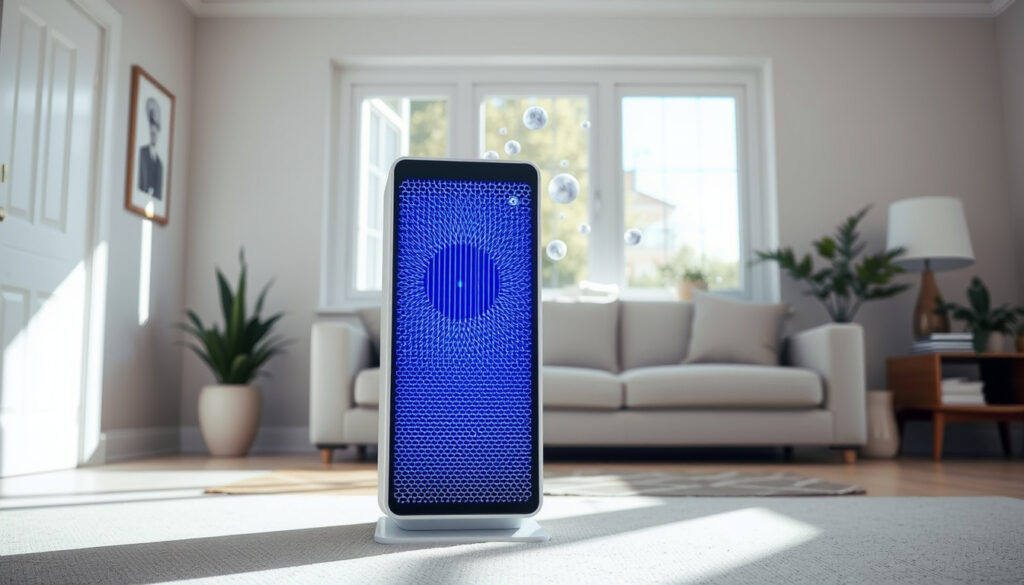
Air Purifiers for Allergies: Do They Help
Anyone who has spent a stuffy night wondering whether the air in their bedroom is the problem has probably asked: will an air purifier actually fix this? For airborne allergens like pollen, pet dander, and dust-mite debris, the answer is yes — HEPA filters can remove up to 99.97% of airborne particles at 0.3 microns, the EPA-linked benchmark cited by New York Magazine’s Strategist.
HEPA filter efficiency: 99.97% of airborne particles at 0.3 microns ·
Typical CADR for large room: 300+ CFM ·
Average energy use: 30–100 watts ·
Allergen reduction in 24 hours: up to 50%
Quick snapshot
- True HEPA filters are the allergy standard — the American College of Allergy, Asthma & Immunology recommends them for single-room use (ACAAI)
- The first buying rule: a true HEPA filter with a CADR matched to the room (GoodRx)
- Purifiers cut the airborne side of allergies: pollen, pet dander, and dust-mite debris (ACAAI)
- Exactly how much symptom relief any individual gets — there is no universal reduction percentage
- Whether very low-level ozone from ionizers has meaningful long-term health effects
- How much real-world performance changes with placement, room geometry, and open doors
- A mid-size purifier can cycle a typical bedroom’s air in under an hour at recommended speeds (Health)
- Allergy-focused units target roughly 4.8 air changes per hour — about one full air change every 12 minutes (Business Insider)
- Filters need replacing every 6–12 months; the grey pre-filter is your reminder (Health)
- Match the Smoke CADR to your room before buying — RTINGS puts a solid allergy target around 188 CFM (RTINGS.com)
- Stick with true HEPA plus activated carbon; skip “ionizing” modes (RTINGS.com)
- Run the unit 24/7 in the room where you sleep, then judge symptoms after two weeks (RTINGS.com)
The numbers that decide whether a purifier helps your allergies — not the marketing — are these:
| Metric | What matters |
|---|---|
| HEPA standard | 99.97% removal of 0.3 micron particles (New York Magazine Strategist) |
| CADR rule | Smoke CADR at least two-thirds of the room’s square footage (Forbes) |
| Bedroom example | 10×15 ft room with a 9-ft ceiling → CADR 150 or higher (New York Magazine Strategist) |
| Allergy ACH target | ~4.8 air changes per hour (HouseFresh) |
| Coverage example | CADR 250 cleans a 250-sq-ft room of smoke in about an hour (Health) |
| CADR definition | Clean air delivered per minute, in CFM (Live Science) |
| Typical bedroom CADR | 200–400 CFM |
| Energy use | 30–100 watts |
| Filter replacement | Every 6–12 months, $30–$200 |
| Noise level | 25–60 dB depending on fan speed |
Does an air purifier really help allergies?
Yes, under the right conditions. An air purifier pulls room air through a fan, passes it through a HEPA fiber mat, and traps the particles that drive most indoor allergies: pollen, dust-mite debris, mold spores, and pet dander. Healthline, a consumer health publisher, explains that HEPA filters are designed to collect at least 99.5% of particles at 3 microns or smaller — exactly the allergy-relevant size range (Healthline).
The mechanism is mechanical, not chemical, which is why the technology is so consistent: nothing is “killed,” nothing is sprayed. Particles get physically caught in the fibers. That also means the purifier’s effect is limited to the air it actually moves — a HEPA filter in the living room does almost nothing for the bedroom.
Do air purifiers clear sinuses?
- Fewer airborne allergens reaching the nasal lining means less irritation for many people with allergic rhinitis.
- They help with allergy-driven congestion, not with colds, structural blockages, or sinus infections.
- Expect the clearest effect after a few nights of continuous use, not after one hour.
GoodRx frames it the same way: the best choice for filtering allergy particles is a true HEPA device, and it should be sized to the room where you spend the most time (GoodRx). Leave a window open and the filter is fighting an endless supply; close the room and the airborne load drops much faster.
The pattern: a purifier treats the air, not the room’s surfaces. If your sinus symptoms flare mainly when pollen counts are high or after time with pets, it should help; if your triggers live in bedding and carpets, you’ll also need to wash and vacuum.
What are the disadvantages of an air purifier?
The drawbacks are not hidden: continuous fan noise, recurring filter costs, a modest electricity draw, and — on some machines — an ozone risk that a true HEPA unit simply doesn’t have.
- Filter replacements run roughly $30–$200 a year depending on the brand and how much you run the unit.
- Fan noise on higher speeds can land around 25–60 dB — noticeable in a quiet bedroom.
- Ionizer and electrostatic modes can emit ozone, an airway irritant.
- No purifier removes settled dust — that job still belongs to a cloth and a vacuum.
Ozone generators trade one allergy problem for an airway irritant. The American College of Allergy, Asthma & Immunology’s guidance is practical: use a true HEPA filter in the room you occupy and skip “ionizing” modes that present ozone as a feature (ACAAI).
What are the negative side effects of HEPA air purifiers?
- True HEPA filters do not intentionally produce ozone — the ozone risk comes from separate ionizer or electrostatic modes on hybrid machines.
- Noise is the most common daily complaint; check the decibel rating on low speed if you’re a light sleeper.
- Recurring costs add up: filters, electricity, and occasional pre-filter cleaning are part of the real price.
- Scope is limited to airborne particles. Mattress dust mites, carpet allergens, and pet hair on the floor stay exactly where they are until you clean them.
None of these are dealbreakers for most households. The pattern: a purifier works when it is sized, placed, and maintained — and the cheapest units tend to cut corners on exactly those things.
The takeaway: the side effects of a well-built HEPA purifier are minor. The side effects worth avoiding come from the wrong technology, not from HEPA itself.
What is the best air purifier for allergy sufferers?
Two design criteria separate the serious contenders from the rest: a true HEPA filter and a CADR that fits the room. RTINGS.com’s lab testing puts a solid allergy target at around 320 m³/h — about 188 CFM (RTINGS.com) — and review recommendations keep returning to the same four models.
Best air purifier for allergies and asthma
- HouseFresh’s air-quality reviewers rank the IQAir Atem X as the best purifier for allergy sufferers right now, citing its ability to remove pollen, dust, and mold (HouseFresh).
- For asthma, treat the purifier as a trigger-reduction tool, not a treatment — medication plans still come first.
Best air purifier for dust allergies
- Dyson’s Hushjet line is the compact, quiet pick, suited to bedrooms where fan noise is the main objection.
- Dust settles fast, so continuous running matters more than an ultra-high CADR.
Best air purifier for pollen allergies
- Coway’s Airmega line is the value pick, with strong CADR per dollar in bedroom-to-living-room sizes.
- Pollen arrives through open doors and windows — run the purifier with the room closed for the fastest effect.
Best air purifier for allergies and pets
- Shark’s BreatheClear is a solid whole-room contender; confirm its CADR against your room size before committing.
- Pet dander is small, light, and stays airborne, which is why GoodRx points to true HEPA as the filter type for pet households (GoodRx).
The pattern: brand names matter less than filter type and sizing. Each of the four models above serves a different room type well — the side-by-side comparison further down shows exactly how they differ.
How many hours a day should you run an air purifier in your house?
Run it all day. The logic is simple: allergen particles are generated continuously — pets move, pollen drifts in, dust mites shed — so the filter has to keep running to keep the airborne load low. A typical purifier draws 30–100 watts, the same class as an older light bulb; a 50-watt unit running 24/7 uses about 36 kWh per month, which is a few dollars on most power bills.
Are you supposed to leave an air purifier on all night?
- Nighttime is when allergic rhinitis most often disturbs sleep, and a purifier beside the bed keeps that micro-environment cleaner while you sleep.
- Low fan speeds on modern units sit well below conversation level — closer to a quiet fan than a vacuum.
- Auto mode or a timer is a reasonable compromise if you find any airflow noise distracting.
Do air purifiers run up your electric bill?
At 30–100 watts, the math is gentle: running a mid-size unit 24/7 typically lands between $5 and $15 a month at residential rates.
- Energy draw of 30–100 W depends mainly on fan speed.
- Timers and eco modes trim the cost further, and most units offer both.
- The expensive mistake is not the electricity — it is buying a unit too small for the room, which runs all day and still underperforms.
The trade-off: stopping the purifier when you leave the house saves cents, not dollars, and lets allergens build right back up. The cheapest running mode is “leave it on.”
How long does it take for an air purifier to purify a room?
The real measure is air changes per hour — how many times the purifier cycles the entire room’s air. HouseFresh reports AHAM’s recommendation of at least 4.8 air changes per hour for allergy use; at that rate, the room’s air passes through the filter roughly every 12 minutes (HouseFresh).
In practice that means a noticeable difference in 15–30 minutes and a substantially cleaner room within the first hour. If the CADR is too low for the room, the same machine can need several hours — which is why sizing matters more than the sticker price.
The clock restarts every time you open a door or window — purification is continuous work, not a one-time event.
Why is my room still dusty with air purifier?
- Purifiers capture airborne dust, not dust already settled on shelves, floors, and bedding (Healthline).
- Dust is also tracked in from outside or shed from skin and clothes — no filter stops that.
- A purifier pushed into a corner behind furniture cleans a much smaller effective area; give it clear airflow.
The dusty-shelf effect is the most common complaint, and it is usually not a filter failure. Run a fingertip across your TV screen: that dust settled; it didn’t float forever. HEPA can only catch what stays suspended. Bedding is the other dust-mite reservoir — the memory foam pillow guide shows one practical way to cut it down.
Do air purifiers still work if the filter is dirty?
- A clogged filter slows airflow, so the unit’s effective CADR drops even if the fan sounds normal.
- Most brands suggest replacement every 6–12 months; some include an indicator light. Skipping changes is the most common cause of “it stopped working.”
- Washable pre-filters extend the HEPA filter’s life — rinse them monthly if you live with pets.
The filter is the machine. When it’s full, the purifier becomes a very slow fan. Replacing it on schedule is the difference between a functioning allergy tool and a placebo.
How to know if an air purifier is actually working?
- Less visible dust on surfaces after a few weeks — a sign the airborne load has dropped.
- Fewer sneezing or congestion episodes, especially after consecutive nights of continuous use.
- Air-quality indicator lights or app readings that drop after cooking, cleaning, or a high-pollen day.
- A particle counter gives the most objective before/after test — compare the purifier’s outlet with a far corner of the room.
The quiet tell is the pre-filter. After two or three weeks, a working purifier’s pre-filter should look slightly grey with captured dust; that is the machine doing its job visibly.
The app will tell you the room is clean, but your nose is the better instrument. Track symptoms and dust separately for two weeks; if neither changes, check the sizing and the filter.
The implication: an undersized, misplaced, or clogged purifier can hum along happily while doing very little. The signs above tell you whether the machine is actually earning its keep.
Air purifiers for allergies: side-by-side
Four leading models share one pattern: the right pick pairs true HEPA with a CADR sized to the room — “best overall” means little if the unit is too small for your space.
| Model | Editor’s take | Filter type | Best placed in | Watch out for |
|---|---|---|---|---|
| IQAir Atem X | Best overall for allergy sufferers — HouseFresh’s current top pick | True HEPA + activated carbon | Living areas, larger bedrooms | Premium price |
| Dyson Hushjet | Compact and quiet | HEPA + carbon | Bedrooms, desks, small rooms | Smaller coverage than bigger units |
| Coway Airmega | Strong value for the CADR it delivers | True HEPA + carbon | Bedrooms, open-plan spaces | Stick to the replacement schedule |
| Shark BreatheClear | Solid whole-room option | True HEPA + carbon | Whole-room allergy control | Confirm CADR vs room size |
The pattern: the IQAir leads on allergy-specific performance, but each alternative wins on a different trade-off — quietness, value, or whole-room coverage.
Air purifier specs that matter
Six labels share one trick: every spec on the box matters only once you know what it measures.
| Spec | What it means for allergies |
|---|---|
| Filter type | True HEPA plus activated carbon is the combination allergy guidance keeps naming (GoodRx) |
| CADR | Clean Air Delivery Rate, measured in cubic feet per minute — higher means faster cleaning for a given room (Live Science) |
| Sizing rule | Smoke CADR should be at least two-thirds of the room’s square footage (Forbes) |
| Air-change target | ~4.8 air changes per hour for allergy-focused use, per AHAM guidance reported by HouseFresh |
| Coverage example | A CADR of 250 can clean a 250-square-foot room of smoke in about an hour (Health) |
| Maintenance | Filters typically last 6–12 months; a clogged filter cuts real-world CADR |
The takeaway: if you check only one number before buying, make it the Smoke CADR — it connects the filter’s speed to your actual room.
Upsides
- Removes airborne pollen, pet dander, and dust-mite debris with true HEPA filtration
- Reduces the allergen load that drives hay fever and allergic rhinitis
- Quiet enough for bedroom use at low fan speeds
- Low running cost — roughly the draw of an older light bulb
Downsides
- Filter replacements add roughly $30–$200 a year
- Ionizer or ozone modes can irritate airways
- No effect on settled dust — a cloth and vacuum are still required
- An undersized unit runs all day and still underdelivers
How to choose an air purifier for allergies, step by step
The best purifier is the one sized for the room you actually sit in — not the largest, not the most expensive.
- Measure the room: length × width gives the floor area, and note the ceiling height.
- Calculate the Smoke CADR you need — at least two-thirds of the square footage (Forbes).
- Choose true HEPA plus activated carbon and skip ozone-generating modes.
- Place the unit where you sit or sleep, away from walls and curtains, and close doors and windows during the cleaning cycle.
- Run it continuously for two weeks before judging symptom changes.
- Set a filter reminder: most brands suggest 6–12 months.
What’s confirmed, what’s not
Confirmed facts
- HEPA filters mechanically capture particles — that is how the standard reaches 99.97% at 0.3 microns (Healthline)
- Air purifiers reduce airborne allergen concentration when the CADR matches the room (GoodRx)
- Ozone-generating purifiers are not recommended for allergy use — the ACAAI warning above is unambiguous
What’s unclear
- Exactly how much symptom relief any individual gets
- Whether low-level ozone from ionizers has long-term health effects
- Whether a purifier alone can fix dust allergies — settled dust needs cleaning, not just filtering
- Whether one pass through a filter catches every particle — 99.97% is the standard, not a guarantee
The pattern: the confirmed claims are about mechanics; the unclear ones are about your individual home.
What the experts say
“HEPA filters can remove up to 99.97% of dust, pollen and any airborne particles with a size of 0.3 microns.”
— American College of Allergy, Asthma & Immunology (ACAAI)
“Atem X from IQAir is the best air purifier for allergy sufferers wanting to remove pollen, dust, mold and other particles.”
— HouseFresh air-quality review lab
The through-line: the right technology is settled; the open question is how carefully you match it to your room.
Editor’s note: The evidence points in one direction: a properly sized HEPA purifier removes airborne allergens, but it cannot vacuum your curtains. For New Zealand households, the decision is clear: measure the room, match the Smoke CADR, and run the unit 24/7 — or keep breathing the same dusty air.
Frequently asked questions
Can air purifiers remove pet dander?
Yes. Pet dander is small and light enough to stay airborne, and HEPA filters are designed to capture particles in that size range. Keep washing bedding and vacuuming, because dander also settles on surfaces.
Are air purifiers safe for babies and children?
The safest type is a true HEPA unit, because it cleans by mechanical filtration and does not intentionally generate ozone. Avoid ionizer or ozone-generating modes in a child’s room.
What is CADR and why does it matter?
CADR stands for Clean Air Delivery Rate. It is measured in cubic feet per minute and shows how quickly the purifier delivers clean air; higher ratings mean faster cleaning for the room size (Live Science).
Do I need an air purifier if I have central HVAC?
Your HVAC filter only cleans air that reaches the return vent. A single-room HEPA purifier cleans the air where you actually sit and sleep, which is why allergy guidance focuses on room-level units.
How often should I replace the filter?
Most brands recommend every 6–12 months. A clogged filter slows airflow and cuts effective CADR, so follow the manual or the filter-change indicator.
Can an air purifier help with asthma?
It can reduce airborne triggers like pollen, pet dander, and dust mites, which may mean fewer asthma symptoms. It does not replace prescribed asthma treatment.
What size air purifier do I need for my room?
Use the Smoke CADR rating: it should be at least two-thirds of your room’s square footage. A 10×15-foot bedroom, for example, needs a CADR of 150 or higher (Forbes).
Related reading
If you’re tackling allergens at home, these guides cover the most common angles:
More related posts
 Cast of Tinā 2024: Actors, True Story, and Where to Watch
 Public Kitchen and Bar Guide: Menus, Reviews, Hours & Locations
 Translate English to Samoan: Best Tools, Phrases & Cultural Guide
 Air New Zealand Boarding Procedures: What You Need to Know
 Those Who Wish Me Dead: Plot, Cast, Reviews & Where to Watch
 Wagner Paint Sprayer NZ: Reviews, Prices & Buyer’s Guide
 Broncos vs Panthers Time: NRL & NFL Kickoff Guide
 Knit World Lower Hutt: Hours, Phone & Yarn Store Guide
