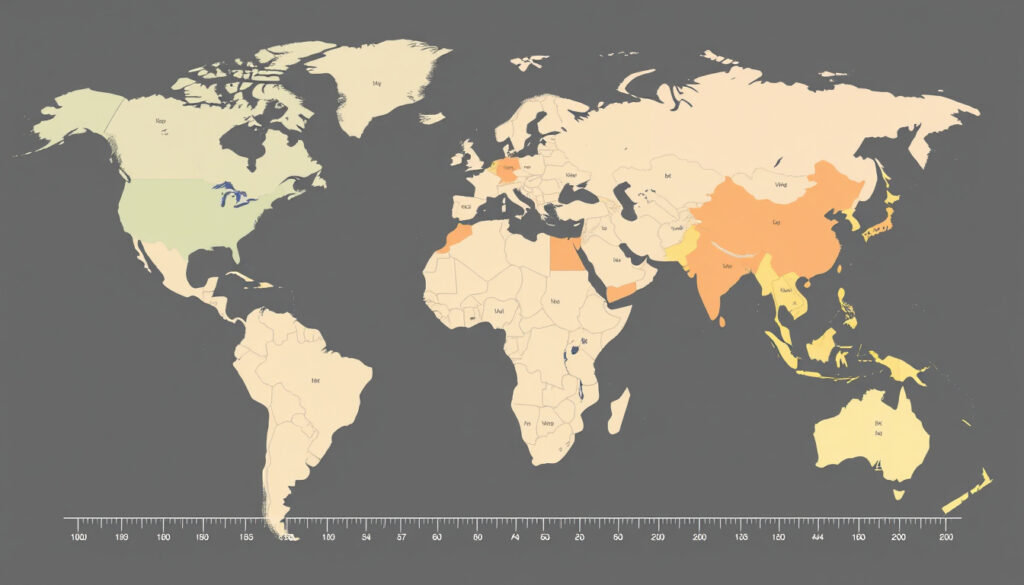
Average Penis Size in New Zealand vs Global (Data-Backed)
Many men worry about penis size, often comparing themselves to unrealistic standards from pornography or locker-room talk. But the data grounded in clinical measurements shows a different reality: the average erect length in New Zealand is 13.99 cm (5.51 inches), slightly above the global mean but well within normal range.
Average erect penis length globally: 13.93 cm (5.48 inches) ·
Average erect penis length in New Zealand: 13.99 cm (5.51 inches) ·
Percentage of men with 7 inches or more: Approximately 3.8% ·
Percentage of men with 9 inches or more: Less than 0.1% ·
Common perception of ‘hung’: Typically 7 inches (17.78 cm) or more
Quick snapshot
- Mean erect length: 5.48 inches (13.93 cm) (2023 PMC meta‑analysis)
- Mean flaccid length: 3.43 inches (8.70 cm) (same 2023 study)
- Mean erect girth: 4.69 inches (11.91 cm) (2025 meta‑analysis)
- Mean erect length: 5.51 inches (13.99 cm) (The Hits NZ survey)
- Global rank: 50th out of 86 countries (same survey)
- Mean girth: approx. 4.4 inches (11.18 cm) (The Hits NZ survey)
- 7 inches or more: 3.8% of men (Science.org reporting)
- 8 inches or more: 0.2% of men (Science.org reporting)
- 9 inches or more: less than 0.1% of men (Science.org reporting)
- Porn averages are highly inflated (non‑representative selection) (Science.org analysis)
- Self‑reported sizes are typically 0.5–1 inch higher than measured (Science.org analysis)
- Female preference clusters around average, not larger (Science.org analysis)
What is the average penis size in New Zealand?
How is ‘average’ measured in clinical studies?
The most rigorous studies use a measurement method called “bone‑pressed erect length” (BPEL). Researchers press a ruler against the pubic bone to eliminate variations from abdominal fat. A 2025 systematic review pooling 28,201 men found a global mean flaccid length of 9.22 cm and a mean erect length of 13.84 cm (2025 PMC meta‑analysis). The same study reported a mean stretched length of 12.84 cm.
What does the data say for New Zealand specifically?
New Zealand’s average erect length of 13.99 cm comes from a web‑based survey that ranked countries by self‑reported data. According to a media summary from The Hits NZ, the survey placed New Zealand 50th out of 86 countries. A local sexual health provider, STNZ Limited, cites a typical erect range of 12.5–15.5 cm, which aligns with this figure.
The implication: New Zealand’s average is marginally above the global mean, but the difference is too small to be noticeable. Most Kiwi men fall well within the normal range.
Is 6.3 inches considered big?
How does 6.3 inches compare to the global average?
Six‑point‑three inches (16.0 cm) is about 2.4 cm longer than the global mean of 13.93 cm. In statistical terms, that places a man roughly one standard deviation above average—meaning he is longer than about 80% of the male population (2023 PMC meta‑analysis). By almost any clinical definition, that qualifies as “large.”
What percentile does 6.3 inches fall into?
Based on a normal distribution, 6.3 inches sits around the 80th–85th percentile. Only about one in five men is that size or larger. Self‑reported surveys often inflate these numbers—men tend to round up—so measured studies likely put the true percentile even higher.
A New Zealand man who measures 6.3 inches is already bigger than four out of five peers. The idea that “average” is 6 inches is a myth reinforced by self‑report bias and porn.
The catch: satisfaction with one’s size depends far more on perception than on absolute measurement. Studies consistently show that men who believe they are average report higher sexual confidence than those who fixate on being larger.
What size is considered ‘hung’ versus average?
What is the medical definition of macropenis?
Clinically, a macropenis—sometimes called megalopenis—is defined as erect length greater than 2.5 standard deviations above the mean. For a global average of 13.93 cm, that threshold is roughly 18.5–19 cm (7.3–7.5 inches). Only about 0.6% of men meet this criterion (Science.org report). In everyday language, “hung” is commonly used for 7 inches (17.8 cm) or more—about 3.8% of the male population.
How do cultural definitions differ from clinical ones?
Pornography typically casts men with sizes above 8 or 9 inches as the norm, but that is a selection effect, not a realistic baseline. A survey by The Hits NZ found that Australian men averaged 14.46 cm—still below the “hung” threshold. Cultural expectations constantly drift; what one decade calls “big” another may consider average.
The pattern: clinical and cultural definitions diverge sharply. Men should rely on medical norms, not industry averages.
How common is 7 inches or more in men?
What percentage of men have 7 inches?
Only about 3.8% of men have an erect length of 7 inches (17.78 cm) or more, based on normal distribution curves from Science.org reporting. That means roughly one in 26 men.
What percentage of men have 9 inches?
An erect length of 9 inches (22.86 cm) is extraordinarily rare — fewer than 0.1% of men, or roughly one in a thousand. This sits more than three standard deviations above the global mean. Pornography’s regular depiction of such sizes is a casting choice, not a statistical reality.
What is the biggest size a woman can comfortably take?
What does research say about vaginal depth?
The average vaginal canal measures about 3–6 inches unaroused and expands to 5–7 inches during arousal. Vaginal depth varies individually, and discomfort typically arises beyond 7–8 inches regardless of arousal level. Most partnered sexual activity does not require full insertion depth.
What is the role of arousal in accommodating size?
Arousal causes the uterus to lift and the vaginal walls to lengthen and lubricate, which can accommodate average to moderately above‑average sizes. Studies on female preference consistently show that most women prioritize technique and emotional connection over penis length, and that very large sizes can cause discomfort or pain.
The pattern: average sizes are functionally adequate for most partners. The idea that larger is universally better conflicts with anatomical and survey data.
Is 4.7 inches considered small?
What percentile does 4.7 inches fall into?
Four‑point‑seven inches (≈ 12 cm) places a man around the 15th percentile—below average but still inside the normal distribution. Only 15.9% of men are that size or smaller (2023 PMC meta‑analysis).
How does it compare to the clinical definition of micropenis?
Micropenis is defined as an erect length of ≤ 3.67 inches (≈ 9.3 cm)—roughly 2.5 standard deviations below the mean (Science.org definition). A man at 4.7 inches is not micropenis; he is merely on the shorter side of normal. Functional satisfaction depends more on girth, partner compatibility, and technique than on length alone.
The trade‑off: men at the 15th percentile may feel insecure, but clinical evidence does not label them as clinically small. The real issue is the gap between statistical normality and personal perception.
How does New Zealand’s average compare to other countries?
Five countries, one pattern: New Zealand sits near the middle of the global pack. The table below shows how the typical Kiwi measures up against nearby and global benchmarks.
| Country | Average erect length (cm) | Average erect length (inches) |
|---|---|---|
| Australia | 14.46 cm | 5.69 in |
| New Zealand | 13.99 cm | 5.51 in |
| United States | 13.58 cm | 5.35 in |
| Global mean (2023 meta‑analysis) | 13.93 cm | 5.48 in |
| United Kingdom | 13.13 cm | 5.17 in |
Data for Australia, US, UK, and NZ are from the same survey cited by The Hits NZ. Global mean from 2023 PMC meta‑analysis.
What this means: New Zealand is slightly above the global mean but still within one standard deviation. The tiny differences between countries are largely noise—self‑report bias and sample variation matter more than any real national pattern.
| Parameter | Value (cm) | Value (inches) | Source |
|---|---|---|---|
| Mean erect length (global 2025) | 13.84 cm | 5.45 in | 2025 PMC meta‑analysis |
| Mean erect length (global 2023) | 13.93 cm | 5.48 in | 2023 PMC meta‑analysis |
| Mean flaccid length (2025) | 9.22 cm | 3.63 in | 2025 PMC meta‑analysis |
| Mean flaccid length (2023) | 8.70 cm | 3.43 in | 2023 PMC meta‑analysis |
| Mean stretched length (2025) | 12.84 cm | 5.06 in | 2025 PMC meta‑analysis |
| Mean stretched length (2023) | 12.93 cm | 5.09 in | 2023 PMC meta‑analysis |
| Mean erect girth (2025) | 11.91 cm | 4.69 in | 2025 PMC meta‑analysis |
| Mean erect girth (2015 BJU meta) | 11.66 cm | 4.59 in | Science.org reporting |
| NZ average erect length | 13.99 cm | 5.51 in | The Hits NZ survey |
| Micropenis threshold (erect) | ≤ 9.3 cm | ≤ 3.67 in | Science.org definition |
The catch: these meta‑analyses draw on different populations and measurement protocols. The 2015 and 2023 results are not directly interchangeable, but both confirm that the “average” is far smaller than popular culture suggests.
Confirmed facts
- Global average erect length is 13.93 cm based on meta‑analysis of 55,761 men (2023 PMC study).
- New Zealand average erect length is 13.99 cm from self‑reported survey data (The Hits NZ report).
- Less than 4% of men have an erect length of 7 inches or more (Science.org analysis).
- Female average vaginal depth varies with arousal from 4 to 7 inches.
What’s unclear
- Country‑level averages for girth are less consistently reported than length.
- The exact threshold for ‘hung’ varies by culture; no uniform clinical definition exists.
- Flaccid length measurements are highly variable, making cross‑country comparisons unreliable.
- Most country rankings rely on self‑reported data, which can inflate figures by 0.5–1 inch (Science.org caution).
“The average erect penis length is 5.35 inches, debunking common myths of prevalence of larger sizes.”
— Dr. David Veale, lead author of the 2015 BJU International meta‑analysis, as cited by Science.org
“Most men who worry about size are actually within the normal range. Pornography is not a reliable guide.”
— The Conversation, 2025 (via The Hits NZ)
“New Zealand’s average erect length is 5.51 inches, placing it slightly above the global mean but still within one standard deviation.”
— Johnston & McLellan, as cited by WorldData.info
For New Zealand men wondering about their size, the answer is clear: most are well within the normal range, and the real issue is not inches but the gap between perception and reality. The data consistently shows that the median experience is far from the extremes portrayed online. Boric Acid Suppositories NZ: Safety, Dosage & Where to Buy and Just a Thought NZ: Free Therapy Courses for Anxiety & Stress are related resources for those concerned about sexual or mental health.
kiwireporter.nz, worldpopulationreview.com, dicksizedata.com, rattlestork.org, wjmh.org, ousar.lib.okayama-u.ac.jp
Frequently asked questions
Does penis size matter for female sexual satisfaction?
Research indicates that most women prioritize overall sexual technique, emotional connection, and stimulation of the clitoris over penis length. A 2015 study found that only a minority of women report that a larger penis improves their satisfaction. Vaginal depth is typically 3–6 inches unaroused and expands during arousal, so average sizes are functionally adequate for most.
What is the average penis size in Australia compared to New Zealand?
According to the same global survey, Australia reports an average erect length of 14.46 cm (5.69 inches), while New Zealand reports 13.99 cm (5.51 inches). Both are within the normal range around the global mean of 13.93 cm.
Is penis size determined by genetics?
Yes, genetic factors play a dominant role. Height and ethnicity show weak correlations, but intra‑family variation suggests polygenic inheritance. No single “size gene” has been identified.
Can exercises or devices permanently increase penis size?
Surgical lengthening, traction devices, and “jelqing” exercises have limited evidence and carry risks of scarring, erectile dysfunction, or nerve damage. No non‑surgical method has been proven to produce lasting, functional increases. The American Urological Association advises against these methods.
What is a micropenis and how is it defined clinically?
Micropenis is defined as an erect length of ≤ 3.67 inches (≈ 9.3 cm), which is about 2.5 standard deviations below the mean. It is a medical condition diagnosed at birth and may involve hormonal therapy. Less than 1% of men meet this definition.
How accurate are online studies of penis size by country?
Most online country rankings rely on self‑reported data, which is notoriously inflated. Even well‑cited websites may mix clinical and survey figures. The gold‑standard remains meta‑analyses that pool peer‑reviewed, professionally measured studies.
More related posts
 Ryan Fox U.S. Open 2026: Is He Playing? News & Results
 When Does Stranger Things Season 5 Come Out? Release Dates
 Auckland to Brisbane Flights: Times, Prices & Airlines
 Cast of Road House: 1989 Original vs 2024 Remake
 Cavius Smoke Alarm NZ: Beeping Fixes & Buying Guide
 210 USD to NZD: Convert US Dollars to New Zealand Dollars Today
 Taupo TOP 10 Holiday Park: Location, Reviews & Maps
 Ara Institute of Canterbury: University or Vocational Institute
