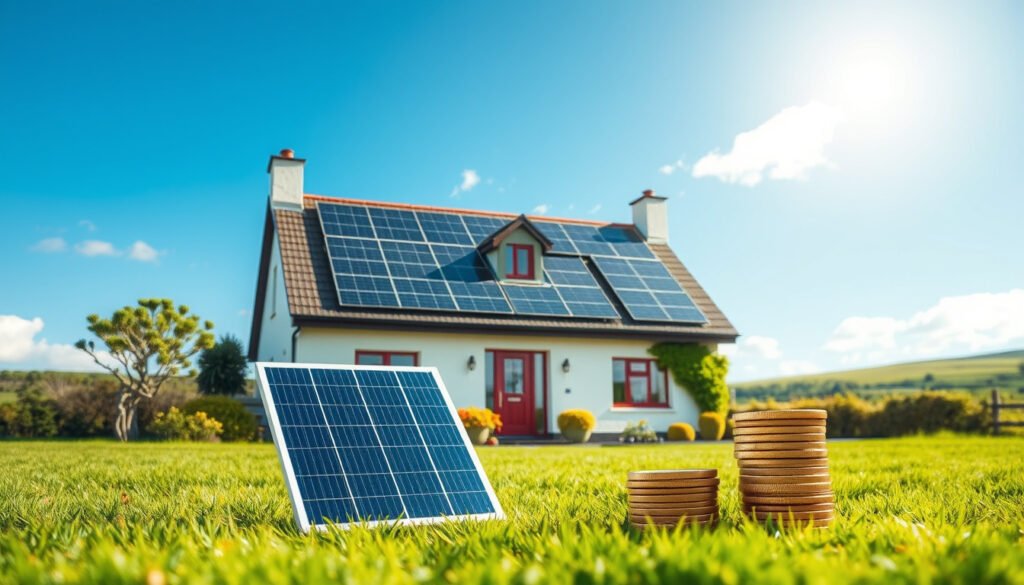
Install Solar Panels Cost in Ireland (2026): Full Guide
There are few home upgrades that create as much quiet excitement as solar panels in Ireland — but the moment a quote arrives, the math starts to get hazy. Below, you’ll find the 2026 numbers that matter, from the exact grant amount to how many panels will comfortably cover a typical Irish home.
Typical cost after grant: €6,000–€9,000 ·
Average system size: 6.6 kWp ·
Market range: €5,000–€20,000 ·
1 kWp generates: 750–900 kWh per year
Quick snapshot
- The maximum residential SEAI solar PV grant is €1,800 for systems up to 4 kWp (SEAI Solar Electricity PV Grants)
- A typical Irish home uses around 4,200 kWh per year, or roughly 11.5 kWh per day (SEAI Solar Electricity PV Grants)
- Standard residential panels now output 400–500 W each (SEAI Solar Electricity PV Grants)
- Exact battery recommendations vary widely by installer and household load; the 20% depth-of-discharge rule needs verification against SEAI or battery manufacturer documentation (Energia’s solar panel cost guide)
- Reported price ranges differ between providers — SolarInfo.ie suggests €4,500–€8,000 after grant, while Energia’s solar panel cost guide quotes €6,000–€9,000
- 2026: SEAI grant scheme remains active, with €700 per kWp for the first 2 kWp and €200 per additional kWp up to 4 kWp (SEAI Solar Electricity PV Grants)
- Grant support is shifting toward battery-ready installations, encouraging homeowners to size systems for future storage (SEAI Solar Electricity PV Grants)
- Get at least three itemised quotes from registered installers before committing
- Use the SEAI grant application process to confirm the exact payable amount for your chosen system size (Citizens Information’s solar panel grants guide)
- Verify that quotes include all components: panels, inverter, mounting, bird-screening, and commissioning
Key facts at a glance
The table below summarises the key financial and technical parameters for Irish solar installations.
| Parameter | Value |
|---|---|
| SEAI max residential grant | €1,800 |
| Grant rate — first 2 kWp | €700 per kWp |
| Grant rate — additional kWp up to 4 kWp | €200 per kWp |
| Typical installed cost after grant | €6,000–€9,000 |
| Full market range | €5,000–€20,000 |
| Average system size | 6.6 kWp |
| Typical daily household use | 10–15 kWh |
| Annual household use | ≈4,200 kWh |
| 1 kWp annual generation (Ireland) | 750–900 kWh |
| Panel output (standard residential) | 400–500 W |
| Recommended battery size (10 kW system) | 10–20 kWh |
| Lithium-ion usable discharge | 80–100% of rated capacity |
One table, one pattern: the SEAI grant caps out at 4 kWp, but the average Irish system is 6.6 kWp. That gap is the real cost driver — and the reason most homeowners pay around €9,000 even after the grant.
How much to install 12 solar panels in Ireland?
Twelve panels at 400–500 W each gives you roughly 4.8–6.0 kWp of capacity. That’s the sweet spot for many Irish homes: big enough to cover a typical annual usage of 4,200 kWh, and in most cases sitting just above the 4 kWp SEAI grant ceiling.
The cost math works like this: a 6.6 kWp system — the current Irish average — falls between €6,000 and €9,000 after the €1,800 SEAI grant (Energia’s solar panel cost guide). Twelve panels with a battery will sit at the upper end of that range, and larger set-ups can climb toward €20,000.
What is the cost of one solar panel in Ireland?
- Purchased individually, a 400–500 W panel typically costs €150–€250
- Installed as part of a full system, the per-panel price rises to roughly €450–€750 once mounting, inverter, cabling, and labour are included
- Provider quotes suggest a minimum whole-system price of around €6,500 before the grant (Bord Gáis Energy’s solar energy guide)
The catch: don’t buy panels in isolation. The value is in the complete system, not the hardware alone.
What is the cost of 8 solar panels and a battery?
Eight panels (roughly 3.2–4.0 kWp) plus a 5–10 kWh battery will cost around €8,000–€12,000 installed. You achieve grant optimisation only if the system stays at or under 4 kWp — otherwise the SEAI’s €1,800 ceiling applies to a portion of your cost.
- 8 panels × 500 W = 4.0 kWp, which sits exactly at the SEAI grant limit
- Adding a battery raises the project into the €10,000+ bracket
- The battery lets you shift afternoon surplus into evening use, which is where the real savings appear
The pattern: 8 panels without a battery is a daylight-only system. With a battery, you’re buying evening independence, not just daytime generation.
Are there solar panel offers in Ireland?
Yes — and the offers are more transparent than they used to be. Providers like Electric Ireland quote from approximately €6,800 upwards before the grant (Electric Ireland’s solar PV page), while Energia publishes a broader after-grant range of €6,000–€16,000 depending on system size (Energia’s installation cost comparison).
Three quotes will expose real price variation. The lowest offer isn’t always the worst value — but it must include the same scope: panels, inverter, mounting, bird-screening, and commissioning.
How many solar panels do I need in Ireland?
A typical Irish home uses about 4,200 kWh per year, or roughly 11.5 kWh per day (EU household electricity consumption statistics). With standard panels outputting 400–500 W, the calculation becomes straightforward: divide your annual usage by the system’s estimated annual generation.
| Home size | Panels needed | System size | Approximate annual generation |
|---|---|---|---|
| Small home / apartment | 6–8 panels | 2.4–4.0 kWp | 1,800–3,600 kWh |
| Medium home | 10–12 panels | 4.0–6.0 kWp | 3,600–5,400 kWh |
| Large home / electric heating | 14+ panels | 7.0+ kWp | 5,400–7,200+ kWh |
The trade-off: a 12-panel system will cover a medium-to-large home’s baseline usage, but roof orientation and shading can shift generation by 20–30% either way.
Can 4 solar panels power a house?
- 4 panels at 500 W = 2.0 kWp, generating roughly 1,500–1,800 kWh per year
- That covers about 35–45% of a typical Irish home’s annual consumption
- It will power the daytime baseline — fridge, router, standby loads — but not evening-heavy usage without a battery
The implication: 4 panels don’t “power a house” in the full sense, but they do shave the biggest chunk off a daytime-heavy household’s bill.
How many solar panels do I need for a typical home?
- 12 panels (≈ 5.0–6.0 kWp) is the most common recommendation for a detached Irish home
- 10 panels (≈ 4.0–5.0 kWp) suits semi-detached homes with moderate usage
- 14+ panels are recommended for homes with electric vehicles or heat pumps
Why this matters: the difference between 10 and 12 panels often costs €1,200–€1,800 — and is usually worth it if orientation is decent. If the roof is shaded for half the day, the extra panels will never pay for themselves. Check the online solar panel cost guide in Ireland for more sizing detail.
Is 10kW enough to run a house?
Yes — emphatically. Average Irish home electricity use is around 11.5 kWh per day (≈4,200 kWh/year), and in Ireland, 1 kWp of solar generates roughly 750–900 kWh annually. A 10 kWp system therefore produces about 7,500–9,000 kWh per year — enough to cover a typical home and then some.
A 10 kWp system doesn’t just cover the average Irish home — it produces around twice the typical household’s annual demand. For most households, the surplus becomes the real return: exported to the grid, or stored in a battery for the evening peak.
How many watts does a house use per day?
Annual use: ~4,200 kWh ·
Daily formula: annual kWh ÷ 365
- Daily electricity use = annual kWh ÷ 365
- Typical daily use is 10–15 kWh in an average Irish home
- Heating water or charging an electric vehicle raises daily wattage significantly — often to 25–35 kWh
The pattern: most homes aren’t consuming 10 kW at any one moment — they’re consuming 10 kWh spread across the day. Generation and consumption are a match of timing, not just totals.
How many kW do I need for my home?
| Household profile | Recommended system | Expected generation |
|---|---|---|
| Small family, no EV | 4–6 kWp | 3,000–5,400 kWh |
| Medium family, gas heating | 6–8 kWp | 4,500–7,200 kWh |
| Large home or EV owner | 8–10 kWp | 6,000–9,000 kWh |
The implication: a 10 kW system is overkill for many homes — but if an EV or heat pump is in your near future, it’s the right-sized hedge.
How many watts does a house use per day?
The number that matters isn’t watts — it’s watt-hours. A typical Irish home consumes between 10 and 15 kWh per day, which is 10,000–15,000 watt-hours. Most of that draw concentrates into morning and evening peaks.
“Typical daily use is 10–15 kWh in an average Irish home — but the split between day and evening usage is what determines whether a solar system pays for itself.”
— Irish solar installer (industry perspective)
- Fridge-freezer: 1–1.5 kWh/day
- Washing machine: 0.5–1 kWh per load
- Tumble dryer: 2–3 kWh per load
- EV charging: 10–15 kWh per full charge
The implication: if you can shift the dryer and dishwasher to solar hours, the daytime curve takes care of itself.
How many batteries do I need for a 10kW solar system?
Battery sizes are measured in kWh of usable capacity. A typical home uses 10–15 kWh per day, and a 10 kW system covers that comfortably — so a battery of 10–20 kWh of usable capacity is the common pairing. Lithium-ion batteries can typically discharge 80–100% of their rated capacity.
| Battery size (usable) | What it powers in the evening | Recommended for |
|---|---|---|
| 5 kWh | Lights, router, fridge, one appliance | Small homes, low backup needs |
| 10 kWh | Normal evening use until midnight | Medium homes with typical usage |
| 15–20 kWh | Full evening + morning peak | Large homes or EV charging at night |
One table, one pattern: battery size should match the evening load you want to cover — not the generation capacity of the panels.
What size battery do I need for a 10kW solar system?
- 10 kWh of usable capacity covers a typical evening
- For EV charging overnight, 15–20 kWh is the workable range
- Check the SEAI solar grant scheme guide for current battery-related incentive rules before adding storage (SEAI Solar PV Scheme Application Guide)
How much battery storage is recommended for solar in Ireland?
- Most installers recommend matching battery capacity to the household’s evening consumption
- For a 10 kW system, that lands at 10–20 kWh of usable capacity
- If you currently export surplus at a low feed-in rate, a larger battery often improves the financial case
The trade-off: batteries are the most expensive component per kWh stored. A 15 kWh battery can nearly equal the cost of the panels themselves.
Is it better to have more solar panels or more batteries?
Adding solar panels directly offsets electricity you would otherwise buy. Adding batteries raises up-front cost but increases the share of self-generated electricity used. For grid-connected homes, exporting surplus can be more economical than adding batteries.
| Factor | More panels | More battery |
|---|---|---|
| Offsets daytime import | Yes | Indirectly |
| Offsets evening import | No | Yes |
| Up-front cost | Lower | Higher |
| Payback period | Shorter | Longer |
| Railway to export surplus | Strong | Weak |
Do I need batteries if I have solar panels?
- No — grid-connection means unused surplus is exported, not wasted
- Without a battery, you still save by offsetting daytime usage
- A battery only makes financial sense if evening usage is high or feed-in rates are low
Should I add more panels or add battery storage?
- If you export a lot at noon, add panels only if your roof has room and your daytime base load can absorb more
- If you import heavily after 6pm, a battery beats extra panels
- If you have an EV, both are justified — panels cover charging at home on weekends, batteries cover it at night
The catch: most households benefit from a balanced approach — panels sized to daytime usage, battery sized to evening usage, with surplus exported as the safety valve.
Why are people getting rid of solar panels?
It’s a fair question, and the honest answer is that most households keep their panels. Removal typically happens for two practical reasons: roof repairs or moving home. The bigger conversation is about the drawbacks that make some people reconsider.
What is the biggest drawback of solar panels?
- High upfront cost: even with the grant, a quality system costs €6,000–€9,000 (Energia’s solar panel cost guide)
- Payback period: typically 5–8 years depending on usage patterns
- Aesthetic impact: roof panels are a visible change that not every homeowner wants
- Repair complexity: if your roof needs work, panels must be removed and refitted, adding cost
- Evening dependency: without a battery, the system is idle after sunset
Getting rid of panels is rarely about the technology failing — it’s about timing. The most frequently cited drawback is the high upfront cost, and the question is whether that cost outweighs the benefit for your specific household. That trade-off depends on your electricity usage, roof orientation, and grant support.
Why this matters: if you’re sizing for 12 panels, the payback math is more forgiving than for small 4-panel systems because the per-panel installation cost drops significantly as system size grows.
Clarity check: what’s confirmed, what’s uncertain
Confirmed facts
- SEAI’s residential Solar Electricity PV grant is capped at €1,800 for systems up to 4 kWp (SEAI Solar Electricity PV Grants)
- SEAI pays €700 per kWp for the first 2 kWp and €200 per additional kWp up to 4 kWp (SEAI Solar Electricity PV Grants)
- A 2.5 kWp system receives a pro-rata SEAI grant of €1,500 (SEAI Solar PV Scheme Application Guide)
- Citizens Information lists the maximum residential solar panel grant at €1,800 (Citizens Information’s solar panel grants guide)
- 1 kWp of solar generates about 750–900 kWh per year in Ireland
What’s unclear
- The 20% rule for battery depth-of-discharge needs verification against official SEAI or manufacturer documentation
- Reported cost after grant ranges vary: SolarInfo.ie says €4,500–€8,000; Energia says €6,000–€9,000
- Electric Ireland’s minimum quoted price of €6,800 (pre-grant) may or may not include scaffolding and bird-screening
- The typical payback period of 5–8 years is an estimate and depends on future electricity price changes and feed-in tariffs
- The cost of a 12-panel system with battery is not consistently reported across providers, with quotes ranging widely
The pattern: the core facts — grant amounts and system sizes — are solid. The price ranges are directionally consistent but differ enough that a three-quote comparison is essential before signing anything.
What installers and providers are saying
“A typical Irish household’s solar panels cost roughly €6,000 to €9,000 after the SEAI grant is applied.”
— Energia (utility provider)
“A solar PV installation ranges from approximately €6,800 upwards before the SEAI grant is applied.”
— Electric Ireland (electricity supplier)
“Most homeowners in Ireland pay between €4,500 and €8,000 after the SEAI grant.”
— SolarInfo.ie (solar specialist)
“Around €6,500 is the minimum expected price for one of our solar PV systems.”
— Bord Gáis Energy (energy provider)
What this means: the spread between providers isn’t random — it reflects different system sizes, hardware quality, and inclusion of extras like scaffolding and bird-screening. Ask for an itemised quote, not a headline number.
energia.ie, seai.ie, seai.ie, seai.ie, irishtimes.com, thejournal.ie, selectra.ie
Frequently asked questions
What is the 20% rule for solar panels?
The 20% rule usually refers to keeping battery depth of discharge at least 20% to preserve battery life. That means a 10 kWh battery would typically be cycled between 20% and 100%, giving a usable capacity of around 8 kWh. Verify the exact wording against the official SEAI guidance or the battery manufacturer’s documentation before sizing a system around it.
Can I get more than €1,800 from the SEAI grant?
For residential solar PV, the maximum is €1,800 for systems up to 4 kWp (SEAI Solar Electricity PV Grants). Some sources mention a €2,400 figure, but that applies to the commercial Non-Domestic Microgen Scheme, not the residential grant.
How long do solar panels pay for themselves in Ireland?
Most estimates put payback at 5–8 years for a typical system, depending on household usage and feed-in tariff rates. The exact figure depends on the share of generation you self-consume — the higher the share, the shorter the payback.
Do solar panels work in winter in Ireland?
Yes, but generation drops sharply. A 1 kWp system might produce 750–900 kWh per year on average, with winter months contributing a small share of that. The panels still offset daytime loads like fridges and washing machines even on overcast days.
How many solar panels do I need for a 3-bedroom house in Ireland?
A 3-bedroom semi-detached home typically needs 10–12 panels, or roughly 4.4–5.0 kWp. That matches the typical annual usage of around 4,200 kWh and maximises the benefit from the SEAI grant.
Should I wait for solar panels to get cheaper?
Panel prices have stabilised, and the SEAI grant is currently active. Waiting means delaying your electricity savings. The better move is to get quotes now, lock in a system sized for your roof, and optionally start with panels and add batteries later when prices continue to trend down.
Related reading
The decision isn’t about whether solar works in Ireland — it does. The question is whether your roof, your usage, and your timing line up. For the typical Irish homeowner, the choice is becoming clear: install a system sized to your daytime usage, add a battery only if evening consumption justifies it, and use the SEAI grant to bring the payback period below seven years. Or wait another year, pay the same or more for hardware, and miss out on the electricity savings you could have banked since spring.
More related posts
 Sudden Death Timaru Today Obituaries: How to Find Them
 How to Multiply Fractions Step by Step Guide
 Have All The Block Houses Sold 2025? Auction Results & Updates
 Open BNZ Account Online: Guide for Residents & Non-Residents
 How Much Is a Dime Worth? Value, Weight, History & More
 Things to Do in Whangamata: Beaches, Adventures & More
 Interior Painters South Auckland: 2025 Costs & Brands
 Punjab Kings vs Delhi Capitals: Record Chase Scorecard
