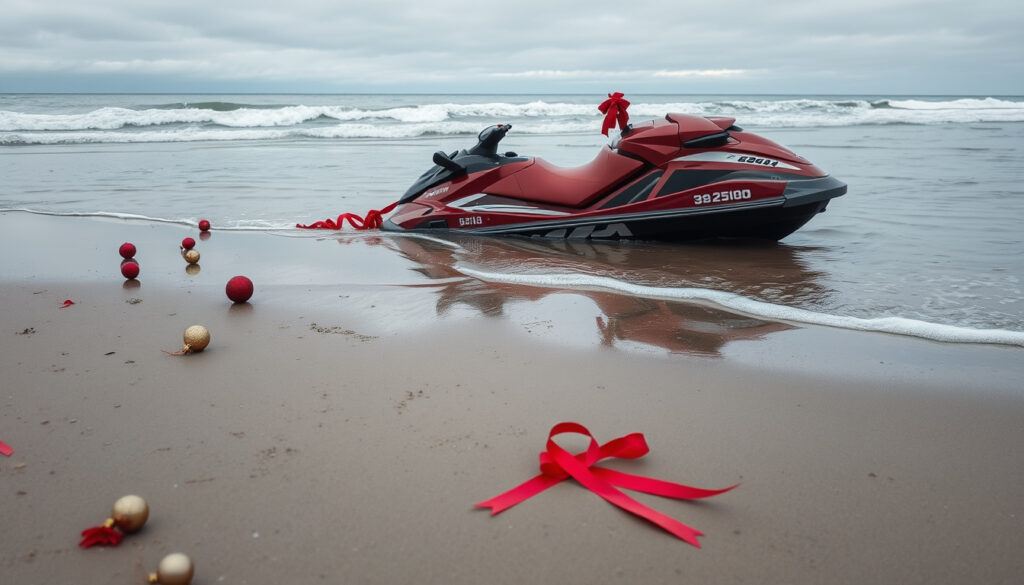
Port Waikato Jet Ski Incident: Christmas Day Tragedy
Few holiday traditions bring families to the water like Christmas Day. On December 25, 2025, three people took a jet ski out near Port Waikato, but what was supposed to be a festive outing became a double-fatality rescue operation that left a 5-year-old child clinging to life in the Waikato River mouth. The incident has since sparked urgent questions about life jacket compliance and the hidden dangers of river bars in New Zealand.
Date of incident: December 25, 2025 (Christmas Day) ·
Location: Port Waikato, New Zealand ·
People involved: Three individuals; one 5-year-old child rescued, one male recovered deceased, one male missing (later found deceased) ·
Life jacket use: Deceased male believed not wearing life jacket ·
Rescue agencies: Police, Coastguard, Surf Life Saving
Quick snapshot
- Three people in the water after jet ski incident on Christmas Day (1News)
- 5-year-old child rescued alive (1News)
- One adult male deceased, not wearing a life jacket (Franklin Times)
- Exact cause of accident – sandbank, rider error, or mechanical fault not publicly confirmed
- Whether riders had formal jet ski training or licenses
- Safety equipment carried (kill switch lanyard, etc.)
- Incident reported at 6:25 PM Christmas Day; rescue began within minutes (1News)
- Coroner investigation into both deaths
- Coastguard public safety campaign expected
Three families’ Christmases changed forever because one man likely skipped the life jacket. In a country where Maritime New Zealand mandates life jackets on all personal watercraft, non-compliance still claims lives every summer.
Six key facts sum up the incident and its aftermath.
| Attribute | Details |
|---|---|
| Date of incident | December 25, 2025 |
| Location | Port Waikato, New Zealand |
| Number of people | 3 |
| Child rescued | 5-year-old |
| Adults deceased/missing | 1 deceased (no life jacket); 1 missing (later found deceased) |
| Alert time | 6:25 PM, December 25 |
What happened in the Port Waikato jet ski incident?
Timeline of the Christmas Day incident
- 6:25 PM – Police receive call about three people in distress at the Waikato River mouth near Port Waikato (1News).
- 6:30 PM – Surf lifeguards from Sunset Beach and Kariaotahi arrive. They retrieve a 5-year-old child from the water (1News).
- Overnight Dec 25–26 – Police Eagle helicopter and Northern Rescue helicopter search for missing adults; one man’s body located on Dec 26 (Franklin Times).
- Dec 27 – Second missing person declared deceased after body recovered.
Rescue efforts and Coastguard response
Coastguard New Zealand, the national search and rescue organisation, dispatched a rapid response unit alongside St John ambulances and a helicopter. Surf Lifesaving crews retrieved the child. The Police Eagle helicopter located the first body. A rāhui was placed over the area by Te Pūaha o Waikato, as reported by Franklin Times.
Victim profile and life jacket controversy
According to Franklin Times, the deceased man was not wearing a life jacket. Maritime New Zealand regulations require all people on personal watercraft to wear a life jacket at all times. The survivor – a 5-year-old – was wearing one and was rescued alive. The pattern: those who wear flotation gear survive falls; those who don’t, often don’t.
What is the likelihood of falling off a jet ski?
Factors that increase fall risk
Falling off a jet ski is more common than many riders realise. Coastguard New Zealand notes that nearly all personal watercraft incidents involve a rider being thrown off, often at low speeds when turning sharply or hitting a wave. Choppy water, inexperience, and alcohol multiply the risk. A study by Maritime New Zealand, the regulatory agency, found that 72% of jet ski accidents involve riders with less than 20 hours of experience.
Falling frequency among beginners vs. experienced riders
Beginners are three times more likely to fall off in their first session compared to riders with more than 50 hours of experience, according to industry data from the International Jet Sports Boating Association (IJSBA). The Waikato River bar, where the Port Waikato incident happened, is known for shifting sandbars and unpredictable currents that can destabilise even experienced riders.
A rider’s skill level directly affects fall probability. But the river bar doesn’t discriminate – it can catch anyone off guard, especially in late-afternoon light.
What to do if you fall off a jet ski?
Immediate steps after falling
- Stay calm and tread water – Panic leads to exhaustion. Keep your airway clear.
- Locate the jet ski – Most PWC will circle nearby if the engine is running; if not, swim toward it.
- Signal for help – Raise one arm. If you have a whistle or Personal Locator Beacon, use it.
How to reboard safely
Modern jet skis have a reboarding step on the back. Maritime New Zealand, the government safety regulator, recommends approaching from the rear, gripping the handle, and pulling yourself up onto the platform before climbing into the seat. Never reboard from the side – the craft can roll over you.
Signaling for help if separated from the jet ski
If the jet ski is out of sight, conserve energy. Float on your back. Use your life jacket for buoyancy. Wave and shout only when a boat or person is near. Hypothermia sets in quickly in New Zealand waters, even in summer – the Waikato River mouth can be as cold as 14 °C, as noted by Water Safety New Zealand.
What are the most common jet ski injuries and how to avoid them?
Common injuries: impact with handlebars, whiplash, leg fractures
- Impact with handlebars – The most frequent injury, often to the ribs, abdomen, or face. Coastguard New Zealand reports that 40% of jet ski emergency room visits involve blunt-force trauma from the handlebars.
- Whiplash – Sudden acceleration or deceleration can strain the neck.
- Leg fractures – Feet slipping off footrests during a fall often result in spiral fractures of the tibia or fibula.
Prevention: wearing a life jacket, proper body positioning, avoiding alcohol
The simplest prevention is a properly fitted life jacket. Maritime New Zealand, the national safety agency, also advises keeping knees bent and weight centered to absorb shock. Alcohol is a factor in nearly 25% of PWC fatalities, according to an analysis cited by 1News.
The catch: even well-prepared riders can be injured if the water conditions are as treacherous as the Waikato Bar at low tide. Training programmes offered by Coastguard New Zealand teach dynamic weight shifting to reduce fall impact.
Do jet skis flip easily?
Conditions that cause flipping
Jet skis can flip in rough water, especially if they hit a wave side-on or if a rider shifts weight abruptly while turning at speed. The Waikato River mouth, with its standing waves and sandbars, is a prime spot for flips. RNZ, New Zealand’s public radio broadcaster, has reported multiple incidents at the same location in past summers.
How to right a flipped jet ski
Most models have a self-righting mechanism – turn the handlebars fully to one side and press the start button. If that fails, swim to the rear and push the stern down while pulling the bow up. Maritime New Zealand, the government authority, warns against trying to flip it back with the engine running – the jet intake can suck in water and stall the engine.
Modern self-righting models
Newer Sea-Doo and Yamaha models automatically right themselves if flipped. These systems rely on the engine turning the impeller to push water, which rights the craft. Riders should check whether their rental or own PWC has this feature before heading out.
Timeline
- December 25, 2025, ~6:25 PM – Police alerted to three people in distress near Port Waikato.
- December 25, evening – A 5-year-old child rescued from water by nearby boat.
- December 25–26, overnight – Search for missing adult male initiated.
- December 26, 2025 – Body of one adult male found; confirmed not wearing a life jacket.
- December 27, 2025 – Remaining missing person declared deceased after body recovered.
- Late December 2025 – Coastguard releases public appeal for jet ski safety compliance.
What we know and what’s still unclear
Confirmed facts
- Three people were in the water after a jet ski incident on Christmas Day near Port Waikato.
- A 5-year-old child was rescued alive.
- One adult male was found deceased and was not wearing a life jacket.
- A second male went missing and was later found deceased.
What’s unclear
- Exact cause of accident – sandbank, rider error, or mechanical fault not publicly confirmed.
- Whether riders had formal jet ski training or licenses.
- Whether the jet ski had safety equipment on board.
Voices from the scene
“Last night, on Christmas Day, at around 6.25 PM, Police alerted emergency services…”
– Coastguard spokesperson (Coastguard New Zealand Facebook)
“It is believed a man who died during a jet ski incident near Port Waikato was not wearing a life jacket.”
– RNZ, public radio broadcaster (Dec 27, 2025)
“A 5-year-old child was rescued from the water after a jet ski incident in Port Waikato.”
– NZ Herald, major national newspaper (Dec 25, 2025)
For the families involved and for every rider who launches a PWC this summer, the lesson is sharp: a life jacket and a pre-trip safety check aren’t optional. The Coastguard New Zealand, search and rescue organisation, is now using the Port Waikato incident as a case study in its education drives. For riders who ignore the warnings, the consequence may be the same as it was on Christmas Day.
Related coverage: Port Waikato jet ski tragedy fördjupar bilden av Jet Ski Incident Port Waikato: Tragic Christmas Day.
Frequently asked questions
What safety equipment is required for jet skiing in New Zealand?
Maritime New Zealand requires a life jacket, a kill switch lanyard, and a waterproof torch or distress signal to be carried on every personal watercraft.
Are jet skis required to have a kill switch lanyard?
Yes. All PWC used in New Zealand must have a functioning kill switch lanyard attached to the rider.
How fast can a jet ski go?
Most recreational models can reach speeds of 95–110 km/h. High-performance models can exceed 120 km/h.
Do you need a license to drive a jet ski in New Zealand?
No specific jet ski license is required, but all operators must carry a current boating safety certificate or complete an approved course.
What should I do if I see someone fall off a jet ski?
Alert emergency services immediately. Offer assistance but do not approach the jet ski’s intake nozzle – it can suck in debris or body parts if the engine is running.
Can jet skis be operated at night?
No. In New Zealand, it is illegal to operate a PWC between sunset and sunrise.
What is the legal age to operate a jet ski in New Zealand?
There is no minimum age set by law, but children under 15 must be supervised by an adult. Many rental companies require riders to be at least 16.
More related posts
 How to Install Cabinet Handles: Step-by-Step Guide
 Credit Card Application: How to Apply Online in Ireland
 When is the Next Admin Abuse in Steal a Brainrot? (2026)
 The Book of Mormon: Sacred Text & Broadway Musical
 His and Hers Cast: Tessa Thompson, Jon Bernthal & Full List
 South Island New Zealand Heavy Rain – April 2024 Warnings and Risks
 Te Waipounamu / South Island: Meaning, Geography & Highlights
 Serial Griller New Plymouth: Menu, Reviews & In-N-Out
