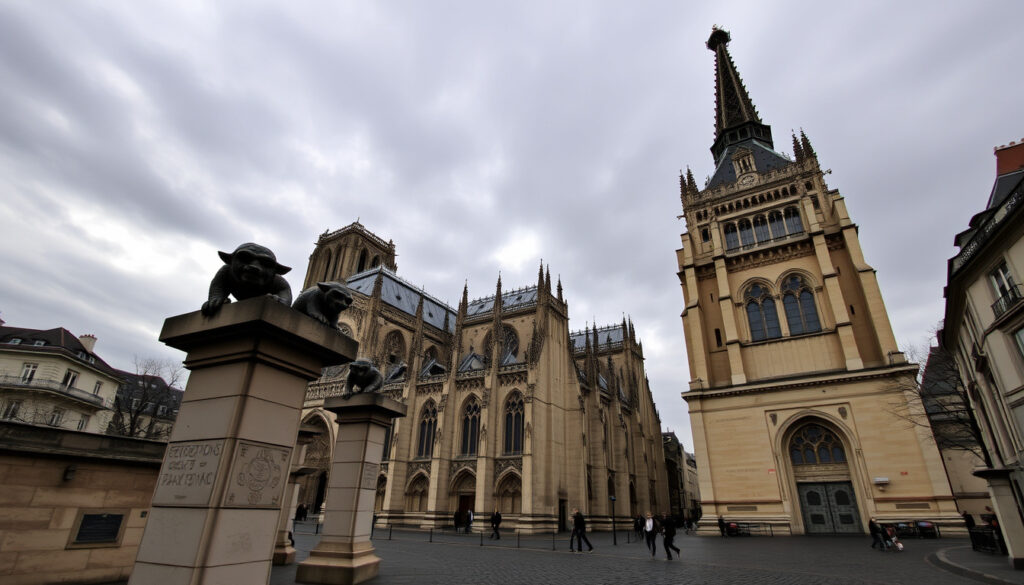
Hugo’s novel awakened the French public to the state of the cathedral and gave birth to a preservation movement that still echoes. — adapted from Encyclopaedia Britannica
What is the story The Hunchback of Notre Dame all about?
Who are the main characters?
- Quasimodo – The deformed bell-ringer of Notre-Dame, adopted by Frollo. He is isolated and longs forconnection (Wikipedia (community encyclopedia)).
- Esmeralda – A kind-hearted Romani dancer who becomes the object of several men’s desires. She is falsely accused of murder and executed in the novel (Encyclopaedia Britannica (reference work)).
- Claude Frollo – The archdeacon of Notrea, whose obsessive lust for Esmeralda drives the tragedy (Wikipedia (community encyclopedia)).
Phoebus – A captain of the king’s archers; Esmeralda loves him, but he ultimately betrays her (Wikipedia (community encyclopedia)).
What is the central conflict?
The storypits unchecked power (Frollo) against innocence (Esmeralda) and physical marginalization (Quasimodo). Frollo’s hypocrisy as a churchman who violates every vow he holds defines the novel’s critique religious corruption. The conflict ends with Esmeralda hanged, Quasimodo killing Frollo, and Quasimodo disappearing into the catacombs to die beside her body (Encyclopaedia Britannica (reference work)).
The implication: Hugo refuses a tidy resolution, forcing readers to sit with the unfairness of a world where the innocent suffer and the powerful escape accountability.
In Hugo’s version, innocence is crushed by institutional corruption, and the bell-ringer follows his only friend into death.
What condition did hunchback of Notre Dame have?
What is the real medical condition called?
Victor Hugo never gives Quasimodo a medical diagnosis. The novel describes him as having a large wart over his left eye, a hunched back, and a crooked leg. Modern readers and medical commentators have proposed several conditions: kyphosis (forward curvature of the spine), scoliosis (ateral curvature), or a congenital syndrome. A 2012 article in PubMed Central (medical research database) argues that tuberculosis or osteoporosis are unlikely because the features suggest condition present from birth. Another interpretation favors congenital kyphosis (The Hunch Blog (fan analysis site)).
Importantly, Hugo’s vagueness allows readers to imagine the character’s suffering without reducing him to a textbook case.
How does the Disney film portray his deformity?
Disney’s 1996 animated version softens Quasimodo considerably. He still has a hunched back and a partial facial deformity, but his figure is more human and less grotesque than Hugo’s original. The film emphasizes his kindness and his desire to be accepted, whereas the novel highlights his extreme physicality and the horror it arouses in others ().
The paradoxDisney’ sanized Quasimodo may be kind and relatable, but it strips the character of the very deformity that defined his isolation in the novel.
Why did Esmeralda get executed?
Was Esmeralda innocent?
Yes. In the novel, Esmeralda is framed for the murder of Captain Phoebus — a crime actually committed by Frollo in a jealous rage. Despite her innocence, the court sentences her to death. hanged in the public square ().
What was the role of Frollo?
Archdeacon Frollo connives Esmeralda’s downfall. His obsession with her is both sexual and possessive; when she refuses his advances, he uses his power to accuse her ofwitchcraft and murder. He stalks her, manipulates the legal system, and ultimately watches her die (Wikipedia (community encyclopedia)Hunchback of Notre-Dame