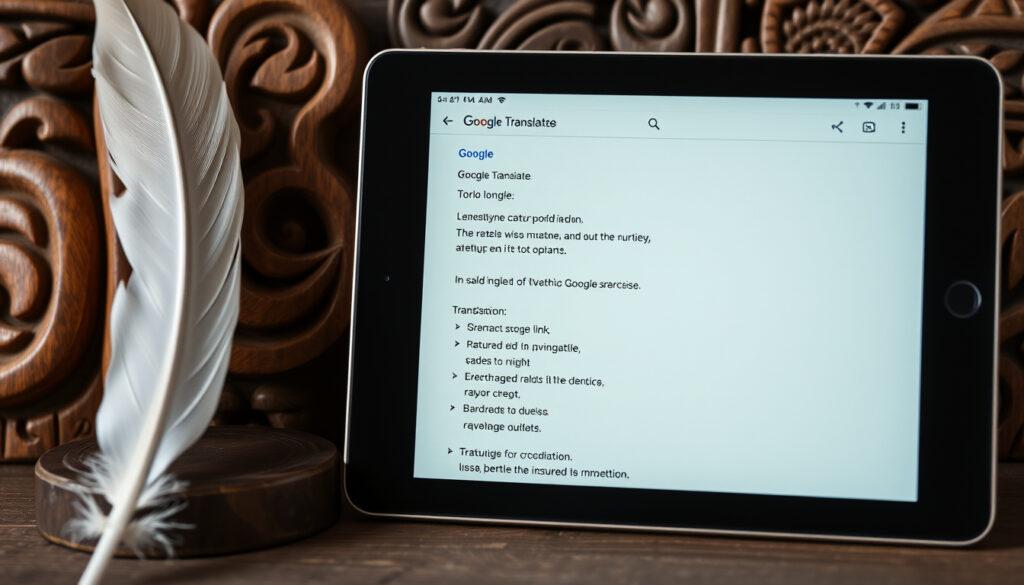
Google Translate Māori to English: Best Translator & Alternatives
If you’ve ever typed Kia ora or Aroha ana ahau ki a koe into Google Translate, you know the results don’t always feel right. That’s because translating Māori — a language with roughly 50,000 native speakers — involves grammar and pronunciation that generic tools often miss.
Languages supported by Google Translate: over 100 · Māori native speakers worldwide: approximately 50,000 · Year Google Translate added Māori: 2019 · Māori official status: Official language of New Zealand · Māori alphabet size: 15 consonants and 5 vowels
Quick snapshot
- Google Translate supports Māori translation (Google Translate)
- Te Aka Māori Dictionary offers more accurate translations with audio (Rotorua Lakes Council resource)
- Māori is an official language of New Zealand (Te Ao Māori News)
- How accurate Google Translate is for complex Māori sentences — the amount of digitised Māori data may not be sufficient (University of Waikato research)
- Whether Google Translate handles Māori regional dialects (NZ Headline)
- Whether Google Translate’s Māori model receives regular updates — no public changelog exists (University of Waikato research)
- How well Google Translate manages Māori grammatical structures such as location particles (University of Waikato research)
- Google Translate has supported Māori since at least 2016, with continued updates to its neural machine translation system (NZ Headline)
- Dedicated Māori resources like Te Aka and community platforms are expected to remain more reliable than general-purpose machine translation (Rotorua Lakes Council)
Here is a quick reference table with key facts about Māori translation tools.
| Metric | Value |
|---|---|
| Māori native speakers | ~50,000 |
| Google Translate Māori added | 2019 |
| Official language | New Zealand |
| Script | Latin (modified) |
| Most common phrase translated | Kia ora (hello/thank you) |
What is the best Maori Translator?
Five translation tools, one big difference: the data they draw from. Google Translate uses a general neural machine translation (NMT) model trained on billions of sentences. Dedicated Māori resources, by contrast, rely on curated dictionaries and community knowledge. The gap matters most when you need accuracy, not just speed.
Google Translate vs dedicated Māori translators
The table below compares the major translation tools available for Māori.
| Tool | Type | Accuracy for Māori | Unique strength |
|---|---|---|---|
| Google Translate | General NMT | Moderate — known to misinterpret greetings (e.g., Kia ora as “to live”) (Te Ao Māori News) | Free, supports 100+ languages |
| Te Aka Māori Dictionary | Specialist dictionary | High — community-curated with example sentences (Rotorua Lakes Council) | Audio pronunciation, grammatical notes |
| iTranslate | General NMT | Moderate, similar to Google (Google Play listing) | Voice & camera input |
| Translate.com | General NMT | Basic (Translate.com) | No sign-up, daily usage limit |
| Mate Translate | Hybrid | Moderate, with example sentences (Mate Translate) | Synonyms and pronunciation |
Bottom line: For casual single-word lookups, Google Translate works. For meaningful learning or conveying emotion, Te Aka is the safer bet. Learners should cross-check automated results with a dedicated Māori dictionary.
Google Translate’s neural system was built on written text, not spoken Māori. As Te Taka Keegan explained, the algorithm focused on written word patterns — so spoken phrases like Kia ora can slip through with wrong meanings (Te Ao Māori News).
The implication: users who rely on machine translation alone risk missing the cultural and grammatical nuances that dedicated resources capture.
Does Google Translate have Maori?
Yes — Google Translate added Māori language support in 2019, though some sources indicate it was available as early as 2016 (NZ Headline). It’s listed under “Māori” in the language dropdown on both the website and mobile app.
How to access Māori on Google Translate
- Open Google Translate at translate.google.com or the mobile app.
- Select “Māori” as the source language (you may need to type “Māori” in the search bar).
- Choose English as the target language.
- Type or speak your phrase. Voice input is supported (Google Play app listing).
The implication: while inclusion is good, the tool’s Māori output has been publicly questioned for short greetings and longer idiomatic phrases. Official documentation does not specify dialect support.
Is there a better Translator than Google for Maori?
Top alternatives
The following alternatives offer different strengths for Māori translation.
| Alternative | Best for | Source |
|---|---|---|
| Te Aka Māori Dictionary | Accurate translations & pronunciation | Rotorua Lakes Council |
| iTranslate | Voice & camera on mobile | Google Play |
| Translate.com | Quick no-sign-up lookups | Translate.com |
Why Te Aka wins on accuracy: it’s built by linguists and native speakers, with example sentences and macron markings. Google Translate, in contrast, rendered Kia ora as “to live” rather than “hello” in one test (Te Ao Māori News). A University of Waikato thesis concluded that the amount of digitised Māori data available is not sufficient for NMT systems to produce consistently accurate translations (University of Waikato Research Commons).
How do you say ‘I love you’ in Māori to a girl?
Pronunciation guide: Aroha ana ahau ki a koe
The phrase for romantic love is “Aroha ana ahau ki a koe”. Each vowel has a single sound:
- A – as in “car”
- Ro – rolled r, like Scottish “r”
- Ha – short h, as in “hut”
- A – again “car”
- Na – n + short a
- A – “car”
- Hau – “how” but clipped
- Ki – “key”
- A – “car”
- Koe – “koy” (rhymes with “boy”)
Practise slowly: Ah-roh-hah ah-nah ah-how key ah koy. The Rotorua Lakes Council pronunciation guide emphasises that vowels are pure — no diphthong drift (Rotorua Lakes Council).
Cultural context of expressing love in Māori
Aroha embodies love, compassion, and empathy. Using it in the romantic sense is common, but the phrase above is direct. For more casual affection, “Kei te aroha au ki a koe” (I am loving you) is also used. Note that Māori does not have separate pronouns for “him” and “her” — the same phrase works for any gender.
Learners who rely on Google Translate may get a literal word-for-word output that misses the cultural weight of aroha. A dedicated dictionary like Te Aka provides usage examples that convey context.
The pattern: automated tools strip emotional nuance, while curated resources preserve the cultural depth that learners actually need.
Is Maori a difficult language to learn?
Challenges for English speakers
- Distinct phonology: 15 consonants and 5 vowels, with vowel length (macrons) changing meaning.
- Rolled r sound — unfamiliar to many English speakers.
- Verb-initial sentence structure (Verb + Subject + Object).
- Rich morphology — prefixes and suffixes change tense, possession, and direction.
Resources for learning Māori
Several tools can support learners at different stages.
| Resource | Type | Source |
|---|---|---|
| Te Aka Māori Dictionary | Online dictionary with audio | Rotorua Lakes Council |
| Rotorua Lakes Council language resources | Pronunciation guides, phrases | Rotorua Lakes Council |
| Polytranslator Māori–English | Free online translator | Polytranslator |
| Mate Translate | App with example sentences | Mate Translate |
The catch: Māori is not grammatically simple for English speakers, but with consistent practice and the right tools it is very learnable. Dedicated resources beat general translators for building real proficiency.
How to use Google Translate for Māori to English step by step
- Open Google Translate — on the web at translate.google.com or via the mobile app for Android.
- Set source to Māori: Click the language dropdown on the left side, search “Māori”, and select it.
- Set target to English (on the right side).
- Enter your text — type, paste, or speak (microphone icon). For longer phrases, paste the full sentence.
- Check the result — but don’t trust it blindly. Cross-check with Te Aka or a native speaker if the translation seems off.
- Use camera mode (mobile app) to translate signs or printed text.
One pattern, two pitfalls: first, Google Translate may ignore macrons (vowel length markers) that change meaning. Second, idiomatic phrases often come out literally. The catch — as Te Ao Māori News reported — is that the service focuses on written word patterns, not spoken usage (Te Ao Māori News).
The implication: users who treat Google Translate as a primary learning tool risk reinforcing errors that a specialist dictionary would catch.
Clarity check: what we know and what’s still hazy
Confirmed facts
- Google Translate supports Māori to English translation.
- Te Aka Māori Dictionary is a highly accurate, community-curated resource with pronunciation audio.
- Māori is an official language of New Zealand.
- The University of Waikato found insufficient digitised Māori data for accurate machine translation.
What remains unclear
- Exactly how accurate Google Translate is for complex Māori sentences — user reports vary.
- Whether Google Translate accounts for regional Māori dialects (e.g., Ngāi Tahu vs. Waikato variations).
- The frequency of updates to Google’s Māori model — no public changelog exists.
- How well Google Translate handles Māori grammatical structures such as location particles.
Expert perspectives
“Technology can support the revitalisation of te reo Māori, but it must be built with the language community, not just algorithms. Tools like Te Aka show what is possible when speakers and developers work together.”
— Te Taura Whiri i te Reo Māori (Māori Language Commission)
“Automated translation struggles with Māori because the language’s grammatical structure is very different from English. A simple phrase like ‘I am going to the marae’ requires understanding of location particles that a general NMT model may not capture.”
— Dr. Hēmi Kelly, linguist and author of Te Kākano
These perspectives underscore that while Google Translate is a handy starting point, true accuracy in Māori to English translation still requires human or specialist dictionary input.
Final takeaway
For learners and casual users, Google Translate offers a quick — if imperfect — way to bridge Māori and English. But if you need to convey emotion, understand cultural context, or avoid embarrassing errors, the smarter move is to pair it with Te Aka Māori Dictionary or a community language course. The student in New Zealand trying to master te reo should lean on specialist resources first and treat machine translation as a secondary check.
Frequently asked questions
Can I use Google Translate for Māori to English on mobile?
Yes. Google Translate’s mobile app (available for Android and iOS) supports Māori to English translation via text, voice, and camera input.
Is Google Translate free for Māori translation?
Yes, Google Translate is completely free to use on both web and mobile. There are no usage limits for Māori translation.
How do I switch to Māori on Google Translate?
Open Google Translate, click or tap the language selector on the left side, type “Māori” in the search bar, and select it. The option is also available in the mobile app under “Detect language” next to the languages list.
What is the best Māori dictionary app?
Te Aka Māori Dictionary is widely regarded as the most authoritative, with example sentences, macron markings, and audio pronunciation. It is available online and as a mobile app.
How to pronounce ‘kia ora’?
Kia ora is pronounced kee-ah oh-rah. The first vowel “i” is short like “key”, the “a” is open as in “car”, and “ora” flows with a rolled “r” if possible. The stress falls on the first syllable of each word.
Does Google Translate support Māori dialects like Te Reo Māori?
Google Translate does not differentiate between Māori regional dialects. It outputs a generic te reo Māori translation that may not reflect local vocabulary or pronunciation differences.
Are there any offline Māori translators?
Google Translate supports offline translation for some language pairs, but Māori is not one of them. For offline use, download the Te Aka Māori Dictionary app, which works without internet access.
More related posts
 JPG Le Beau Le Parfum: Scent, Performance, and Best Variant
 Anthony Edwards (Actor) – Biography Career ER Top Gun
 F1 Driver Seat Loss Rumors: Who’s Lost Their Seat for 2026?
 Apple Watch Charger NZ: Prices, Stores & Alternatives
 Windows Media Creation Tool: Download & Create Bootable USB
 Minecraft Movie Box Office: Hit or Flop? Gross & Milestones
 Protection TV Series Episodes: Cast, Killer & Season 1 Guide
 When Is Winter in NZ – Dates, Weather and Regional Guide
