I Have a Dream Speech: Famous Lines and Key Facts
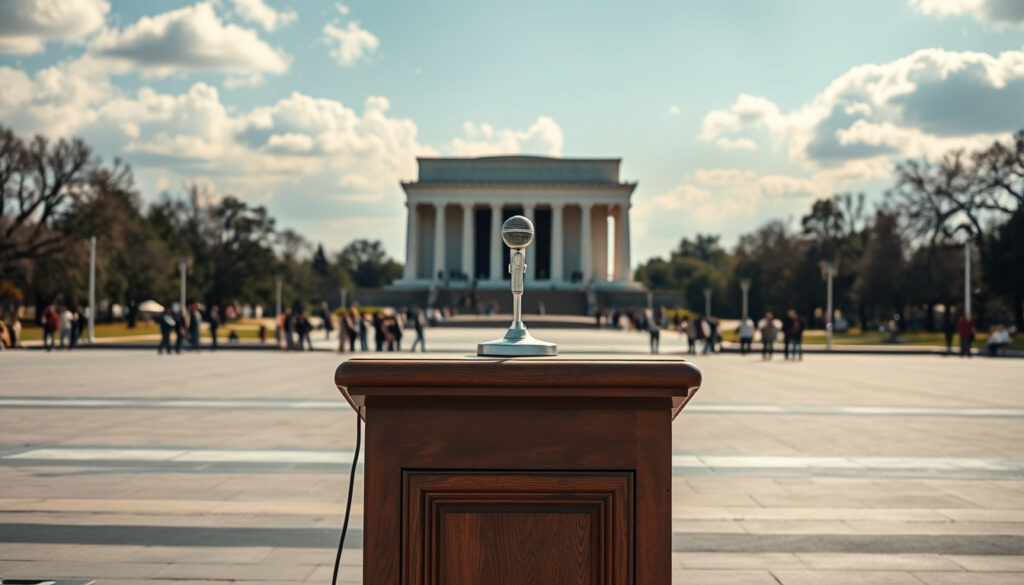
There’s a reason the phrase “I have a dream” still echoes more than six decades on: it wasn’t just written — it was felt into existence. Martin Luther King Jr.’s address from the Lincoln Memorial on August 28, 1963 (Britannica) drew around 250,000 people and became the defining moment of the March on Washington.
Date delivered: August 28, 1963 ·
Location: Lincoln Memorial, Washington, D.C. ·
Speaker: Martin Luther King Jr. ·
Duration: 17 minutes ·
Audience size: Approximately 250,000 ·
Number of ‘I have a dream’ repetitions: 9 times (in the improvised section)
Quick snapshot
- Speech delivered August 28, 1963 at March on Washington (Britannica)
- Delivered from Lincoln Memorial steps (Wikipedia)
- Audience of about 250,000 (Constitution Center)
- Exact count of “I have a dream” repetitions varies 8–10; consensus is 9 (Stanford King Institute)
- Whether King fully planned the dream refrain before the speech (U.S. Embassy in Korea)
- Attendee count varies between 200,000 and 250,000 (American Rhetoric)
- August 28, 1963 — speech delivered (Britannica)
- Early 1960s — King uses “dream” imagery in earlier sermons and speeches (Stanford King Institute)
- Speech continues to be studied in schools and cited in civil rights discussions (Archive.org)
- Full audio and transcript widely available on Archive.org and American Rhetoric
These core details are often cited when discussing the speech.
| Attribute | Value |
|---|---|
| Full Title | I Have a Dream |
| Speaker | Martin Luther King Jr. |
| Date | August 28, 1963 |
| Location | Lincoln Memorial, Washington, D.C. |
| Event | March on Washington for Jobs and Freedom |
| Famous Line | “I have a dream that my four little children will one day live in a nation where they will not be judged by the color of their skin but by the content of their character.” |
| Number of ‘I have a dream’ repetitions | 9 |
What is the most famous line from the I Have a Dream speech?
Origin of the line
The most celebrated line of the speech — “I have a dream that my four little children will one day live in a nation where they will not be judged by the color of their skin but by the content of their character” — was not part of King’s prepared text. According to the U.S. Embassy in Korea (primary source), gospel singer Mahalia Jackson reportedly called out, “Tell them about your dream, Martin!” King then shifted into an improvised section built around the refrain he had used in earlier speeches.
Why it resonates
The line’s power lies in its concrete vision of a future where character, not color, determines judgment. Britannica (reference work) describes the speech as one of the most iconic in American history, and this single sentence is often cited as its emotional peak. The spontaneous delivery adds a layer of authenticity that no amount of drafting could replicate.
King’s decision to go off-script turned a fine speech into an immortal one. For anyone studying rhetorical delivery, the lesson is clear: preparation gives you the frame, but instinct gives you the moment.
The implication: the most memorable part of the speech was born from a live prompt, not from a scripted page.
Who actually wrote Martin Luther King’s ‘I Have a Dream’ speech?
Drafting process
King began drafting the speech in the days before the March, working closely with advisers Clarence Jones and Stanley Levison (Stanford King Institute). Jones, a speechwriter and attorney, helped shape the early structure. The speech underwent multiple revisions — a more formal text was prepared, but King deviated from it during delivery.
Key contributors
Clarence Jones later recalled that King had been using “dream” imagery in sermons since at least 1960. The Stanford King Institute notes that the speech synthesized portions of earlier sermons and the broader civil rights vocabulary King had been developing. The question of sole authorship is therefore complex: King was the author, but he drew on a network of ideas and editing.
What are the words to the ‘I Have a Dream’ speech?
Excerpted sections
The speech opens with the line “Five score years ago, a great American, in whose symbolic shadow we stand today, signed the Emancipation Proclamation.” King then draws a contrast between the promise of freedom and the reality of segregation. The full text runs approximately 1,700 words and takes about 17 minutes to deliver at King’s pace.
Where to find the complete text
Authoritative full-text versions are available from American Rhetoric (speech archive) and the Internet Archive (digital library). Both include annotations and audio recordings. The Constitution Center also offers a factsheet with key excerpts.
Many online versions silently edit the text. For accurate scholarly use, always cross-check against the recording or a primary repository.
The catch: a quick search may yield truncated versions, so always cross-check with the recording.
What is the main message of ‘I Have a Dream’?
Call for racial equality
The central argument of the speech is that America has defaulted on its promissory note of equality. King uses the metaphor of a “bad check” — the Declaration of Independence and the Constitution promised freedom to all, but Black Americans were given insufficient funds. He calls for immediate action, not gradual reform.
Nonviolent protest
King frames the struggle as a nonviolent revolution. He warns against “drinking from the cup of bitterness and hatred” and insists that the movement maintain discipline. Britannica notes that this message helped solidify the moral authority of the Civil Rights Movement and influenced public opinion nationwide.
The pattern: King transforms a political demand into a moral vision. He does not ask for charity; he demands that America live up to its own founding ideals.
How many times does Martin Luther King say ‘I have a dream’ in the speech?
Count variations
King repeats the phrase “I have a dream” nine times during the speech — all in the final section that was largely improvised. Some transcriptions record eight or ten occurrences depending on whether partial utterances are counted. The consensus among scholars, including the Stanford King Institute, is nine.
Context of each repetition
Each “I have a dream” introduces a specific vision: from the red hills of Georgia to the prodigious hilltops of New Hampshire. The anaphora builds emotional momentum, a technique Study.com (educational publisher) identifies as a central rhetorical device in the speech.
The exact number matters less than the effect: nine repetitions in under three minutes create a rhythmic climax that no single line could achieve. For speechwriters, it’s a masterclass in escalation.
Confirmed facts
The speech was delivered on August 28, 1963 (Britannica). The most famous “I have a dream” sequence was improvised (U.S. Embassy in Korea). The speech was drafted with help from Clarence Jones and Stanley Levison (Stanford King Institute).
What’s unclear
Exact number of “I have a dream” repetitions varies between 8 and 10 depending on transcription; consensus is 9. Whether King fully intended to use the “dream” refrain from the start remains debated.
Key quotes from the speech and its creators
“I have a dream that my four little children will one day live in a nation where they will not be judged by the color of their skin but by the content of their character.”
— Martin Luther King Jr., August 28, 1963
“King had been using the ‘dream’ refrain in sermons since the late 1950s. The speech at the Lincoln Memorial was the first time he used it on a national stage.”
— Clarence Jones, speechwriter and attorney, recalling the drafting process (per Stanford King Institute)
“With this faith, we will be able to hew out of the mountain of despair a stone of hope.”
— Martin Luther King Jr., earlier sermon (paraphrased in the speech’s closing)
The implication: King’s genius lay in repurposing and elevating material he had tested with smaller audiences. The Lincoln Memorial was the culmination of years of rhetorical refinement.
Summary
The “I Have a Dream” speech endures because it combined meticulous drafting with a moment of spontaneous courage. For students, writers, and activists, the lesson is clear: preparation gives you the structure, but the willingness to improvise gives you the truth. For anyone studying the Civil Rights Movement, the speech remains the clearest window into King’s vision — a vision that demanded America cash the check it had written centuries before.
Frequently asked questions
Why did Martin Luther King choose the Lincoln Memorial for the speech?
The March on Washington was deliberately held at the Lincoln Memorial to symbolically connect the fight for civil rights with Lincoln’s legacy of emancipation. King referenced the “great American” in his opening line.
What was the original title of the speech?
King’s prepared text did not have a formal title; the speech is universally known as “I Have a Dream” based on its most famous refrain. It was officially titled “I Have a Dream” in later publications.
How did the audience react during the speech?
The crowd of approximately 250,000 responded with cheers, tears, and sustained applause. The U.S. Embassy in Korea notes that Mahalia Jackson’s prompting was part of the live interaction.
What other major speeches did MLK give?
King delivered “Letter from Birmingham Jail” (1963), “Beyond Vietnam” (1967), and his final “I’ve Been to the Mountaintop” (1968). Each addressed different facets of justice and nonviolence.
What is the significance of the phrase ‘I have a dream’?
The phrase serves as an anaphoric anchor, repeating a vision of racial harmony. It transforms abstract hope into a concrete, repeated demand — one of the most effective rhetorical devices in public speaking history.
Is the ‘I Have a Dream’ speech copyrighted?
Yes, the speech is under copyright held by the King estate. However, the text is widely available for educational use. Full audio and transcript are accessible through nonprofit archives.
How was the speech received by the media at the time?
Major newspapers covered the March extensively. Editorial responses were mixed, but the speech itself was praised for its eloquence. It quickly became a reference point for the movement.
Related reading
- In Search of Lost Time: A Practical Guide for New Readers — another classic work explored for modern audiences.
- The Hunchback of Notre Dame: True Story, Summary & Condition — historical context behind a culturally significant story.
More related posts
 Hand, Foot and Mouth Disease: Symptoms, Treatment, and Contagion
 ANZ KiwiSaver Withdrawal Form: How to Withdraw & Documents
 Car Seat Covers NZ: Best Options, Reviews & Buying Guide
 Weather in My Location: Live, Hourly, Tomorrow, Warnings
 Garmin Instinct 3 Solar: Worth It? Features, Price, Review (2025)
 Shaver Shop Near Me – Store Locator, Hours & Directions
 Love It or Li t It NZ: Payment, Renovation , Ho t & How to Apply
 Albany Street Medical Centre: Contact, Services & Registration
