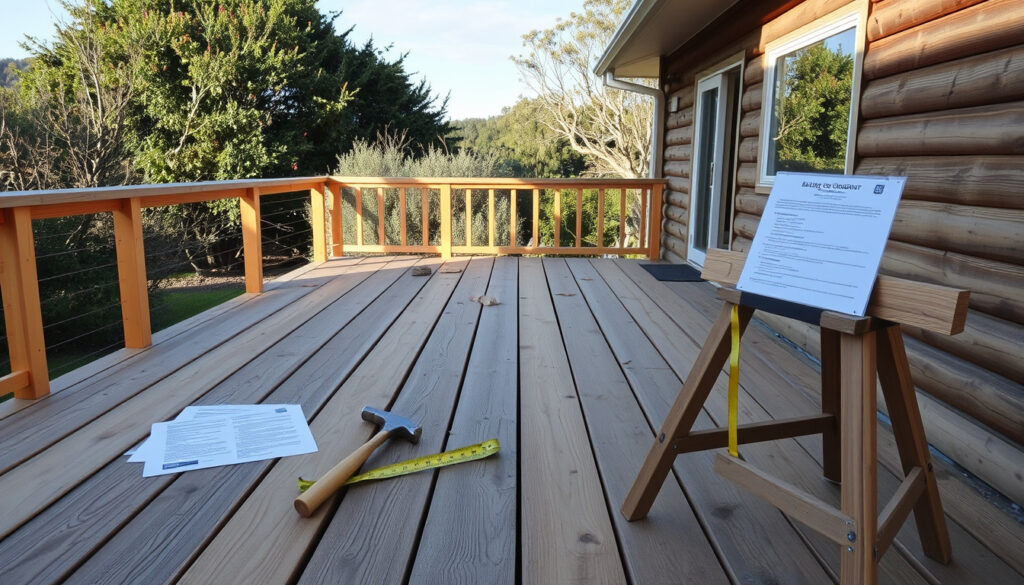
How to Build a Deck in New Zealand: Step-by-Step Guide & Rules
There’s something deeply satisfying about building your own deck—a weekend project that turns a patch of lawn into an outdoor living room. But in New Zealand, before you pick up a hammer, there are a few rules to know. This guide covers the building consent exemptions, the correct joist spacing, and the step-by-step process to help you build a safe, compliant deck. Whether you’re a first-time DIYer or looking to avoid costly mistakes, you’ll find the practical details here.
Maximum deck area without building consent (NZ): 30 m² · Minimum distance from boundary for low decks: 30 cm · Standard joist spacing for 100×50 timber: 450 mm · Common decking timber treatment grade: H3.2 treated pine
Quick snapshot
- Decks under 30 m² and ≤1.5 m high do not require building consent in most NZ councils (Building Performance, NZ building regulator).
- The 3-4-5 rule reliably squares deck frames (SpecRite, NZ hardware supplier guide).
- Joist spacing of 450 mm for 100×50 timber is standard and safe (PlaceMakers, NZ timber merchant).
- Radiata pine treated to H3.2 is the most common framing timber in NZ (PlaceMakers, NZ timber merchant).
- Specific boundary setback distances vary between councils (e.g., 300 mm vs 250 mm) (Auckland Council).
- Exact cost savings of DIY versus professional depend on deck complexity and local labour rates. (Auckland Council)
- Consent processing for decks over 1.5 m can take 20–30 working days at most councils (Building Performance).
- DIY build time for a 20 m² deck: 2–4 weekends for an experienced amateur. (Building Performance)
- Apply protective oil or stain within 4 weeks of installation.
- Schedule council inspection if your deck required consent.
- Plan ongoing maintenance: re-coat every 1–2 years in NZ climate.
| Specification | Value |
|---|---|
| Maximum deck area without consent | 30 m² (Schedule 1, Building Act 2004) (Building Performance) |
| Minimum boundary setback | 300 mm (common council rule for low decks) (Auckland Council) |
| Standard joist spacing | 450 mm for 100×50 timber (PlaceMakers) |
| Timber treatment required | H3.2 for framing, H3.1 for deck boards above ground (PlaceMakers) |
| Drainage gap between boards | 5–8 mm (Mitre 10 Easy As DIY) |
What is the 3 4 5 rule for decks?
Why squaring is critical for deck alignment
A deck that isn’t square will haunt you with uneven boards and awkward gaps. The 3-4-5 rule is a geometry trick that guarantees a perfect right angle at every corner. It’s the same method builders use to lay foundations (SpecRite, NZ hardware supplier guide).
How to measure and apply the 3-4-5 triangle method
- Measure 3 units along one side of the frame from the corner.
- Measure 4 units along the perpendicular side.
- The diagonal between the two marks must be 5 units if the corner is square.
Use any consistent unit—metres, feet, or even a measured string line. Adjust the frame until the diagonal hits 5. This method is officially recommended in NZS 3604 for timber framing (Building Performance).
An out-of-square deck frame forces you to cut every decking board at an angle, wasting material and time. Spending an extra 10 minutes on the 3-4-5 check saves hours of frustration later.
The implication: squaring is non-negotiable for a professional-looking result. Even a 2-degree error compounds over a 5-metre span.
Can you build your own deck in New Zealand?
Consent requirements for DIY decks
The straightforward answer: yes, and most DIY decks under 30 m² and lower than 1.5 m above ground don’t need a building consent (Building Performance). This exemption is known as Exemption 24 in the Building Act. But even exempt decks must still comply with the NZ Building Code, especially clauses B1 (structure) and F4 (safety barriers) (PlaceMakers).
Tools and skills needed for a DIY deck
- Circular saw, drill, spirit level, tape measure, string line.
- Basic carpentry skills: measuring square, cutting straight, levelling.
- Ability to dig post holes and mix concrete (or use adjustable deck piles).
Cost comparison: DIY vs professional build
DIY can save 30–50% on labour, but you trade time and risk. Professional builds typically cost $180–$300 per m² in NZ, while DIY materials average $80–$150 per m² (PlaceMakers). The trade-off: a mistake in framing can cost more to fix than the labour saved.
The catch: consent exemption doesn’t mean no regulation. Your deck still needs to be structurally sound and not cause safety risks.
How far apart should joists be on a deck in New Zealand?
Standard joist spacing for different timber sizes
Five numbers define safe joist spacing. For 100×50 mm timber, the maximum centre-to-centre spacing is 450 mm (PlaceMakers). Thicker joists like 150×50 can span up to 600 mm.
Effect of decking material on joist spacing
- Timber decking (19 mm thick): 450 mm max.
- Composite decking (typically 22 mm): 400 mm max (check manufacturer specs).
How to verify spacing compliance with NZ Building Code
The NZ Building Code clause B1 requires structural adequacy. You can verify spacing by checking tables in NZS 3604 (Building Performance). Local councils may have additional requirements; always check with your council before starting (Auckland Council).
The pattern: tighter spacing means stronger deck but more material. For a residential low deck, 450 mm on 100×50 is the sweet spot.
How to build a deck for beginners step by step?
Planning and measuring the deck layout
Start with a detailed plan: dimensions, height, and pile positions. Sketch to scale on paper and check council guidelines (SpecRite). Mark the deck outline with string lines and use the 3-4-5 rule to square the layout.
Setting piles and bearers
Dig holes at marked pile positions, pour concrete, and set galvanised post brackets. Place bearers (the horizontal beams) on the brackets, levelling with a spirit line. The Mitre 10 guide recommends checking for underground pipes and wires before digging (Mitre 10 Easy As DIY).
Fixing joists and laying decking boards
- Attach joists to bearers using galvanised joist hangers at 450 mm centres.
- Install solid nogging every 1.8 m to prevent joist rotation (Mitre 10).
- Lay decking boards perpendicular to joists, leaving a 5–8 mm gap for drainage (Mitre 10).
- Fix each board with two screws per joist, using stainless steel or galvanised screws.
Finishing and sealing the deck
Sand any rough edges, then apply a weatherproof oil or stain within 4 weeks. Re-coat every 1–2 years depending on sun and rain exposure. For decks requiring consent, schedule a final inspection by the council.
The No. 1 beginner mistake: forgetting to check underground services. Contact before you dig. A severed power cable or water pipe will bankrupt your budget.
The upshot: build sequence matters more than speed. Level bearers first, square the frame, then lay boards. Rushing any step compounds later.
What are common decking mistakes?
Incorrect joist spacing and support
Joists spaced wider than 450 mm for 100×50 timber cause sagging and unsafe decks. Always follow the standard (PlaceMakers).
Poor drainage and ventilation
Deck boards laid without gaps trap moisture, leading to rot and moss. Mitre 10 recommends a 3 mm gap, but most NZ guides say 5–8 mm for better drainage in wet climates (Mitre 10 Easy As DIY).
Using wrong fixings or timber treatment
Always use hot-dipped galvanised or stainless steel screws for outdoor use. Framing timber should be H3.2 treated; decking boards at least H3.1 (PlaceMakers).
Neglecting building consent and council inspections
Building a deck over 30 m² or above 1.5 m without consent can lead to a legal order to remove it (Building Performance). Council enforcement varies, but the risk is real.
The pattern: most mistakes come from skipping the planning phase. A 30-minute check of council rules and NZS 3604 saves weeks of rework.
What are the 30cm and 30m2 rules for decking in New Zealand?
Understanding the 30 cm boundary setback rule
The 30 cm rule typically requires a deck to be at least 300 mm from a boundary, or lower if within that distance, to avoid fire spread and neighbour nuisance (Auckland Council). Check your local district plan, as some councils specify 250 mm.
The 30 m² exemption for building consent
Schedule 1 of the Building Act exempts a single-storey deck up to 30 m² floor area from needing a building consent, provided it is not possible to fall more than 1.5 m (Building Performance).
What happens if your deck exceeds these limits?
Decks over 30 m² or over 1.5 m high require full building consent and structural engineering. You’ll need to submit plans, pay fees ($1,500–$3,000 typical), and obtain a code compliance certificate after inspection (Auckland Council).
The trade-off: staying under 30 m² and 1.5 m saves consent hassle but limits your design. A 31 m² deck triggers the full consent process—decide early.
Confirmed facts
- Decks under 30 m² and ≤1.5 m high do not require building consent in most NZ councils.
- The 3-4-5 rule is a reliable method for squaring deck frames.
- Joist spacing of 450 mm for 100×50 timber is standard and safe.
- Radiata pine treated to H3.2 is the most common framing timber in NZ.
What’s unclear
- Specific boundary setback distances vary between councils (e.g., 300 mm vs 250 mm).
- Exact cost savings of DIY versus professional build depend on deck complexity and local labour rates.
Expert perspectives on deck building
“The biggest issue we see is decks built without any thought to drainage. A gap of at least 5mm between boards isn’t optional—it’s the difference between a deck that lasts 20 years and one that rots in 5.”
— Building Consent Authority inspector (quoted via Building Performance guidance)
“Take the time to mark out your deck accurately with string lines and a level. If the frame isn’t square, every board you cut will be a compromise.”
— Mitre 10 Easy As DIY deck guide
For New Zealand DIY homeowners, the choice is clear: build within the 30 m² / 1.5 m exemption to skip consent, but never skip the planning. Measure twice, space joists at 450 mm, leave drainage gaps, and use treated timber. Do that, and your deck will earn its place as the best room in the house.
Related reading: Building a House NZ: Cost, Rules & Buy vs Build Guide
Frequently asked questions
What is the maximum height a deck can be without a handrail in NZ?
The New Zealand Building Code clause F4 requires a barrier if it is possible to fall 1 m or more from the deck surface (PlaceMakers deck guide). So decks less than 1 m high may not need a handrail, but check local council variations.
Can I build a deck directly on the ground?
Yes, but only if the ground is stable and well-drained. A ground-level deck (sometimes called a “floating deck”) typically uses adjustable plastic pedestals or concrete pavers to keep timber off the soil. Avoid direct timber-to-soil contact to prevent rot.
What is the best timber for decking in New Zealand?
Radiata pine treated to H3.2 is the most common and cost-effective choice for framing. For decking boards, H3.1 treated pine is standard. Hardwoods like kwila or treated macrocarpa are more durable but cost 2–3 times more (PlaceMakers).
Do I need a building consent for a deck replacement?
If you replace an existing deck with one of the same or smaller size, and the height and structure meet exemption criteria, a consent is usually not needed. However, any change that increases area or height triggers the same rules as a new deck (Building Performance).
How long does it take to build a deck yourself?
A typical 20 m² deck takes an experienced DIYer 2–4 weekends, including planning and finishing. First-timers should allow 4–6 weekends to account for learning curve and potential corrections.
What is the cost per square meter for a DIY deck in NZ?
Material costs range from $80–$150 per m² for a basic treated pine deck. Adding features like privacy screens, steps, or composite decking can push costs to $200–$300 per m². Professional installation adds $100–$150 per m² labour.
How do I maintain a wooden deck in NZ climate?
Clean and re-oil or re-stain every 1–2 years. Use a deck cleaner to remove moss and algae before recoating. Check for loose screws or boards after winter. In high-moisture areas, improve sub-deck ventilation to prevent rot.
More related posts
 Credit Card Application: How to Apply Online in Ireland
 Diamond Lake & Rocky Mountain Track: Complete Hiking Guide
 Long Island Iced Tea: Ingredients, Recipe, Alcohol Content
 New Years Festivals NZ 2026: Best NYE Celebrations
 Pounds to KG Converter: Exact lb to kg Formula & Tables
 Taupo TOP 10 Holiday Park: Location, Reviews & Maps
 What Is a Content Audit? Definition, Steps, and Best Practices
 210 USD to NZD: Convert US Dollars to New Zealand Dollars Today
