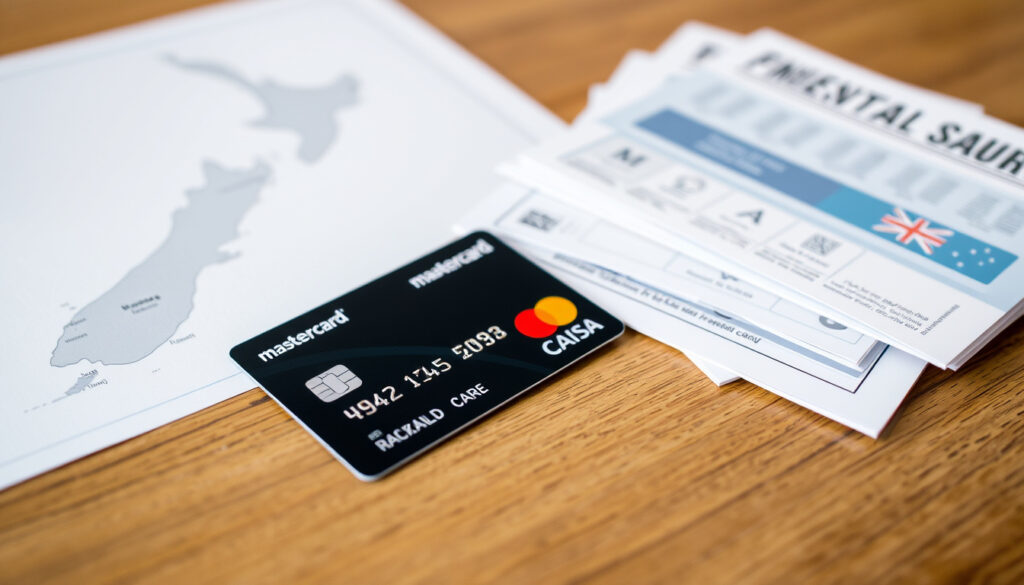
Mastercard Credit Cards NZ: Best Options, Comparisons & FAQs
Anyone who has compared credit cards in New Zealand knows the choice narrows quickly to two logos: Mastercard and Visa. The country’s major banks issue both, and acceptance spans more than 210 countries, so the real differences sit in fees, rewards, and fine print. The cards that deserve your wallet are the ones with issuer-level numbers that match your spending — not the flashiest marketing campaign.
Global merchant acceptance: Over 210 countries ·
Card tiers available: Standard, Gold, Platinum, World Elite ·
Major NZ issuers: ANZ, ASB, BNZ, Westpac, TSB, Farmers, Flight Centre ·
Competing network: Visa
Quick snapshot
- Mastercard is accepted in more than 210 countries and territories, and in practice both networks work at virtually every retailer worldwide (MoneyHub NZ (consumer money guide)).
- TSB (issuing bank) advertises a Low Rate Mastercard at 11.95% p.a. with a $20 annual card fee.
- Westpac NZ (issuing bank)‘s Airpoints Mastercard earns 1 Airpoints Dollar for every $150 spent on eligible purchases.
- Exact Mastercard vs Visa market share in New Zealand is not publicly disclosed.
- Which specific billionaires carry which cards is not publicly verified.
- Whether Elon Musk personally uses a credit card rests on a single interview statement.
- Founded in 1966 as Interbank Card Association; renamed Mastercard in 1979 (Mastercard NZ (card network)).
- Present in New Zealand since the 1970s and issued by all major banks (Mastercard NZ).
- The World Mastercard tier is positioned as a travel-and-lifestyle product (Mastercard NZ).
Mastercard at a glance
Six facts, one pattern: Mastercard’s global footprint is huge, but the numbers that decide your bill are set by the bank that issues your card.
| Fact | Detail |
|---|---|
| Founded | 1966 (as Interbank Card Association); renamed Mastercard in 1979 |
| Headquarters | Purchase, New York, USA |
| CEO | Michael Miebach |
| Global cards in circulation | Approximately 2.8 billion (2023) |
| New Zealand presence | Since the 1970s; issued by all major banks |
| Card acceptance | More than 210 countries and territories |
The pattern: Mastercard’s scale is unmatched, but the issuer determines your actual costs and benefits.
Is Visa or Mastercard better in New Zealand?
At the checkout, the honest answer is: not really. MoneyHub NZ says both networks are accepted by virtually every retailer in New Zealand, and Canstar NZ says most consumers will see no real difference at the point of sale.
- Both networks are accepted by virtually every retailer in NZ and worldwide.
- The issuing bank, not the network, sets interest rates, annual fees, rewards, and other card charges.
- Mastercard’s NZ consumer pages emphasise convenience, security, and tailored cards for different needs.
Who is stronger, Visa or Mastercard?
Stop comparing logos and start comparing statements. A $20-fee Mastercard with cashback will beat a premium Visa with a higher annual fee on most NZ shopping baskets.
“Stronger” depends on what you measure. Visa’s global merchant network is often described as slightly larger, while Mastercard leans into lifestyle perks: Mastercard New Zealand positions the World Mastercard as a travel-and-lifestyle product for everyday purchases and beyond. In New Zealand, network-level differences rarely change your monthly statement.
The issuer is what changes it. MoneyHub and Canstar both make the same point in their NZ card guides: the bank sets the rates, the fees, and the rewards — the network just moves the transaction. That single fact settles most Visa-vs-Mastercard arguments.
What this means: network choice is nearly irrelevant at the checkout; the card’s cost structure is where the real battle happens.
What is the best credit card to have in NZ?
“Best” depends on how you spend. If you clear your balance each month, rewards matter. If you carry debt, the interest rate matters more. The strongest Mastercard options in New Zealand split cleanly along those lines.
What is the best card to use in New Zealand?
- TSB Platinum Mastercard: $1 cashback for every $125 spent on eligible purchases, subject to a $60 monthly cashback threshold (TSB (issuing bank)).
- Westpac Airpoints Mastercard: 1 Airpoints Dollar for every $150 spent up to $3,500 a month, then 1 Airpoints Dollar for every $300 each month after that (Westpac NZ (issuing bank)).
- TSB Low Rate Mastercard: the value pick for balance carriers — low ongoing rate and a modest annual fee.
- Flight Centre Mastercard: travel rewards for frequent bookers.
- Farmers Mastercard: up to 90 days interest-free on retail purchases.
- Q Mastercard: flexible payment plans instead of revolving credit.
The cashback math explains the popularity of TSB’s Platinum card: $1 per $125 is about 0.8% back on eligible spend. Westpac NZ prices the Airpoints card at a $70 annual fee — sensible mainly for travellers who would earn those Airpoints Dollars anyway.
Rewards cards only win when spending matches the reward. A $70 Airpoints fee on a card used mostly for groceries is a donation to the bank.
TSB’s Low Rate and Platinum Mastercards both offer up to 55 days interest-free on purchases when the statement balance is paid in full by the due date (TSB (issuing bank)). If you always pay in full, that interest-free window is free credit.
Which credit card is a Mastercard?
- Any card with the interlocking Mastercard circles is a Mastercard.
- ANZ, ASB, BNZ, Westpac, and TSB all issue Mastercard credit cards in New Zealand.
- Retailer and specialist cards — Farmers, Flight Centre, Q — also run on the Mastercard network.
If you are unsure, check the card face: the network logo sits at the bottom-right on virtually every NZ card.
The pattern: the best Mastercard in NZ is the one whose fees and rewards match your real behaviour — cashback for everyday spenders, Airpoints for frequent flyers, low interest for balance carriers.
The catch: rewards only pay off if your spending aligns with the card’s structure.
Which credit card is a Mastercard?
Look at the bottom-right corner of a New Zealand credit card and you will usually see either the Mastercard interlocking circles or the Visa wordmark. The logo identifies the network; everything else comes from the issuer.
- Major banks: ANZ, ASB, BNZ, Westpac, and TSB all issue Mastercard credit cards.
- Retailer cards: Farmers Mastercard and Flight Centre Mastercard run on the Mastercard network.
- Specialist cards: Q Mastercard offers flexible payment plans instead of revolving credit.
Mastercard structures its consumer cards in tiers — Standard, Gold, Platinum, and World Elite — and Mastercard New Zealand notes that benefits can vary by issuer, directing cardholders to their issuing financial institution for complete coverage terms, conditions, and exclusions. Tier matters less at the checkout than you might think: a Standard card and a World Elite card run on the same network and are accepted in the same places, with the differences showing up in perks, not access.
The takeaway: if it carries the interlocking circles, it’s a Mastercard — but the issuer decides what it costs and what it earns.
What are the disadvantages of Mastercard?
Mastercard’s weaknesses in New Zealand are mostly issuer-level, not network-level — which is both bad news and good news. The fees are real, and a better-issued card fixes most of them.
- Annual fees: popular Mastercards in New Zealand carry fees from $20 to $70 a year, depending on the issuer and tier.
- Foreign transaction fees: some Mastercards include issuer-set overseas purchase fees that add up quickly for travellers.
- Acceptance gaps: a small number of merchants, mainly in markets like China, may not take Mastercard even where Visa is accepted.
- Rewards ceiling: rewards on some co-branded Visa cards may be richer than comparable Mastercards.
None of these are hidden — but all of them sit in the card’s terms and conditions rather than in the Mastercard logo. The issuer’s product page, not the network’s marketing, is the document that matters.
A $70 Airpoints annual fee only pays off if you actually convert spend into Airpoints Dollars. Infrequent flyers end up subsidising the airport lounge crowd.
The implication: Mastercard’s disadvantages are cost problems, and cost problems are solved by choosing the right issuer — not by switching to Visa.
Where is Mastercard not accepted?
Mastercard is accepted in more than 210 countries and territories, and in New Zealand acceptance is effectively universal. The gaps are small, specific, and worth knowing before you travel.
- Virtually every retailer in New Zealand accepts Mastercard.
- Some budget airlines and a few government agencies in certain markets may route payments exclusively through Visa.
- A small number of merchants, mainly in markets like China, may not accept Mastercard even where Visa is accepted.
For practical purposes, travellers should carry a backup card outside major tourist routes. The network overlap between Mastercard and Visa is enormous, but “virtually everywhere” is not “everywhere.”
The catch: global acceptance is enormous, yet a backup card costs nothing and removes the rare exception from the equation.
Which card do billionaires use?
The short answer: nobody can verify it, because billionaires do not publish their wallet contents. The longer answer involves invitation-only cards, travel perks, and one memorable Elon Musk interview moment.
- High-end cards reportedly favoured by wealthy users include the American Express Centurion Black (by invitation only), Mastercard World Elite, and JCB Premium.
- Elon Musk said in an interview that he uses a credit card, but has not publicly confirmed which one.
- Global premium-card rankings typically mix American Express Platinum, Chase Sapphire Reserve, Citi Prestige, Mastercard World Elite, and Visa Infinite.
What are the top 5 credit cards in the world?
- American Express Platinum — premium travel and lifestyle benefits.
- Chase Sapphire Reserve — popular in the US for travel credits and transferable points.
- Citi Prestige — lounge access and travel insurance.
- Mastercard World Elite — concierge and travel perks.
- Visa Infinite — Visa’s premium tier with concierge services.
Notice the pattern: the premium-card conversation is about perks, not cashback. That is also true in New Zealand, where Mastercard sells the World Mastercard as a lifestyle product rather than a low-rate borrowing tool.
What bank do most rich people bank with?
There is no public ledger of the world’s wealthy and their banks. The more useful question is which card features they actually use — and the answer is travel perks, concierge, and lounge access.
Wealthy individuals typically hold accounts across multiple banks in multiple countries, and their credit-card choices are private. Treat any list naming a single “billionaire bank” with scepticism.
Does Elon Musk own a credit card?
Musk said in an interview that he uses a credit card, but did not specify which one. That single statement is the entire public record.
There is no verifiable public information about Musk’s personal card use beyond that interview. The viral lists that “reveal” billionaire cards are entertainment — the practical lesson is more useful.
Why this matters: people who can afford any card choose perks and travel benefits over brand loyalty. The same logic works at a $20 annual fee: pick the card that fits your spending, not the one that sounds impressive.
The pattern: perks and travel benefits drive choices, not brand loyalty.
Four factors, one pattern: in New Zealand the networks are effectively interchangeable, and the differences that matter are perks, fees, and global reach.
| Factor | Mastercard | Visa |
|---|---|---|
| NZ acceptance | Virtually every retailer | Virtually every retailer — both networks are effectively universal at the checkout |
| Rates and fees | Set by the issuing bank — e.g., TSB Low Rate at 11.95% p.a. with a $20 annual fee | Set by the issuing bank — no network-level difference |
| Global reach | More than 210 countries and territories | Often described as slightly larger |
| Signature perks | World Mastercard travel-and-lifestyle benefits | Visa Infinite concierge and travel programs |
Mastercard pros and cons for NZ cardholders
Upsides
- Accepted by virtually every retailer in New Zealand, and by both networks almost everywhere worldwide.
- Issuer competition keeps costs low for careful shoppers — TSB’s Low Rate Mastercard costs $20 a year.
- Rewards and perks: Mastercard New Zealand says its payment network supports rewards and benefits for cardholders.
- Up to 55 days interest-free on purchases when the statement balance is paid in full — available on TSB and Westpac Mastercards.
Downsides
- Annual fees on popular Mastercards range from $20 to $70.
- Foreign transaction fees may apply on some cards, set by the issuer.
- Rewards on some co-branded Visa cards may be richer than comparable Mastercards.
- Benefits vary by issuer, so cardholders must read the issuing bank’s terms.
The takeaway: weigh fees against rewards – the right card depends on your spending pattern.
What’s confirmed vs what’s unclear
Credit-card rumours travel fast. Here is the line between what is documented and what is not.
Confirmed facts
- Mastercard and Visa are accepted by virtually every New Zealand retailer.
- The issuing bank sets rates, fees, and rewards — not the network (Canstar NZ (financial comparison site)).
- TSB’s Low Rate Mastercard charges 11.95% p.a. and a $20 annual fee.
- Westpac’s Airpoints Mastercard earns 1 Airpoints Dollar per $150 up to $3,500 a month.
What’s unclear
- Exact Mastercard vs Visa market share in New Zealand is not publicly disclosed.
- The personal credit card choices of specific billionaires are not publicly verified.
- Whether Elon Musk uses a credit card rests on a single interview statement.
- Whether some budget airlines and agencies exclusively accept Visa may vary by route and region.
- Mastercard’s precise global card count depends on the reporting year and methodology.
The implication: the line between known and unknown is clear – trust issuer data, not network marketing.
What the key sources say
“In New Zealand, Mastercard and Visa are payment networks, not card issuers, so the issuing bank sets the interest rates, annual fees, rewards, and other card charges.”
“There is no difference between Mastercard and Visa on interest rates, fees, or interest-free days because those are set by the bank.”
“Benefits can vary by issuer, and users should refer to their issuing financial institution for complete coverage terms, conditions, and exclusions.”
Mastercard New Zealand (card network)
The pattern: all three sources converge on one point – the issuer, not the network, controls the card’s terms.
The verdict
The choice between Mastercard and Visa in New Zealand is, for most people, no choice at all — both networks work at virtually every checkout, and the issuing bank sets the numbers that matter. For the average Kiwi consumer, the decision is clear: compare annual fees, interest rates, and rewards before you apply, or hand the bank an easy margin on a card you hardly use.
mastercard.com, mastercard.co.nz, canstar.co.nz, mastercard.com, canstar.co.nz, tsb.co.nz
Frequently asked questions
How do I apply for a Mastercard credit card in New Zealand?
Apply online directly with the issuing bank. TSB, for example, requires applicants to be 18 or over, earn at least $18,000 a year after tax, and be a New Zealand citizen or resident visa holder living in New Zealand.
What is the credit limit for a Mastercard in NZ?
The issuing bank sets your limit based on income, credit history, and existing debt. Mastercard, as the network, does not decide individual limits — so two people with the same card can have very different limits.
Does Mastercard charge foreign transaction fees?
Mastercard itself does not set the fee; the issuer does. Check your card’s terms before travelling, because overseas purchase fees vary by bank, card tier, and destination.
Can I use my Mastercard overseas?
Yes. Mastercard is accepted in more than 210 countries and territories, and in practice both Mastercard and Visa work at virtually every retailer worldwide. Keep a backup card for the rare merchant that accepts only one network.
What is the difference between Mastercard and Visa in terms of security?
Both networks run strong fraud-detection systems. The protection you actually experience — fraud monitoring, card controls, dispute handling — is set by your issuing bank, not by the logo on the card.
Are there any Mastercard credit cards with no annual fee in NZ?
Annual fees on the Mastercards examined range from $20 (TSB Low Rate) to $70 (Westpac Airpoints). Bank promotions and card lineups change regularly, so check current issuer terms before applying.
How long does it take to get a Mastercard in NZ?
The timeline is set by the issuer, not the network. TSB and Westpac both accept online applications; approval speed depends on their credit assessment and verification process.
What should I do if my Mastercard is lost or stolen?
Contact your issuing bank immediately. The bank blocks the card, arranges a replacement, and handles fraud disputes; Mastercard’s role is the payment network behind the transaction.
Related reading
- Air New Zealand Airpoints Guide — a practical companion if you are weighing the Westpac Airpoints Mastercard.
- NZ Investment Interest Rates 2025 — context for comparing credit-card interest rates with the wider NZ rate environment.
More related posts
 Kids Table and Chairs: Best Picks & Buying Guide
 Liam Lawson Formula 1 2026: Points, Salary, and Latest News
 Happy Mothers Day Images: Free Download, Quotes & Ideas
 Normal Temperature for Child – Ranges by Age and Method
 Port Waikato Jet Ski Incident: Christmas Day Tragedy
 Singapore Airlines Manage Booking: Seats, Check-In, Fees
 In Search of Lost Time: A Practical Guide for New Readers
 Best Airpoints Credit Card NZ 2026: Compare Fees & Rewards
