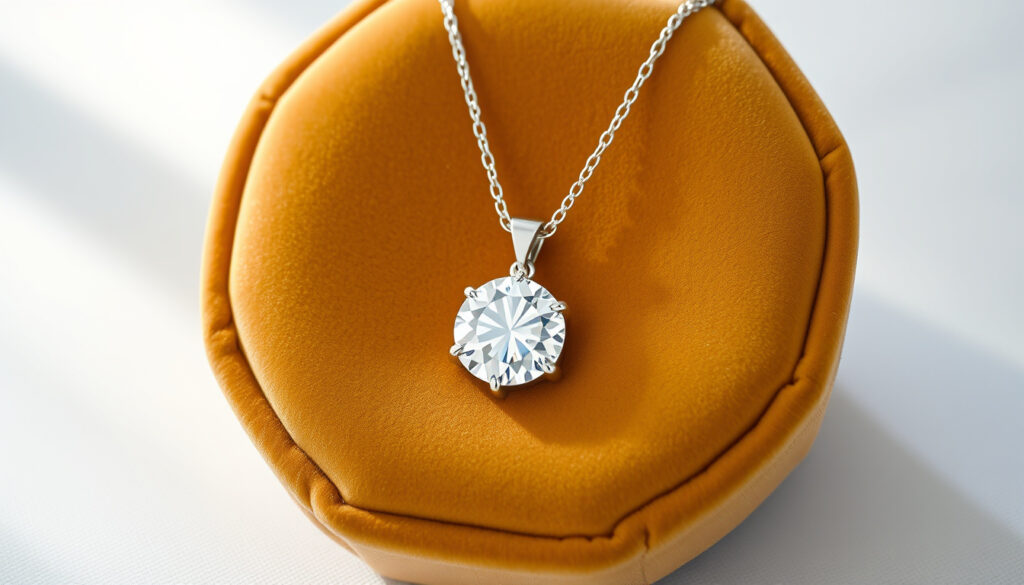
Lab Grown Diamond Necklaces: Worth It? Cost, Resale & Value
A diamond necklace used to be the kind of purchase you saved for and second-guessed for months. Lab-grown stones have redrawn that math — the same carat weight often costs thousands less than a mined equivalent (CBS News cost comparison) — but affordability comes with a catch: resale values run far lower, and some jewelers won’t take lab-grown pieces for trade-ins. Here’s what the price tags don’t tell you.
1 ct lab-grown: $400–$800 ·
1 ct natural (similar quality): $2,000–$4,000 ·
Price gap vs. natural: 40–60% lower ·
Lab diamond lifespan: Same as natural ·
Typical lab resale value: 30–50% of original retail
Quick snapshot
- The same carat weight and quality costs thousands less as a lab-grown stone (CBS News cost comparison).
- Lab-grown diamonds typically keep 30–40% of their purchase price at resale (GoodStone price analysis).
- Lab-grown diamonds do not retain resale value like rare collectibles do (PriceScope’s value guide).
- How lab-diamond values will hold as production capacity keeps rising.
- What share of jewelers actually refuse lab-grown trade-ins.
- Whether future regulation will change how lab-grown stones are labeled.
- Natural diamond jewelry commonly resells at 20–60% of its original retail price (Accurate PMR’s resale analysis).
- Natural diamond value history goes back decades; lab-grown value history is only a few years long. (Accurate PMR’s resale analysis)
- As lab-grown production scales, retail prices have been moving lower. (Accurate PMR’s resale analysis)
- Treat a lab-grown necklace as a purchase to wear, not an asset to flip.
- Trade-in and insurance terms matter more than the sticker price.
- More brands are expected to expand lab-grown necklace lines as buyer demand grows.
Key Facts: Lab-Grown Diamond Necklaces
Six rows, one pattern: lab-grown diamonds match natural diamonds on the physical standards that define a diamond — and split sharply on price and resale.
| Fact | Value |
|---|---|
| 1 ct lab diamond price range | $400–$800 (Diamonds.pro pricing guide) |
| 1 ct natural diamond price range (similar quality) | $2,000–$4,000 (Diamonds.pro pricing guide) |
| Lab vs. natural visual difference | None to the naked eye |
| Lab diamond resale value (typical) | 30–50% of original retail (Rare Carat’s diamond resale guide) |
| Natural diamond resale value (typical) | 20–60% of original retail, varies greatly (Rare Carat’s diamond resale guide) |
| FTC classification of lab diamonds | Real diamonds (not imitation) (FTC diamond advertising guide) |
Is it worth buying lab-grown diamond jewelry?
A lab-grown diamond necklace costs thousands less upfront, but the money you save is exactly where the resale gap sits. Buyers who treat it as jewelry to wear for decades come out ahead; buyers who treat it as an asset tend to lose.
What determines the worth of a lab-grown diamond necklace?
- Worth is three things: what you pay, how long you wear it, and what you get back at resale.
- The same carat weight and quality costs thousands less as a lab-grown stone (CBS News cost comparison).
- The gap that matters appears at resale, not at purchase.
The affordability is real, and so is the resale penalty. A lab-grown necklace is best understood as a shopping decision — a way to own more diamond for the money — not as a savings vehicle.
How does resale value compare between lab and natural diamonds?
- Lab-grown resale estimates cluster between 10% and 40% of the original price — GoodStone cites 30–40%, while Accurate PMR puts lab-grown pieces at 10–30% (GoodStone price analysis; Accurate PMR).
- Natural stones have a much longer resale track record, commonly 20–60% of retail.
- The deepest drops happen in the first years of ownership.
Read those ranges slowly: the resale penalty is the price of the discount. How much that matters depends on whether you ever plan to sell.
Are lab diamonds dropping in value over time?
- Lab-grown diamonds have only scaled as a consumer category recently.
- There is not enough price history to anchor long-term forecasts.
- Production capacity has risen sharply, and buyers are already seeing softer prices.
The pattern: lab-grown diamonds are behaving like a manufactured product, not a finite natural resource. Every year that production improves, the same quality stone should cost a little less.
The implication: your choice hinges on holding period, not on the stone itself.
How much should a 1 carat lab-grown diamond cost?
- 1 ct lab-grown, typical retail: $400–$800 depending on cut, color, and clarity.
- 1 ct natural, similar quality: about $2,000–$4,000.
- Both ranges come from Diamonds.pro’s lab-created diamond pricing guide.
Price range for a 1 carat lab-grown diamond
- $400–$800 is a planning range, not a quote.
- Round brilliants and popular shapes (oval, pear) usually command more than less common cuts.
- Certified stones carry a premium at most retailers.
What you actually pay depends on the 4Cs and the seller’s margin. The biggest misconception is that “lab-grown” means “cheap quality” — it doesn’t. It means the price reflects manufacturing, not mining rarity. For 2 carat stones, the same ratio holds — see the 2 ct row in the comparison table below.
Factors that affect lab diamond pricing (cut, color, clarity)
- Cut drives the sparkle and the premium more than any other C.
- Colorless and near-colorless grades (D–G) cost more than warmer grades.
- Clarity matters less in a necklace than in a solitaire ring, because the stone sits farther from the eye.
The practical takeaway: for a necklace, buy the best cut and color you can afford, and spend less on clarity than you would for a ring stone.
What is the downside of a lab-grown diamond?
The biggest downside isn’t the stone — it’s the resale market. Lab-grown diamonds can be difficult to resell, and the buyback math gets worse as retail prices fall.
Why do jewelers not like lab diamonds?
- The secondary market is thin: buyback offers are often a small fraction of the original retail price.
- A store that accepts a lab-grown trade-in takes on the risk of reselling a stone whose retail price keeps falling.
- Some jewelers steer buyers toward natural stones, where margins and resale history are better understood.
Part of the reluctance is commercial, not emotional. The same manufacturing advances that make lab-grown necklaces affordable also make them a harder asset for a jeweler to hold.
Resale and trade-in challenges
- The buyback math for lab-grown pieces is harsh: most owners recover only a fraction of the purchase price within a few years.
- Natural diamond pieces have a deeper secondary market — the 20–60% resale range in the comparison table above.
- The steepest loss lands in the first ownership period, so short-term buyers take the biggest hit.
What this means: the discount you enjoy at purchase is the discount you’ll suffer at sale.
Lack of long-term historical market data
- Lab-grown diamonds have only scaled as a consumer category recently.
- There is not enough price history to anchor reliable long-term forecasts.
- Natural diamonds have decades of auction and retail records behind them.
This is why the resale numbers in this article are ranges, not promises. The lab-grown market is still forming — and that is precisely why the low price tag comes with a value warning.
Can a jeweler tell if a diamond is lab or natural?
- Lab-grown and natural diamonds share essentially the same optical, physical, and chemical properties — the FTC’s own standard for a real diamond (FTC diamond advertising guide).
- The same guidance requires sellers to disclose lab-grown stones as not mined, using terms like “laboratory-grown” immediately before the word “diamond.”
- To the naked eye, the two are indistinguishable.
So the practical answer: a jeweler can’t tell by looking, and a standard counter test can’t either, because the material is the same. The difference is paperwork — a clear label — not sparkle.
Are lab diamonds fake diamonds?
- No. A lab-grown diamond is a real diamond, grown in a lab instead of mined from the earth.
- Imitation stones — cubic zirconia, moissanite — are a different category entirely.
- The FTC’s classification in the key facts table settles the point: lab-grown diamonds are not imitations.
Don’t let the low price talk you into suspicion. The discount comes from the manufacturing process, not from a shortcut in the material.
Testing methods used by gemologists
- Advanced gemological screening can identify growth indicators that distinguish lab-grown from natural.
- These are laboratory-grade methods, not the standard thermal testers used at retail counters.
- For buyers, the practical test is documentation: a certificate or a receipt that states the stone’s origin.
The implication: origin is a disclosure issue, not a quality issue. Both stones are diamonds; the label tells you which one you’re buying.
Should I get a lab grown or natural diamond?
The decision reduces to one question: are you buying this necklace for the wearing or for the value? Lab-grown maximizes the first; natural maximizes the second.
Longevity and lifespan: do lab diamonds last as long?
- Lab-grown diamonds share the same hardness as natural ones — 10 on the Mohs scale.
- They do not fade, cloud, or degrade with normal wear.
- In practice, a lab-grown necklace lasts as long as a natural one.
Because the material is identical — the FTC standard covered above — the durability of a lab-grown stone matches a natural stone. Care is the same: warm water, mild soap, a soft brush, and an occasional check of the setting.
Value retention and emotional factors
- Natural diamonds retain more value at resale but cost far more upfront (see the comparison table above).
- Lab-grown diamonds avoid the mining question, which is decisive for many buyers.
- The right answer depends on the necklace’s role: self-purchase, gift, heirloom, or status piece.
The trade-off: a lab-grown necklace gives you more diamond for the money today; a natural necklace gives you more money back tomorrow. Choose by your holding period, not by the sparkle — the sparkle is the same.
How Lab-Grown and Natural Diamond Necklaces Compare
Three rows, one pattern: the stones are the same; the markets are not.
| Feature | Lab-grown diamond necklace | Natural diamond necklace |
|---|---|---|
| Typical resale value | 30–40% of purchase price (GoodStone price analysis) | 20–60% of original retail (Rare Carat’s diamond resale guide) |
| 2 ct resale example | $3,000 purchase → about $500 after two years (PriceScope’s lab vs. natural analysis) | $6,000 stone → $2,000–$3,000 (PriceScope’s lab vs. natural analysis) |
| Naked-eye appearance | Indistinguishable from natural | Baseline |
What this means: the retail discount and the resale penalty are two sides of the same manufactured-stone economics.
Pros and Cons of Lab-Grown Diamond Necklaces
Upsides
- Upfront cost is far below a comparable natural stone, by most retail comparisons.
- Real diamonds, not imitations, per the FTC classification in the key facts table.
- Same lifespan, hardness, and sparkle as natural diamonds.
- No mining footprint — a real consideration for many buyers.
Downsides
- Resale returns are low and dropping.
- Trade-in and buyback offers are hard to find for lab-grown pieces.
- The long-term value track record does not exist yet.
The verdict: the pros suit a wearer; the cons suit an investor.
What’s Confirmed, What’s Not
Confirmed facts
- Lab-grown diamonds are real diamonds by the FTC’s classification (FTC diamond advertising guide).
- Lab-grown stones cost substantially less than comparable natural stones (CBS News cost comparison).
- Lab-grown resale values sit far below original retail — often 10–30% of what you paid (Accurate PMR’s resale analysis).
What’s unclear
- Whether lab-diamond prices will stabilize or keep falling as production scales.
- What share of jewelers actually refuse lab-grown trade-ins — the exact figure isn’t documented.
- Whether future regulation will add new labeling or disclosure requirements.
- How the secondary market will mature once today’s lab-grown necklaces reach estate sales.
The pattern: the knowns are solid; the unknowns are structural, not speculative.
What the Sources Say
Four voices sum up the lab-grown necklace market — a regulator, a news outlet, and two diamond-industry analysts.
“Sellers of laboratory-created diamonds should disclose that they are not mined diamonds, using terms like ‘laboratory-grown’ or ‘laboratory-created’ immediately before the word ‘diamond.’”
— U.S. Federal Trade Commission, diamond advertising guidance
“A natural diamond of roughly the same quality as a lab-grown one can cost several times more — in one documented comparison, about $2,500 for the natural stone versus about $500 for the lab-grown equivalent.”
— CBS News, consumer pricing report
“A 2-carat lab diamond bought for $3,000 might sell for about $500 two years later.”
— PriceScope, lab-grown vs. natural diamond analysis
“Lab-grown diamonds usually see resale values around 30% to 40%, and in some cases even zero.”
— Rare Carat, diamond value education guide
The Verdict
A lab-grown diamond necklace is a real diamond necklace that costs thousands less, lasts as long, and returns less of what you paid if you ever sell it. The quality argument is closed; the value argument depends on how long you plan to wear it. For a first-time necklace buyer, the choice is clear: take the upfront savings and wear the lab-grown piece for decades — or pay the natural-diamond premium because getting a meaningful share back at resale matters more than the discount.
Frequently asked questions
Do lab diamonds pass a diamond tester?
Yes. Lab-grown and natural diamonds share essentially the same optical, physical, and chemical properties — the FTC’s own standard for a real diamond (see the key facts table above). Standard testers measure diamond material, not origin, so they read lab-grown and natural stones the same way.
Can I insure a lab-grown diamond necklace?
Yes. Insurers typically cover lab-grown diamonds, but the policy should state a replacement value, not a resale value or what you originally paid. Since lab-grown prices have been declining, the replacement number can shift within a few years.
Are lab diamonds considered ethical?
Many buyers choose lab-grown specifically to avoid mining’s environmental and social footprint. The FTC’s focus is labeling: it requires sellers to disclose lab-grown stones as not mined, so the ethical case is paired with a transparency requirement (see the disclosure guidance above).
Do lab diamonds have resale value?
Some, but far less than natural stones. Typical estimates put lab-grown resale at 10–40% of the original price, and certain stones return only a few dollars on resale marketplaces (see the resale rows in the key facts and comparison tables above).
How does the cut quality of lab diamonds compare to natural?
The same 4Cs — cut, color, clarity, carat — apply to both, because the material is the same. A well-cut lab-grown diamond produces the same brilliance and fire as a well-cut natural diamond.
Is a lab-grown diamond necklace a good engagement gift?
If the recipient values size and sparkle for the budget, yes. If they care about resale value or the emotional weight of a mined stone, discuss it first. The two stones look identical, which makes this a conversation about values, not quality.
What is the best metal for a lab diamond pendant?
Platinum and white gold are the classic choices because they let the stone’s sparkle lead; yellow and rose gold create a warmer contrast. For daily wear, platinum is the most durable setting metal.
More related posts
 Number 1 Shoe Warehouse: Number One Shoes NZ Deals
 Tallest Building in the World: Burj Khalifa, Jeddah Tower & More
 The Warehouse Group Careers: How to Apply and Find Jobs
 Spanish Classes Online for Beginners: Best Courses & Tips
 Man City vs Wolves: How to Watch, Team News & History
 How to Bake Sweet Potatoes – Crispy Skin and Exact Times
 Cast of The Lincoln Lawyer TV Series – Full Season 4 Guide
