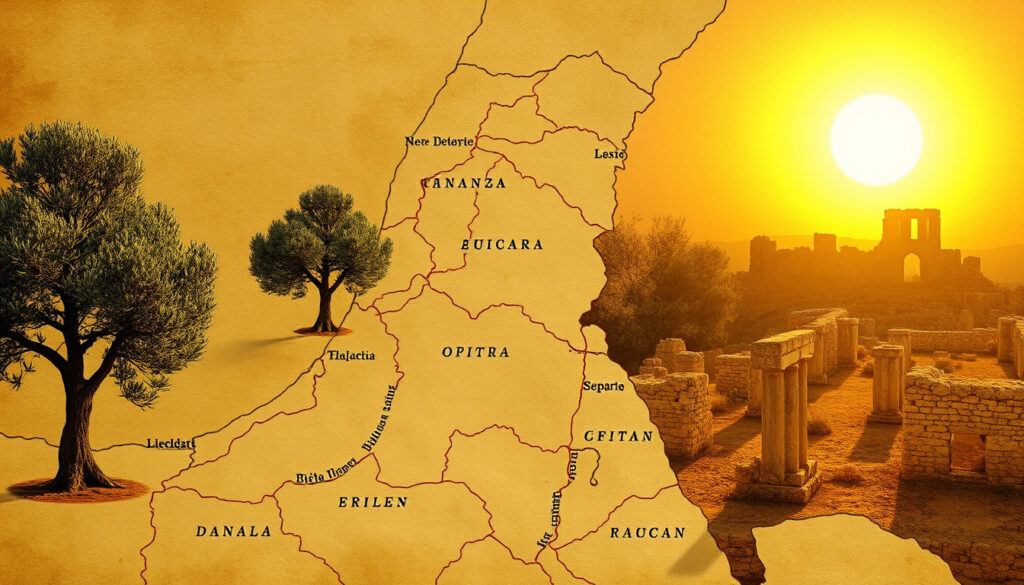
Who Owned the Land First: Israel or Palestine? Historical Facts
Which people held this land first — that question stirs deep emotions but resists a simple answer. Archaeological evidence shows the Kingdom of Israel emerged around 1020 BCE, while the term “Palestine” first appears in Greek writings around 450 BCE, meaning neither “first” claim is straightforward.
Earliest known kingdom in the region: Kingdom of Israel (c. 1020 BCE) ·
First use of ‘Palestine’ as a toponym: c. 450 BCE (Herodotus) ·
Modern state of Israel established: 1948 CE ·
Palestinian Authority established: 1994 CE ·
Jewish population in the region before 1948: ~33% (1947) ·
Arab population in the region before 1948: ~67% (1947)
Quick snapshot
- Kingdom of Israel existed by 9th century BCE (archaeological consensus) (Institute for the Study of Ancient Cultures, University of Chicago)
- Term ‘Palestine’ used by 5th century BCE (Wikipedia citing classical sources)
- Modern state of Israel founded 1948 (Institute for the Study of Ancient Cultures, University of Chicago)
- Exact date of first Israelite settlement in Canaan
- Whether the biblical united monarchy under David and Solomon was a historical state
- Who ‘owned’ the land in a modern legal sense before 1948
- c. 1208 BCE – Merneptah Stele mentions ‘Israel’ as a people (Wikipedia based on epigraphic evidence)
- Ongoing UNESCO heritage disputes and archaeological projects in the West Bank
Four key facts frame the historical picture: the earliest known state, the first recorded name, and the modern political entities.
| Label | Value |
|---|---|
| Earliest known state in the area | Kingdom of Israel (c. 1020 BCE) |
| First recorded use of ‘Palestine’ | Herodotus, Histories (c. 450 BCE) |
| Current sovereign states | Israel (1948), no Palestinian state |
| UN recognition | Israel: full member; Palestine: non-member observer state |
Who existed first, Israel or Palestine?
What does the archaeological record show?
- The earliest identifiable polity in the region is the Kingdom of Israel, which emerged around the 11th century BCE. The Merneptah Stele (c. 1208 BCE) mentions “Israel” as a people group in Canaan (Institute for the Study of Ancient Cultures, University of Chicago).
- The region before that was home to the Canaanites and Philistines. The Philistines were coastal actors during the Iron Age, indicating that multiple peoples shared the land (Wikipedia based on archaeological and textual sources).
- Tell es-Sultan (ancient Jericho) shows continuous occupation from the Early Bronze Age onward, predating both Israelite and Philistine polities (UNESCO World Heritage Centre).
When did the name ‘Palestine’ first appear?
- The Greek historian Herodotus, writing around 450 BCE, used the term “Palaistinē” to refer to the region between Phoenicia and Egypt (Wikipedia citing classical sources).
- After the Bar Kokhba revolt (135 CE), the Roman administration renamed the province “Syria Palaestina” (Wikipedia covering Roman administrative history).
The implication: “Israel” as a kingdom and a people appears in the archaeological record several centuries before the toponym “Palestine” was used. However, neither term represented a sovereign “ownership” in the modern sense.
Was Jesus Palestinian or Israeli?
What was the region called in the 1st century CE?
- During Jesus’s lifetime, the region was the Roman province of Judea, part of the larger Syria province (Wikipedia on Roman provincial organization).
- The term “Palestine” was not used as a political designator at that time; it became official after 135 CE.
What was Jesus’s ethnic identity?
- Jesus was a Jewish man born in Nazareth, a village in Galilee. All canonical Gospels describe him as participating in Jewish religious life. The modern national category “Palestinian” did not exist in the 1st century (Wikipedia on historical identity context).
The catch: applying 20th‑century national labels to a 1st‑century figure leads to anachronism. Jesus was a Jew from Judea, not an “Israeli” or “Palestinian” in the modern sense.
Why do Israelis think Palestine belongs to them?
What is the biblical basis for the claim?
- The Hebrew Bible describes a divine covenant promising the land of Canaan to Abraham and his descendants (Genesis 12:7, 15:18–21). This religious narrative underpins many Jewish claims to the land (Wikipedia on biblical tradition).
What is the historical basis for the claim?
- Independent kingdoms of Israel and Judah existed from roughly the 10th to 6th centuries BCE. Archaeological evidence confirms a distinct Israelite material culture (Institute for the Study of Ancient Cultures, University of Chicago).
- After the Roman destruction of the Second Temple (70 CE) and the Bar Kokhba revolt (132–135 CE), a Jewish diaspora began, but a continuous Jewish presence in the region remained (Wikipedia on diaspora history).
- The 1947 UN Partition Plan (Resolution 181) recommended the creation of Jewish and Arab states, which Israel accepted (Wikipedia on the UN plan).
The pattern: both religious and historical layers feed into the claim, but they do not establish a legal “ownership” over the entire territory.
When were the Jews originally kicked out of Israel?
What happened in 70 CE?
- The Roman army under Titus besieged Jerusalem and destroyed the Second Temple. This event ended the Jewish revolt and led to widespread displacement (Wikipedia on the Roman period).
What happened in 135 CE?
- The Bar Kokhba revolt (132–135 CE) was crushed by Emperor Hadrian. Jerusalem was rebuilt as a Roman colony called Aelia Capitolina, and Jews were barred from entering the city. The province was renamed Syria Palaestina to sever the Jewish connection to the land (Wikipedia on the renaming of the province).
The catch: the phrase “kicked out” oversimplifies a gradual diaspora. Many Jews remained in Galilee and elsewhere, but Jewish political autonomy was lost until the 20th century.
What was Israel called before 1948?
What was the region called under the Ottoman Empire?
- The Ottoman Empire administered the area as part of the vilayet (province) of Syria, with subdivisions such as the Sanjak of Jerusalem. There was no political entity called “Israel” or “Palestine” (Wikipedia on the Ottoman period).
What was the region called under the British Mandate?
- After World War I, the League of Nations granted Britain the Mandate for Palestine (1920–1948). The territory was officially called “Palestine” (Wikipedia on the British Mandate).
The implication: before 1948, no state named “Israel” or “Palestine” existed. The land was a collection of provinces under various empires.
Five key historical periods show how both names have deep roots, but neither exhausts the region’s past:
| Aspect | Ancient Israel / Judah | Philistia / Palaestina | Modern interpretations |
|---|---|---|---|
| First clear attestation | Merneptah Stele (1208 BCE) | Herodotus (c. 450 BCE) | Both predate modern nationalisms |
| Political entities | Kingdom of Israel (c. 1020–720 BCE), Kingdom of Judah (c. 930–586 BCE) | Philistine city‑states (Iron Age), Roman province Syria Palaestina (135–390 CE) | Neither modern “Israel” nor “Palestine” existed in antiquity |
| Modern continuity | Jewish diaspora maintained religious and ethnic identity | Term revived by Palestinian national movement in 20th century | Both peoples assert historical ties |
The same archaeological record that confirms ancient Israel’s existence also shows that the land was never exclusively “owned” by any single group—Canaanites, Philistines, Israelites, Judeans, Romans, and others all left layers that cannot be reduced to a modern binary.
Timeline: key dates in the land’s history
- c. 1208 BCE – Merneptah Stele mentions “Israel” as a people in Canaan (Institute for the Study of Ancient Cultures, University of Chicago)
- c. 1020 BCE – Kingdom of Israel established under Saul
- c. 450 BCE – Herodotus uses term “Palestine” for the region (Wikipedia based on classical sources)
- 70 CE – Roman destruction of Second Temple in Jerusalem
- 135 CE – Bar Kokhba revolt crushed; Roman province renamed Syria Palaestina (Wikipedia on the Roman renaming)
- 1920–1948 – British Mandate for Palestine
- 1948 – State of Israel declared; Arab-Israeli war begins
- 1994 – Palestinian Authority established
What’s confirmed and what’s unclear
Confirmed facts
- Kingdom of Israel existed by the 9th century BCE (archaeological consensus from the Merneptah Stele and other evidence) (UNESCO World Heritage Centre)
- Term “Palestine” used by 5th century BCE (Herodotus)
- Modern state of Israel founded 1948 (PBS NewsHour reporting on UNESCO heritage contexts)
- Jericho is one of the oldest continuously inhabited cities (UNESCO World Heritage Centre)
What remains unclear
- Exact date of first Israelite settlement – some scholars argue for earlier, some later
- Whether the biblical united monarchy under David and Solomon was a historical state (Wikipedia on debated historicity)
- Who “owned” the land in a modern legal sense before 1948 – sovereignty concepts changed over time
Archaeology establishes a sequence of material cultures, but it cannot retroactively assign modern ownership. The deepest heritage claim—both Jewish and Palestinian—rests on millennia of continuous habitation, not a single “first” owner.
Quotes from key sources
“The Merneptah Stele is the earliest extrabiblical reference to Israel. It places the people of Israel in Canaan by the late 13th century BCE.”
— Michael Langlois, epigrapher at the University of Strasbourg (Institute for the Study of Ancient Cultures, University of Chicago)
“Those who dwell in the land of Palaistinē” – Herodotus, Histories, Book 7 (c. 450 BCE).
— Herodotus, often called the “Father of History” (Wikipedia on classical Greek geography)
“The General Assembly … recommends to the United Kingdom … the partition of Palestine into independent Arab and Jewish States.”
— UN General Assembly Resolution 181, 29 November 1947 (Wikipedia on the UN partition plan)
The historical evidence does not support a single “first owner.” Instead, it shows a sequence of overlapping populations, each leaving material traces. For anyone trying to answer “who owned the land first,” the honest verdict is that the land was never owned by one people—it was shared, contested, and renamed over three millennia.
Related reading: I Have a Dream Speech: Famous Lines and Key Facts
palestine-studies.org, aljazeera.com, youtube.com, reddit.com, youtube.com, whitelevy.fas.harvard.edu, facebook.com
For a deeper look at the archaeological and historical evidence behind these competing narratives, see historical claims and archaeological evidence.
Frequently asked questions
What is the difference between ancient Israel and modern Israel?
Ancient Israel was an Iron Age kingdom that existed from around 1020 to 720 BCE. Modern Israel is a sovereign state founded in 1948. The two share a name and religious heritage but are separated by nearly 2,700 years of history.
Is Palestine mentioned in the Bible?
The word “Palestine” does not appear in the Bible. The Old Testament uses names like Canaan, Israel, and Judah. The term was introduced by Greek writers and later used by the Romans.
Who lived in the region before the Israelites?
The Canaanites were the dominant population in the Bronze Age. The Bible and external sources also mention Philistines, Jebusites, Amorites, and other groups. Jericho was already an ancient city when Israelites arrived.
What does the term ‘Palestine’ mean historically?
Originally from Greek “Palaistinē,” derived from the name of the Philistines. It was used by Roman administration after 135 CE and later applied broadly to the geographic region.
How did the British Mandate for Palestine affect land ownership?
The Mandate (1920–1948) created a single administrative unit under British control, facilitating Jewish immigration while facing Arab opposition. It set the territorial stage for the 1948 conflict.
What is the current legal status of Palestinian territories?
The West Bank and Gaza Strip are occupied territories under international law. The Palestinian Authority exercises limited self‑government. Palestine is a non‑member observer state at the UN.
Do both Jews and Palestinians have historical claims to the land?
Yes. Jewish claims are rooted in the ancient kingdoms and continuous religious ties. Palestinian claims are rooted in centuries of habitation and the modern national movement. Both are recognized in various UN resolutions.
More related posts
 Pick A Part NZ: Locations, Stock List & Used Parts Guide
 Liam Lawson Formula 1 2026: Points, Salary, and Latest News
 ANZ KiwiSaver Withdrawal Form: How to Withdraw & Documents
 The Hunchback of Notre Dame: True Story, Summary & Condition
 Houses for Sale West Auckland: Prices, Suburbs & Tips
 Hell or High Water: Worth Watching? True Story & Taylor Sheridan
 Shona McFarlane Retirement Village: Costs, Care & Guide
 I Have a Dream Speech: Famous Lines and Key Facts
