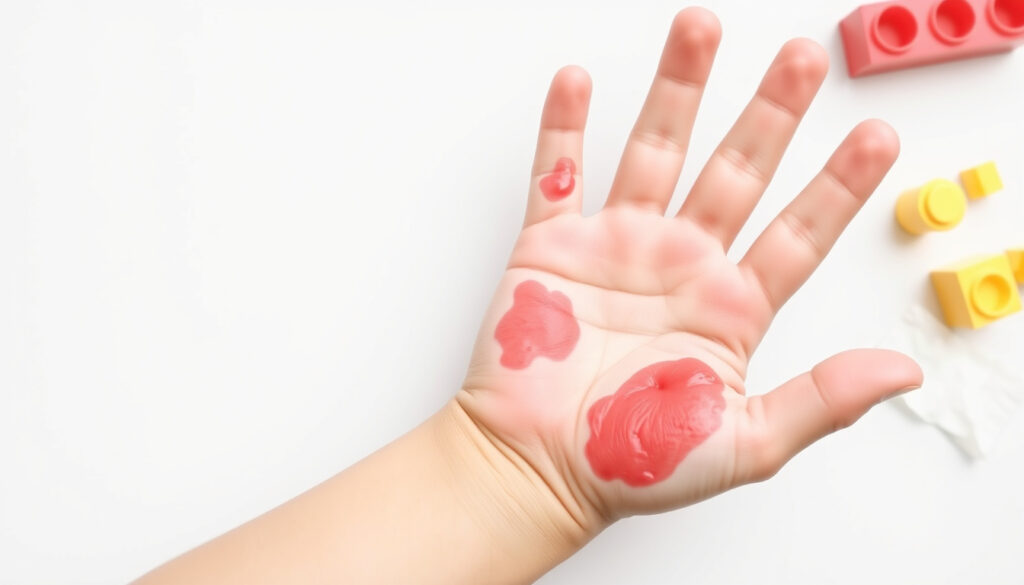
Hand, Foot and Mouth Disease: Symptoms, Treatment, and Contagion
Few things send a parent scrolling through WebMD faster than a sudden fever and a rash that wasn’t there yesterday. If your child has a sore throat, spots in the mouth, and blisters on their hands or feet, it’s likely hand, foot and mouth disease (HFMD) — a common viral illness that usually clears up on its own in about a week.
Common childhood illness: Affects mainly children under 5 ·
Incubation period: 3 to 6 days ·
Duration: Usually 7 to 10 days ·
Adults affected: Yes, but most are immune
Quick snapshot
- Fever (CDC)
- Sore throat (HealthyChildren.org)
- Mouth sores (CDC)
- Rash on palms, soles, buttocks (HealthyChildren.org)
- Coxsackievirus A16 (CDC)
- Enterovirus 71 (CDC)
- Rest (Mayo Clinic)
- Pain relief (CDC)
- Hydration (Cleveland Clinic)
- No antibiotics (WebMD)
- Hand washing (CDC)
- Avoid close contact (CDC)
- Disinfect surfaces (CDC)
The pattern: HFMD hits fast, then fades. Most children recover without needing a doctor visit.
| Fact | Value |
|---|---|
| Incubation period | 3-6 days (CDC) |
| Duration | 7-10 days (CDC) |
| Peak age | Children under 5 (PMC/NIH) |
| Fever range | 101-103°F (38-39°C) (CDC) |
What is hand, foot and mouth disease?
Cause
- HFMD is caused by coxsackievirus A16 and enterovirus 71, both members of the enterovirus family (CDC).
- The virus spreads through respiratory droplets, saliva, fluid from blisters, and contaminated surfaces (CDC).
Who is at risk
- Children under 5 are the most common group, but older kids and adults can also get it (PMC/NIH).
- Adults who are not immune (most are) may catch it from their own children (Cleveland Clinic).
The implication: HFMD is a classic childhood infection that parents can’t ignore, but it rarely causes serious trouble.
What are the first signs of hand, foot, and mouth?
In children
- Symptoms often start with fever, sore throat, and runny nose 3 to 5 days after exposure (CDC).
- Painful mouth sores (ulcers) appear in the back of the throat, then a red rash on the palms, soles, and sometimes the buttocks (Children’s Hospital of Philadelphia).
In adults
- Adults may have no symptoms at all, but when they do, the pattern is similar: fever, sore throat, and painful mouth lesions (Cleveland Clinic).
- Some adults report a more severe rash and higher fever than children (PMC/NIH).
The trade-off: Adults who get HFMD tend to feel worse, but the illness still resolves on its own within a week.
Adults are often the silent carriers — they can spread the virus without ever knowing they have it, which is why daycare outbreaks spread so quickly to parents.
What does HFM look like in adults?
Rash patterns
- The rash in adults can be more widespread and more painful, often involving the hands, feet, and sometimes the trunk (PMC/NIH).
- Blisters may be larger and more numerous than in children (Mayo Clinic).
Pain levels
- Mouth sores in adults can make eating and drinking very painful, increasing the risk of dehydration (CDC).
- Fever in adults tends to be higher, sometimes reaching 103°F (39°C) (CDC).
Why this matters: If you’re an adult with a fever and a blistery rash, don’t assume it’s just a cold — HFMD is a real possibility, and it’s highly contagious.
How do you treat hand, foot and mouth disease?
Home care
- There is no specific antiviral treatment; care focuses on relieving symptoms (Mayo Clinic).
- Use over-the-counter pain relievers like acetaminophen or ibuprofen to reduce fever and mouth pain. Do not give aspirin to children (CDC).
- Offer soft, cold foods (yogurt, smoothies, ice cream) to help with swallowing (Children’s Hospital of Philadelphia).
- Encourage fluids to prevent dehydration. Avoid acidic or spicy foods that irritate mouth sores (Cleveland Clinic).
When to see a doctor
- If your child cannot swallow any fluids, has a fever over 103°F, or seems very lethargic, contact your pediatrician (CDC).
- Adults with severe symptoms or signs of dehydration should also seek medical advice (Mayo Clinic).
Antibiotics won’t touch HFMD — it’s a virus. The best you can do is keep the patient comfortable and hydrated until the body clears the infection.
How long is hand foot mouth contagious?
Contagious period
- HFMD is most contagious during the first week of illness (HealthyChildren.org).
- The virus can be spread starting the day before the rash appears and for several days afterward (Children’s Hospital of Philadelphia).
Return to school/work
- Children can return to daycare or school once the fever is gone and mouth sores have healed — usually about 7 days after symptom onset (CDC).
- Adults should stay home from work until they are no longer contagious, typically 5–7 days (WebMD).
The pattern: The contagious window is short, but it starts before you know you’re sick — which is why outbreaks spread so fast in close-contact settings.
What gets mistaken for hand, foot, and mouth?
Other viral rashes
- Herpangina — caused by the same coxsackie virus — produces mouth ulcers but no hand/foot rash (CDC).
- Chickenpox causes a blistery rash that can look similar, but chickenpox rash is more widespread and intensely itchy (Mayo Clinic).
Allergic reactions
- Contact dermatitis or allergic reactions to medications can produce red spots, but they lack the mouth sores and fever typical of HFMD (HealthyChildren.org).
The trade-off: When in doubt, look for the combination of fever + mouth sores + rash on palms and soles — that’s the HFMD signature.
How to treat HFMD at home: a step-by-step guide
- Identify the symptoms — Check for fever, sore throat, and red spots on the tongue, gums, or inside the cheeks. Confirm the rash on hands, feet, or buttocks (CDC).
- Isolate the patient — Keep the sick person away from others, especially infants and pregnant women, for at least the first week (CDC).
- Relieve pain and fever — Give acetaminophen or ibuprofen as directed. Do not use aspirin for children (CDC).
- Keep them hydrated — Offer small amounts of water, milk, or oral rehydration solutions frequently. Cold fluids and ice pops can soothe mouth pain (Children’s Hospital of Philadelphia).
- Rest and monitor — Ensure plenty of rest. Watch for signs of dehydration (dry mouth, no tears, dark urine) and call a doctor if they appear (Cleveland Clinic).
What we know and what’s still unclear
Confirmed facts
- Caused by coxsackievirus A16 and enterovirus 71 (CDC)
- Highly contagious via respiratory droplets and contact with blisters (CDC)
- No specific antiviral treatment; care is supportive (Mayo Clinic)
- Most children recover without complications (CDC)
What’s unclear
- Exact incubation period for adults may vary slightly (CDC)
- Long-term immunity not guaranteed after infection (Cleveland Clinic)
Expert perspectives on HFMD
Most children with HFMD get better on their own in 7 to 10 days. The key is to keep them comfortable and hydrated.
— CDC (U.S. public health authority)
There is no specific treatment for HFMD. Antibiotics won’t work because it’s a virus.
— Mayo Clinic (leading medical center)
HFMD is very contagious and spreads quickly in schools and day care centers. Good hand hygiene is the best prevention.
— Cleveland Clinic (academic medical center)
For parents of young children, the decision is clear: recognize the symptoms early, isolate the sick child, and focus on hydration and pain relief. For adults, the same rules apply — but don’t be surprised if the rash hurts more than you expected. The virus will run its course in about a week, and your job is to make that week as bearable as possible.
medicalnewstoday.com, lvhn.org, pmc.ncbi.nlm.nih.gov, childrensnebraska.org
Frequently asked questions
Can hand, foot and mouth disease occur more than once?
Yes, because the body may not develop lifelong immunity, especially against different strains of the virus (CDC).
Is hand, foot and mouth disease the same as foot and mouth disease in animals?
No. HFMD is caused by enteroviruses and is not related to the foot-and-mouth disease that affects livestock (CDC).
What are the stages of hand foot and mouth disease?
Stage 1: fever and sore throat (days 1–2). Stage 2: mouth sores and rash appear (days 2–3). Stage 3: blisters crust and heal (days 5–7) (HealthyChildren.org).
Can adults get hand foot and mouth disease multiple times?
Yes. Adults can get HFMD more than once, but the second infection is usually milder (PMC/NIH).
How to soothe mouth pain from HFMD in toddlers?
Offer cold foods like yogurt, ice cream, or smoothies. Use a soft cup for liquids. Avoid citrus, salty, or spicy foods (Children’s Hospital of Philadelphia).
When should I take my child to the doctor for HFMD?
If your child is unable to drink fluids, has a fever above 103°F, seems lethargic, or shows signs of dehydration (dry mouth, no tears for 6+ hours), see a doctor (CDC).
Is there a vaccine for hand foot and mouth disease?
No vaccine is available in the U.S. or Europe. A vaccine for enterovirus 71 exists in China, but it is not widely used elsewhere (WebMD).
More related posts
 Wellington Events Next 14 Days: Family & Free Events
 All Blacks vs France Live Stream Free: Watch Online
 Bed Bath & Beyond Whakatane: Still Open at New Location
 Trade Me Marketplace NZ: How to Find Furniture, Cars & Free Stuff
 Cast of Dead Poets Society: Full Actor List (1989)
 The Church of Jesus Christ: Beliefs, Mormon Name & LGBTQ Stance
 COLORSTEEL Colours NZ: Cost, Durability & Paint Guide
 Love It or Li t It NZ: Payment, Renovation , Ho t & How to Apply
