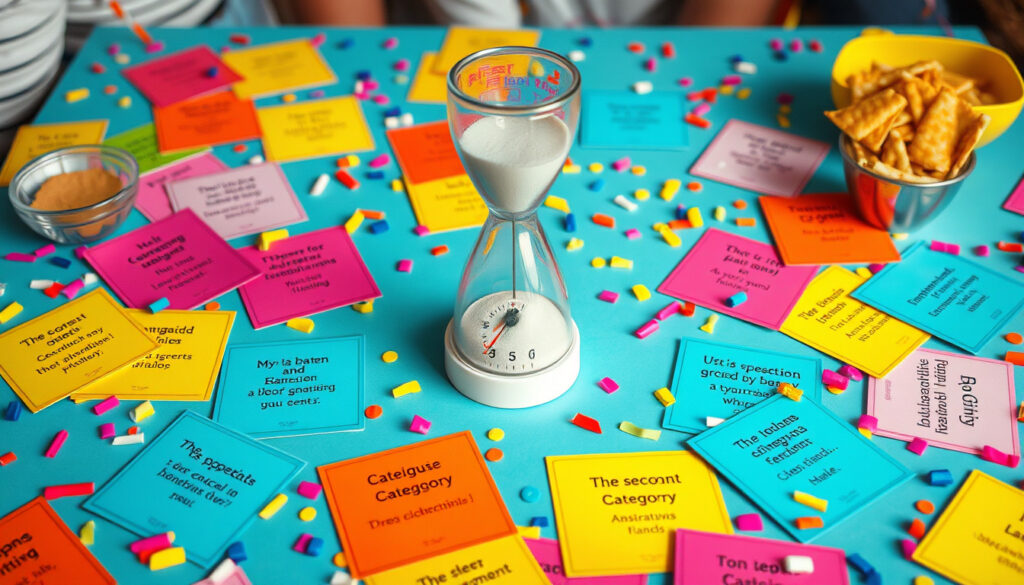
5 Second Rule Game: Rules, How to Play & Questions
The 5 Second Rule game turns simple prompts into frantic five-second challenges. Created by Michael Sistrunk in 2011, this party game has become a staple at game nights because it turns easy prompts into pressure-cooker moments that leave everyone laughing.
Subjects Available: Over 500 ·
Online Questions: 1000+ ·
Typical Players: 3-6 ·
Recommended Age: 8+ ·
Game Duration: 20-30 minutes
Quick snapshot
- Core rule is a 5-second naming challenge (Official Rulebook PDF)
- Game designed for 3-6 players, ages 8+ (Official Rulebook PDF)
- 376 cards contain 752 questions (Official Rulebook PDF)
- Exact question counts vary across all editions
- Limited public data on Mini variant’s full question bank
- International regional adaptations remain undocumented
- 2011: Sistrunk invents the game (People of Play)
- 2018: PlayMonster publishes official rules PDF (People of Play)
- 2022: Mini Entertainment Rules versioned (People of Play)
| Attribute | Value |
|---|---|
| Players | 3-6 |
| Age Range | 8+ |
| Play Time | 20-30 min |
| Components | 376 cards (752 questions), timer, board, 6 pawns |
| Special Cards | 2 PASS ON + 2 SWITCH per player |
| Variants | Junior, Uncensored, Relay, App |
How do you play the game 5 Second Rule?
The 5 Second Rule game distills party gaming to its most stripped-back challenge: name three things in a category before time runs out. The spiral timer is the heartbeat of every round, and once it starts, thinking turns to scrambling.
Setup
Before the first card is drawn, each player receives a set of special cards: two PASS ON cards and two SWITCH cards, which allow tactical retreats during the game. Players place their pawns at the START space on the board and are ready to play. The youngest player takes the first Hot Seat position, according to the Official Rulebook PDF.
Turn structure
A player draws a card from the deck and reads the prompt aloud—typically “Name 3…” followed by a category like celebrities, fruits, or cartoon characters. The player in the Hot Seat then has exactly five seconds to list three answers that fit that prompt. The spiral timer tracks those seconds, and the round ends when all the balls reach the bottom, according to the YouTube How to Play Tutorial. Successful answers earn the Hot Seat player a point card; failed attempts allow the next player to try.
Winning conditions
The objective is straightforward: collect the most cards by naming three correct answers under pressure. In the board version, successfully naming three allows your pawn to advance one space. In tiebreaker scenarios, tied players face off in a single extra round, as detailed in the YouTube Tutorial. Groups decide whether answers are acceptable, and disputed answers can be looked up online by group consensus.
What are the rules of the 5 second rule?
The official rules from PlayMonster (published in June 2018) form the backbone of how most people play today. Two key mechanics drive the action: the five-second timer and the Hot Seat system, according to the PlayMonster Official Rules PDF.
Basic rules
The owner of the game starts in the Hot Seat in the official PlayMonster version, with play moving to the right. Subsequent players cannot repeat answers that have already been given—the game demands fresh responses each round. When a player names three acceptable answers before time expires, they earn a card and the Hot Seat passes to the next player.
Common variations
Some versions flip the rotation to the left, and the original rulebook specifies the youngest player begins. Group voting decides questionable answers, which keeps the experience social rather than adversarial. The Geeky Hobbies Uncensored Rules explain how challenges can be raised with a majority vote or online lookup.
Timer usage
The spiral timer is central to the experience. Players flip it to start, and the round ends when the balls stop moving—not when the distinctive zoop sound plays. This matters because some players mistake the sound for the end signal, leading to premature celebrations. The timer creates the pressure that transforms simple categories into frantic word searches.
What questions are in the 5 second rule game?
The game ships with 376 cards featuring 752 total questions spanning dozens of categories, from animals and sports to food and famous landmarks. Each card presents a “Name 3…” prompt that seems easy until the timer starts spinning, according to the Official Rulebook PDF.
Sample categories
Categories include animals, sports, movies, foods, occupations, colors, things that make you laugh, and famous Michaels (like Michael Jordan, Michael Jackson, and Michael Eisner). The PlayMonster rules PDF provides this specific example, showing how prompts can range from broad to oddly specific. According to Rogers State University Library Guide, the real challenge lies in the pressure, not the categories themselves.
10 good questions
Effective prompts share a trait: the category is immediately recognizable, but producing three distinct answers under time pressure reveals how much mental work actually happens. Questions like “Name 3 breakfast foods,” “Name 3 superhero powers,” or “Name 3 ocean animals” perform well because everyone has relevant knowledge but limited instant access to three confirmed answers.
20 random questions
Questions that blend categories or require unexpected recall create the most laughter. “Name 3 things that are round,” “Name 3 Taylor Swift songs,” and “Name 3 things you might find in a purse” show how prompts can mix the mundane with the pop-cultural. The 50-topic example list from community sources includes prompts like colors in the rainbow and things that make you laugh.
What is the 5 second rule game JNR?
The Junior version of 5 Second Rule strips down the complexity for younger players while keeping the core timer mechanic intact. Designed for ages 6 and up, Junior simplifies both the question categories and the physical components.
Junior version features
Junior uses kid-friendly prompts with simpler vocabulary and more concrete categories. Instead of the spiral timer with its potentially intimidating ball-drop sequence, some Junior editions use a simplified timer or even an app-based countdown. The Mini Entertainment Rules provide guidance on how special cards work in the scaled-down versions.
Age suitability
The standard game targets ages 8 and up, but Junior accommodates players as young as 6 with age-appropriate content. Children at the lower end of the range benefit from adult facilitation during early rounds until they grasp the mechanics. The simplified categories mean less reading comprehension overhead and more focus on the naming challenge itself.
Differences from original
The main differences are question content, physical timer style, and the absence of some edge-case rules. The board and pawn system often shrinks or disappears entirely in Junior editions, replaced by a card-only format that moves faster and requires less table space. Question categories in Junior stay concrete and visual rather than abstract or culturally niche.
Is the 5 second rule game good for adults?
Adult game nights benefit from the 5 Second Rule’s combination of low setup friction and high laugh potential. The Uncensored variant specifically targets adult humor with raunchier questions that would feel out of place in family play, according to Geeky Hobbies.
Adult variants
The Uncensored edition keeps the same core mechanics but populates the question deck with adult-oriented prompts. Questions touch on topics like relationships, adult humor, and embarrassing situations. Players can remove specific cards for classroom or mixed-company settings, making the deck customizable for different audiences.
Uncensored edition
In the Uncensored variant, the Hot Seat player scores a point by naming three answers before the timer reaches its third ball at the bottom. This slightly different timer endpoint adds an extra beat compared to some standard versions, creating marginally more response time. Challenges are resolved through majority vote or quick online lookup.
Party suitability
The 5 Second Rule format works particularly well at parties because it requires no advance knowledge, accommodates large groups, and creates natural laugh-out-loud moments. The game scales from 3 to 12 players without modifications, and predetermined round counts (2-3 for large groups, 4-5 for smaller gatherings) keep sessions manageable.
Clarity section
Confirmed facts
- Core rule: name three items in your category within 5 seconds
- Standard game designed for 3-6 players, ages 8+
- 376 question cards contain 752 total questions
- Game invented by Michael Sistrunk in 2011
- Spiral timer ends round when balls stop
- Each player receives 2 PASS ON and 2 SWITCH cards
- Uncensored variant has raunchier content with removable cards
What’s rumored
- Exact question counts vary across all editions—not publicly confirmed
- Limited documentation on Mini variant’s full question bank size
- International regional adaptations remain unverified
- Specific player count upper limits reported differently across sources
What experts say
Seems easy enough, but under pressure, it’s a different story.
— Michael Sistrunk, inventor (PlayMonster)
Time’s not on your side, so just say what comes to mind and risk ridiculous answers slipping out.
— Rogers State University Library Guide (Library Guide)
The instant party hit with over 1000+ exciting questions.
— 5second.app description (App Store)
The game’s simple premise—three answers, five seconds, one timer—masks a surprisingly deep party dynamic. The pressure mechanic transforms easy categories into frantic brainstorms, and that contrast is precisely where the laughter lives. For hosts seeking a game that plays itself with minimal setup, the 5 Second Rule delivers.
Michael Sistrunk built this game from a childhood game he played with his siblings, pitching the prototype from a bedside notepad to PlayMonster. That origin story explains why the game feels more like family tradition than engineered product—it emerged from actual play rather than focus groups. That organic feel is what keeps people returning to it decade after decade.
The 5 Second Rule has outlasted countless trend-driven party games because it taps into something fundamental: the gap between knowing something and being able to say it under pressure. The spiral timer is a physical manifestation of that gap, and watching friends struggle with prompts they would normally answer instantly is consistently funny. For hosts planning game night, the game offers quick setup, natural laugh generation, and replay value without requiring anyone to study rules beforehand.
Related reading: Code Cracker Solver · Fastest Animal in the World
Frequently asked questions
How many players are needed for 5 Second Rule game?
The standard game accommodates 3 to 6 players, according to the Official Rulebook PDF. Some variants and digital versions allow solo play or larger groups, but the physical board game works best within that range. Groups of 3-6 create balanced Hot Seat rotation without long waits between turns.
What age group is 5 Second Rule game for?
The standard edition targets ages 8 and up. Junior versions exist for ages 6 and older, with simplified categories and smaller physical components. Uncensored editions are marketed toward adult audiences and may include content unsuitable for younger players.
Where can I play 5 Second Rule game online?
The official mobile app offers browser-based and downloadable versions with over 1000 questions, according to the App Store listing. Community sites also host question lists and virtual card generators, though these vary in quality and completeness compared to official sources.
Is there a 5 Second Rule game rules PDF?
Yes. PlayMonster published an official rules PDF in June 2018 that covers the standard game mechanics, Hot Seat rotation, special cards, and timer usage. The official rulebook PDF from Amazon also provides detailed setup and component information.
What is 5 Second Rule Relay?
Relay editions involve passing cards between players as part of the scoring mechanics, creating a team-based dynamic that differs from standard individual play. This variant emphasizes coordination and quick handoffs rather than individual Hot Seat performance.
Can 5 Second Rule game be played without cards?
Yes. The mobile app and online generators can substitute for physical cards. Players can also create custom prompts using the same “Name 3…” format, making the game playable with nothing more than a timer and improvised categories.
How to make custom 5 Second Rule questions?
Custom questions follow the same format: a “Name 3…” prompt with a specific, recognizable category. Effective prompts use concrete categories where players have relevant knowledge but need the timer to feel the retrieval pressure. Mix familiar and niche categories to keep rounds unpredictable.
More related posts
 Sophie, Duchess of Edinburgh: Bio, Family & Royal Life
 Panthers vs Broncos 2025: Final Score, Date & Match Facts
 Pick A Part NZ: Locations, Stock List & Used Parts Guide
 Arsenal vs Chelsea Stats: Head-to-Head Record & Live Updates
 Under Armour Compression Shirt vs Nike: Which is Better
 Ferrari for Sale NZ: 2025 Prices, Models & Buying Guide
 360 USD to NZD: Convert US Dollars to New Zealand Dollars
 Barrel Leg Jeans NZ: Who Can Wear Them, Styling & Best Brands
