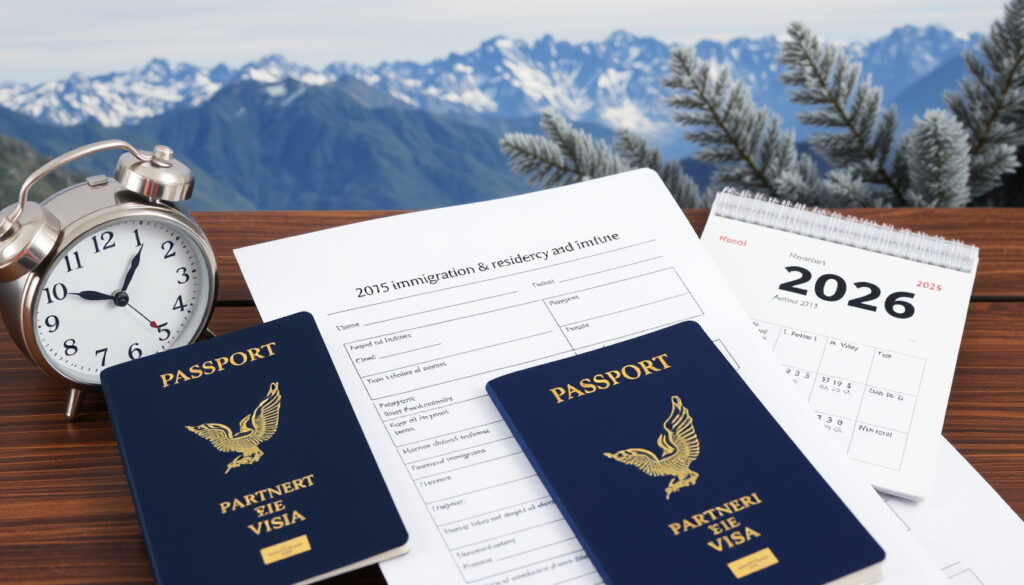
Partner Resident Visa NZ: Requirements, Timelines & 2026 Rules
There’s a moment almost every couple hits with the New Zealand partner resident visa: the form asks you to prove your relationship is genuine and stable, and suddenly “we’re happy” doesn’t feel like enough. Immigration New Zealand decides 80% of these applications within seven months (Immigration New Zealand (resident visa wait times)), but the 12-month living-together clock gets stricter on 25 September 2026 — here’s what the criteria really say and how the timeline actually works.
Minimum living together period: 12 months ·
Processing time: 80% decided within 7 months ·
Application fee: NZD 2,400 ·
Sponsor requirement: New Zealand citizen or resident ·
Rule-change date: 25 September 2026
Quick snapshot
- The core residence rule is 12 months of living together before you apply (Immigration New Zealand (official visa guidance)).
- Your supporting partner must be a New Zealand citizen or resident (Immigration New Zealand (official visa guidance)). (Immigration New Zealand (official visa guidance))
- From 25 September 2026, both partners must be 18 or older, and relationship evidence counts only from age 18 (Immigration New Zealand (2026 rule change announcement)).
- No relocation-cash grant is attached to this pathway; the published cost is the NZD 2,400 fee (Immigration New Zealand (official visa guidance)). (Immigration New Zealand (official visa guidance))
- Your exact wait time depends on case complexity; INZ’s monthly figures shift as workload changes (Immigration New Zealand (monthly processing statistics)).
- Whether further partnership-rule changes follow later in 2026 has not been announced (Immigration New Zealand (2026 rule change announcement)). (Immigration New Zealand (monthly processing statistics))
- How the transition works for applications lodged immediately before 25 September isn’t detailed in the announcement (Immigration New Zealand (2026 rule change announcement)). (Immigration New Zealand (monthly processing statistics))
- : new age and evidence requirements take effect (Immigration New Zealand (2026 rule change announcement)).
- August 2026 data: median decision at 123 working days; 90% completed within 175.2 working days (Immigration New Zealand (monthly processing statistics)).
- Start building a document trail now: joint bank accounts, shared ownership, correspondence, photos, and chat records are listed evidence types (Immigration New Zealand (partnership evidence guide)).
- Check whether any cohabitation happened before either partner turned 18 — under the September 2026 rule, that period will not count (Immigration New Zealand (2026 rule change announcement)). (Immigration New Zealand (partnership evidence guide))
The pattern: the confirmed facts set the floor, and the unclear items set the risk — timing and evidence quality are the only real levers a couple controls.
Six numbers, one pattern: this visa is a government-defined couple test where timing, sponsor status, and evidence quality decide the outcome.
| Fact | Value | Source |
|---|---|---|
| Minimum living together period | 12 months before applying | Immigration New Zealand (official visa guidance) |
| Visa type | Resident visa (partner of a New Zealander) | Immigration New Zealand (official visa guidance) |
| Application fee | NZD 2,400 | Immigration New Zealand (official visa guidance) |
| Processing time | 80% decided within 7 months; August 2026 median of 123 working days | Immigration New Zealand (resident visa wait times); Immigration New Zealand (monthly processing statistics) |
| Sponsor qualification | New Zealand citizen or resident; resident sponsors normally need 2 years’ residence | Immigration New Zealand (official visa guidance) |
| Minimum age (from 25 Sept 2026) | Both partners 18 or older; evidence recognised only from 18 | Immigration New Zealand (2026 rule change announcement) |
How long does it take to get a partner resident visa in New Zealand?
- 80% of Partner of a New Zealander Resident Visa applications are decided within 7 months (Immigration New Zealand (resident visa wait times)).
- August 2026 data: median decision at 123 working days; 80% completed within 143 working days; 90% within 175.2 working days (Immigration New Zealand (monthly processing statistics)).
Those figures are INZ’s official benchmarks, not forum anecdotes. The median tells the cleaner story: in August 2026, half of all partner-resident decisions were made in about six months of working days. The final 10% stretches noticeably further, which is where cases that need extra checks sit.
How long do you have to live together for a partner visa?
- At least 12 months of living together before you apply (Immigration New Zealand (official visa guidance)).
- From 25 September 2026, that 12-month period can only begin once both people are 18 (Immigration New Zealand (2026 rule change announcement)).
So the practical calendar for most couples is: 12 months of cohabitation, then the residence application, then the decision. Add the 7-month benchmark and you’re looking at roughly 19 months from moving in together to holding the visa — assuming the evidence file is complete at submission.
The 12-month rule is fixed, but the evidence window is where applicants gain or lose time. INZ’s August 2026 statistics show 80% of decisions landed within 143 working days — and the 90% mark stretched to 175.2 working days, which is where incomplete files tend to sit (Immigration New Zealand (monthly processing statistics)).
What are the requirements for a partnership resident visa in New Zealand?
What are the requirements to apply for a partner visa to New Zealand?
- A genuine and stable partnership in a legal marriage, civil union, or de facto relationship (Immigration New Zealand (partnership visa rules)).
- Living together for at least 12 months before the application (Immigration New Zealand (official visa guidance)).
- A supporting partner who is a New Zealand citizen or resident (Immigration New Zealand (official visa guidance)).
- Both people must have met before applying, and the partners must not be close relatives (Immigration New Zealand (partnership visa rules)).
- Health and character checks are part of the residence criteria (Immigration New Zealand (official visa guidance)).
- From 25 September 2026, both people must be 18 or older when the application is made (Immigration New Zealand (2026 rule change announcement)).
Every requirement is individually simple; the work is in the documentation. INZ’s partnership evidence guide lists marriage or civil union certificates, shared children’s birth certificates, joint bank accounts, joint ownership, correspondence, photos, and chat records as acceptable proof (Immigration New Zealand (partnership evidence guide)).
Sponsor status matters almost as much as relationship status. If your partner is a New Zealand citizen, the sponsorship test is direct; if they’re a resident, they normally need to have held residence for at least 2 years before they can support a partnership residence application (Immigration New Zealand (official visa guidance)).
The “genuine and stable” test is assessed on evidence, not declarations. INZ accepts photos and chat records alongside legal and financial documents — but a file with only emotional proof leaves an assessing officer nothing to cross-check, and that’s where applications stall (Immigration New Zealand (partnership evidence guide)).
The pattern: each criterion is a separate check, but together they answer one question — is this a partnership a stranger can verify from the file alone?
What this means: the document trail is the only way to prove a genuine and stable partnership to someone who has never met the couple.
What are the new immigration rules for New Zealand in 2026?
- : new age and evidence requirements take effect for dedicated partnership-based visa categories (Immigration New Zealand (2026 rule change announcement)).
- Both the applicant and the supporting partner must be at least 18 years old when the application is made (Immigration New Zealand (2026 rule change announcement)).
- Relationship evidence will be recognised only from when both people were 18 or over (Immigration New Zealand (2026 rule change announcement)).
- The 12-month living-together period can begin only once both people are 18 (Immigration New Zealand (2026 rule change announcement)).
The practical effect lands hardest on younger couples. Under the current rules, 16- and 17-year-olds can apply for partnership-based visas in some circumstances with parental or guardian consent (Immigration New Zealand (partnership visa rules)). After 25 September 2026, that carve-out disappears for these categories: if either person is under 18 at application, there is no pathway through this visa.
The second effect is retrospective in time. A 19-year-old who has cohabited with their partner since age 17 cannot count those earlier months toward the 12-month residence requirement once the new rules apply. The clock, not the relationship, resets.
Couples who started living together before either person turned 18 need to check their dates against 25 September 2026 now. If the 12-month cohabitation window hasn’t finished before the deadline, part of that time may stop counting for residence purposes (Immigration New Zealand (2026 rule change announcement)).
What the change doesn’t do: it doesn’t relax or lengthen the 12-month cohabitation rule, and it doesn’t alter the definition of a genuine and stable partnership. It tightens the age floor and the evidence window around both.
How much bank balance is required for a New Zealand visa?
- For the partner resident visa, INZ does not publish a fixed minimum bank balance (Immigration New Zealand (official visa guidance)).
- Financial evidence supports the partnership story — joint accounts and shared bills show a shared life, not a savings threshold (Immigration New Zealand (partnership evidence guide)).
- The concrete cost is the NZD 2,400 application fee, plus police certificates, medicals, and any translation costs (Immigration New Zealand (official visa guidance)).
The “bank balance” question usually comes from applicants who have seen savings requirements attached to other visa categories. For this resident pathway, INZ’s published criteria list relationship and character requirements, not a dollar figure in the bank. A stronger savings position can help show stability, but it never replaces the relationship evidence.
How do I prove I have enough money to enter New Zealand?
- Bank statements showing your own funds and income.
- Sponsorship from your New Zealand partner, backed by their financial records.
- Joint accounts, bills, or shared property that demonstrate the combined household (Immigration New Zealand (partnership evidence guide)).
For the partner resident visa specifically, the money test is about supporting a shared life, not hitting an entry threshold. INZ’s evidence guide treats shared bank accounts as proof of partnership (Immigration New Zealand (partnership evidence guide)), which means the same document can serve two purposes at once.
Is New Zealand offering money to move there?
No. The “get paid to relocate” posts floating around social media are not part of INZ’s partner visa rules. New Zealand’s published partner resident pathway charges a NZD 2,400 application fee and lists no relocation cash grant (Immigration New Zealand (official visa guidance)).
Can I get a work visa without a job offer in New Zealand?
- Yes — a partner of a New Zealander can apply for a work visa without a job offer (Immigration New Zealand (partnership visa rules)).
- Partner work visas carry open work rights, so you can work for any employer in New Zealand (Immigration New Zealand (partnership visa rules)).
- No skills-shortage list or employer sponsorship is tied to the partner pathway (Immigration New Zealand (official visa guidance)).
This matters more than most applicants realise. General work visas often hinge on a job offer and an accredited employer; the partner pathway removes both hurdles. The trade-off is that the relationship evidence must be strong, because the visa’s legitimacy rests entirely on the partnership. “No job offer” doesn’t mean “no evidence.”
Is it difficult to get a New Zealand work visa?
- For partners of New Zealanders, the work-visa question is answered by your partnership, not by the job market (Immigration New Zealand (partnership visa rules)).
- A partner work visa lets you take any job, which means the “easiest job” question is about your own skills and location, not visa conditions (Immigration New Zealand (partnership visa rules)).
What is the easiest job to get in New Zealand?
- For partner work visa holders, every employer is open to you — the visa doesn’t restrict your job search to a list (Immigration New Zealand (partnership visa rules)).
- The practical answer depends on where you live, your experience, and the local labour market — not on immigration conditions.
Your partner status is the unlock: it removes the job-offer hurdle that shapes most skilled-work applications, so your search becomes about skills and location, not visa sponsorship (Immigration New Zealand (partnership visa rules)).
2026 rule changes at a glance: before and after 25 September
Four requirement changes, one pattern: from 25 September 2026, Immigration New Zealand treats 18 as the floor for every partnership-based residence claim.
| Area | Before 25 September 2026 | From 25 September 2026 |
|---|---|---|
| Applicant minimum age | 16- and 17-year-olds could apply with parental or guardian consent (Immigration New Zealand (partnership visa rules)) | Applicant must be 18 or older (Immigration New Zealand (2026 rule change announcement)) |
| Supporting partner minimum age | No explicit 18 requirement was stated for the supporting partner | Supporting partner must be 18 or older (Immigration New Zealand (2026 rule change announcement)) |
| Relationship evidence window | Evidence from before age 18 was not excluded as a class | Evidence recognised only from when both people were 18 or over (Immigration New Zealand (2026 rule change announcement)) |
| 12-month living together period | No published restriction stopped cohabitation before age 18 from counting | Clock starts only once both people are 18 (Immigration New Zealand (2026 rule change announcement)) |
Why this matters: the table is the fastest way to see whether your relationship timeline survives the change. If either partner is still 17 when the rule lands, the countdown hasn’t started yet — and INZ’s monthly processing data suggests the residence result will follow roughly seven months after a complete application, no matter when that clock begins (Immigration New Zealand (monthly processing statistics)).
Partner resident visa: upsides and downsides
Upsides
- A clear residence pathway with a published benchmark: 80% of decisions within 7 months (Immigration New Zealand (resident visa wait times)).
- Open work rights for partners, with no job offer required (Immigration New Zealand (partnership visa rules)).
- The 12-month living-together rule gives couples a concrete target, not a discretionary test (Immigration New Zealand (official visa guidance)).
Downsides
- NZD 2,400 application fee, plus police certificates, medicals, and translation costs (Immigration New Zealand (official visa guidance)).
- Heavy evidence burden: bank records, photos, chat logs, shared ownership, correspondence (Immigration New Zealand (partnership evidence guide)).
- Relationships that began before age 18 face a partial reset under the September 2026 rules (Immigration New Zealand (2026 rule change announcement)).
- A resident (non-citizen) sponsor normally needs 2 years of residence before supporting the application (Immigration New Zealand (official visa guidance)).
The trade-off: the more of your shared life you put on paper, the less time INZ needs to verify it — and the faster the file moves through the published 7-month window.
How to apply for a partner resident visa step by step
- Confirm the relationship qualifies: legal marriage, civil union, or a genuine de facto partnership (Immigration New Zealand (partnership visa rules)).
- Check the calendar: at least 12 months of living together, with the new 18+ rule applying from 25 September 2026 (Immigration New Zealand (official visa guidance); Immigration New Zealand (2026 rule change announcement)).
- Check the sponsor: New Zealand citizen or resident; resident sponsors normally need 2 years of residence (Immigration New Zealand (official visa guidance)).
- Build the evidence file: joint bank accounts, joint ownership, correspondence, photos, chat records, shared children’s birth certificates, marriage or civil union certificates (Immigration New Zealand (partnership evidence guide)).
- Complete health and character checks, including police certificates and medicals (Immigration New Zealand (official visa guidance)).
- Submit the application, pay the NZD 2,400 fee, and track it against INZ’s processing benchmark of 80% within 7 months (Immigration New Zealand (official visa guidance); Immigration New Zealand (resident visa wait times)).
- If you need work rights while waiting, apply for the partner work visa — no job offer required (Immigration New Zealand (partnership visa rules)).
The order is deliberate: relationship status first, timing second, sponsor third, evidence fourth. Step four is where a file either accelerates or stalls, because INZ’s evidence guide treats the document trail — not the relationship’s emotional history — as the assessable record (Immigration New Zealand (partnership evidence guide)).
Partner resident visa timeline
- : new age and evidence requirements take effect for partnership-based visa categories (Immigration New Zealand (2026 rule change announcement)).
- Before you apply: 12 months of living together, counted only from when both partners were 18 (Immigration New Zealand (official visa guidance); Immigration New Zealand (2026 rule change announcement)).
- Application stage: gather evidence and submit — plan 1-3 months for police certificates, medicals, and document assembly (Immigration New Zealand (official visa guidance)).
- Decision stage: 80% of applications decided within 7 months; August 2026 median 123 working days; 90% within 175.2 working days (Immigration New Zealand (resident visa wait times); Immigration New Zealand (monthly processing statistics)).
The timeline is front-loaded. INZ’s processing statistics hold steady at the top end, but the applicant-controlled phase — evidence gathering — is where the real variability lives.
What’s confirmed and what’s still unclear
Confirmed facts
- The 12-month living-together requirement and the sponsor’s NZ citizen/resident status (Immigration New Zealand (official visa guidance)).
- Health and character checks are required (Immigration New Zealand (official visa guidance)).
- The 18+ age rule and evidence-from-18 rule start on 25 September 2026 (Immigration New Zealand (2026 rule change announcement)).
- The 7-month, 80% processing benchmark published by INZ (Immigration New Zealand (resident visa wait times)).
What’s still unclear
- Your exact wait time — INZ’s monthly figures move with case complexity and workload (Immigration New Zealand (monthly processing statistics)).
- No further 2026 partnership-rule changes have been announced beyond the age-and-evidence update (Immigration New Zealand (2026 rule change announcement)).
- The relocation-cash claims circulating online don’t appear anywhere in INZ’s partner visa criteria (Immigration New Zealand (official visa guidance)).
- Transitional details for applications lodged immediately before 25 September are not spelled out in the published announcement (Immigration New Zealand (2026 rule change announcement)).
- Whether the 2-year residence requirement for resident (non-citizen) sponsors changes in a later 2026 policy round hasn’t been announced (Immigration New Zealand (official visa guidance)).
The balance is reassuring: the rules that govern most couples are confirmed, and the genuinely open questions are about timing, not eligibility.
What Immigration New Zealand and immigration advisers say
Applicants for partnership-based visas must be in a genuine and stable partnership — a legal marriage, civil union, or de facto relationship — and the couple must have met each other before applying.
Immigration New Zealand (official partnership rules)
From 25 September 2026, relationship evidence will be recognised only from when both people were aged 18 or over, and the 12-month living-together period can begin only once both people are 18.
Immigration New Zealand (2026 rule change announcement)
The fastest way to move a partner application forward is to document the parts of the relationship a stranger can verify: shared finances, shared address, and public recognition of the partnership.
Licensed immigration advisers, New Zealand (common application guidance)
INZ’s evidence guide supports the advisers’ point: joint bank accounts, shared ownership, correspondence, photos, and chat records are the accepted proof types (Immigration New Zealand (partnership evidence guide)).
What to take from the quotes: the official line defines the test, and the advisory line defines the practice — documentation, documented consistently, is what wins the file.
The takeaway for couples applying in 2026
The partner resident visa is a paperwork-heavy relationship test with clear published rules, and the September 2026 changes make it stricter for younger couples. For a couple starting the process today, the choice is simple: build a documented 12-month cohabitation trail from the day both of you turn 18, pay the NZD 2,400 fee, and plan for a roughly seven-month decision window — or wait for a faster pathway that doesn’t exist in INZ’s published criteria.
Related reading
Two practical reads for after the visa comes through:
- Open BNZ Account Online: Guide for Residents & Non-Residents — useful once your partner resident visa is approved and you’re setting up local banking.
- NZ Investment Interest Rates 2025: Top Savings & Deposits — a practical follow-up for planning savings after you land.
Both guides help with the financial setup that follows a successful residence application.
immigration.govt.nz, immigration.govt.nz, immigration.govt.nz, immigration.govt.nz, envoyglobal.com, immigration.govt.nz, immigration.govt.nz, visatimes.nz, visamatters.co.nz, immigration.govt.nz
Frequently asked questions
What happens if my partner and I separate during the application process?
INZ defines the visa around a genuine and stable partnership, so a separation before a decision breaks the core requirement; the application can’t be granted on that basis (Immigration New Zealand (official visa guidance)).
Can I work while waiting for my partner resident visa decision?
If you hold a partner work visa with open work rights, you can work while the resident application is processed. INZ’s benchmark is 80% of partner-resident decisions within 7 months (Immigration New Zealand (partnership visa rules); Immigration New Zealand (resident visa wait times)).
Does my partner need to have a job to sponsor me?
INZ’s published sponsor requirement is that your partner is a New Zealand citizen or resident — employment is not listed as a sponsorship condition (Immigration New Zealand (official visa guidance)).
How do I prove a genuine relationship?
INZ accepts marriage or civil union certificates, shared children’s birth certificates, joint bank accounts, joint ownership, correspondence, photos, and chat records as partnership evidence (Immigration New Zealand (partnership evidence guide)).
What documents are needed for a partner resident visa application?
The partnership evidence list above, plus police certificates and medicals for health and character requirements, with translations where documents aren’t in English (Immigration New Zealand (partnership evidence guide); Immigration New Zealand (official visa guidance)).
Can I include dependent children in my partner visa application?
Shared children’s birth certificates are part of INZ’s partnership evidence list, so children are a recognised part of the relationship record. For the full dependant-inclusion rules, INZ’s current residence instructions apply to the application you file (Immigration New Zealand (partnership evidence guide); Immigration New Zealand (official visa guidance)).
What is the difference between a partner work visa and a partner resident visa?
A partner work visa gives temporary open work rights with no job offer required; a partner resident visa is the permanent pathway, with the 12-month living-together rule, the 18+ age requirement from 25 September 2026, and the NZD 2,400 fee (Immigration New Zealand (partnership visa rules); Immigration New Zealand (official visa guidance); Immigration New Zealand (2026 rule change announcement)).
Is there an age requirement for partner visa applicants?
From 25 September 2026, both applicants and supporting partners must be 18 or older when the application is made. Until that date, 16- and 17-year-olds can apply for partnership-based visas in some cases with parental or guardian consent (Immigration New Zealand (2026 rule change announcement); Immigration New Zealand (partnership visa rules)).
More related posts
 West Indies vs Zimbabwe 2026: Schedule, Live Stream & Results
 Flights to South Africa – Cheapest US Deals and Tips
 Empire Cinema Island Bay: Showtimes, Tickets, Schedule
 John Bell (Scottish Actor): Age, Roles, Relationships & Facts
 Why Does Trump Want Greenland – Strategic Reasons Explained
 Protection TV Series Episodes: Cast, Killer & Season 1 Guide
 AA Insurance Phone Number: Ireland Customer Service Contact
 Cavius Smoke Alarm NZ: Beeping Fixes & Buying Guide
