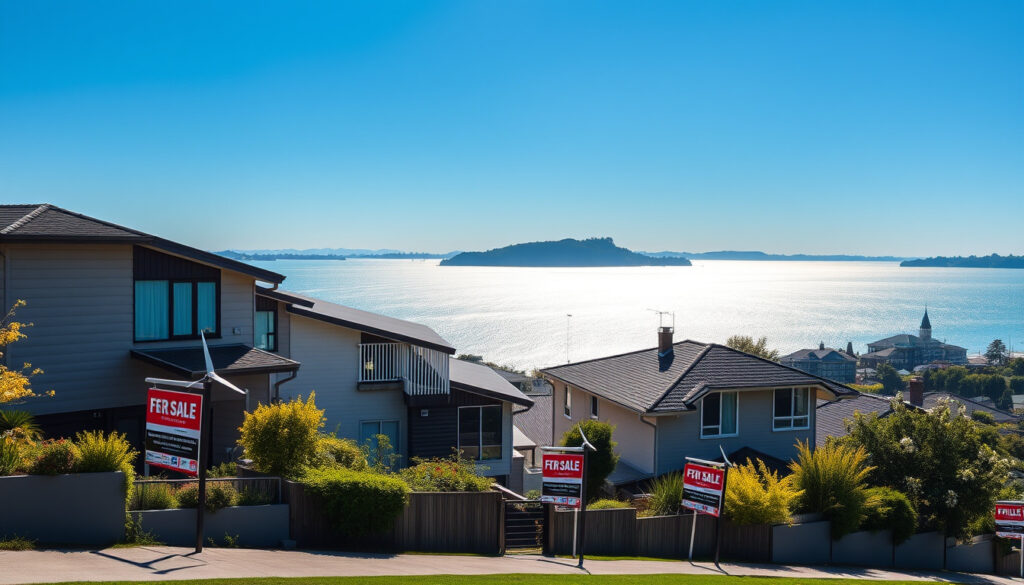
Houses for Sale in New Zealand Auckland: Listings & Prices
Auckland’s housing market has always attracted attention, but recent shifts are worth noting for anyone scouting houses for sale in New Zealand Auckland right now. Prices have eased from their 2021 peak, yet the city still ranks among the world’s least affordable markets. Whether you’re a first home buyer or an overseas resident trying to understand the rules, the landscape has a few sharp edges worth knowing about.
Houses for sale in Auckland: 16,000+ ·
Trade Me listings: 16,748 ·
Auckland median (June 2025): NZD 990,000 ·
North Shore drop from peak: -17.9%
Quick snapshot
- Auckland HPI fell -2.1% to December 2025 while rest of NZ rose +0.7% (MoneyHub)
- National median price June 2025: NZD 770,000, flat year-on-year (Global Property Guide)
- Auckland median price fell 3.4% to NZD 990,000 in June 2025 (Global Property Guide)
- Exact 2025–2026 salary thresholds for comfortable living in Auckland vary by source
- Current volume of listings specifically under NZD 500,000 fluctuates daily
- How quickly migration recovery might reverse softening vacancy rates
- Property values across NZ dipped -0.1% in January 2026, suggesting sluggishness carries over (Cotality)
- 23 consecutive months of year-on-year inventory growth ended December 2025 (MoneyHub)
- Reuters poll projects 6.0% price rise in 2026, 5.1% in 2027 (Global Property Guide)
- First home buyers and upsizers remain most active buyer group (MoneyHub)
- Investors largely absent due to poor yields and negative real returns (MoneyHub)
- Sub-$800k properties increasingly found outside Auckland where medians sit under NZD 700k (MoneyHub)
| Metric | Value | Source |
|---|---|---|
| Total houses for sale in Auckland | Over 16,000 | Trade Me, OneRoof listings |
| Auckland HPI change (year to Dec 2025) | -2.1% | MoneyHub |
| Rest of NZ HPI change (same period) | +0.7% | MoneyHub |
| National median price (June 2025) | NZD 770,000 | Global Property Guide |
| Auckland median price (December 2025) | NZD 990,000 | Global Property Guide |
| Auckland purchasing power loss (5yr) | -28% | MoneyHub |
| Auckland inventory (Dec 2025) | 30 weeks | MoneyHub |
| Days to sell Auckland (Dec 2025) | 41 days | MoneyHub |
| North Shore drop from peak | -17.9% | Cotality |
| Foreigner buying rules | LINZ overseas investment guidance applies | Land Information NZ |
How much is an average house in Auckland, New Zealand?
House values in Auckland
Auckland’s housing market tells a story of two speeds. The city’s House Price Index fell 2.1% in the year to December 2025, while the rest of New Zealand climbed 0.7% over the same period (MoneyHub market analysis). That divergence matters: Auckland property has lost 28% of its purchasing power over five years, a hit that reflects both nominal price stagnation and cumulative inflation running at 24%.
The June 2025 median price data from the Global Property Guide shows Auckland at NZD 990,000, down 3.4% year-on-year. Nationally, the median sat at NZD 770,000, flat compared to the prior year. Excluding Auckland, the rest of New Zealand actually rose 1.7% to NZD 691,500 — a gap that makes the city’s affordability problem harder to ignore.
Days on market tell the same story. Properties in Auckland took a median 41 days to sell in December 2025, above the 10-year December average of 36 days (MoneyHub). More stock sitting unsold means buyers have leverage — something that was harder to find during the 2021 boom.
Auckland’s affordability crisis isn’t new, but the 2025–2026 softening gives buyers breathing room that simply didn’t exist a few years ago. The national median of NZD 770,000 is still steep, yet Auckland’s -2.1% HPI decline signals a market where negotiation is possible.
Regional trends
Not all Auckland areas have softened equally. North Shore has been relatively resilient — down 17.9% from its peak — while other parts of the super-city have dropped more than 20% from theirs (Cotality analyst (regional market specialist)). Manukau has seen new townhouse developments that continue subduing values, and Auckland City faces headwinds from apartment concentration, body corporate insurance costs, and buyer caution around build quality.
The data reveals a clear two-speed market: standalone houses in Auckland sit roughly 14% below peak levels, while townhouses are closer to 9–10% below peak (Najib Real Estate (property market analyst)). Houses capture more upside during booms but also more downside in corrections — a trade-off buyers should weigh carefully.
The Demographia 2025 report classified Auckland as “severely unaffordable,” a ranking that places the city among the world’s most expensive markets relative to income. Nationwide, home prices run approximately six times the average household income (Global Property Guide affordability research).
Can a foreigner buy a house in New Zealand?
Residential property rules for overseas buyers
New Zealand maintains rules around foreign purchases that stem from the Overseas Investment Amendment Act. The Land Information NZ (LINZ) guidance makes clear that non-residents face restrictions on purchasing most residential property — the rules are not a blanket ban for all categories, but the process is not straightforward. Overseas nationals who are not resident class visa holders generally cannot purchase existing residential property without specific consent pathways.
For those on visitor visas, Immigration NZ sets maximum stay limits that do not allow property ownership as a practical matter. Non-residents looking at houses for sale in New Zealand Auckland through the lens of investment need to understand that the market dynamics — with investors largely absent due to poor yields and negative real returns — reflect these ownership constraints.
The practical implication: if you’re scouting properties from overseas, the path is narrower than for a resident. Immigration status determines eligibility more than budget alone.
LINZ guidance
The LINZ overseas investment portal outlines that consent pathways exist for certain categories — including development that increases housing supply or investments that create significant economic benefit. However, the standard residential purchase by an overseas person seeking to live in the property requires either residency or a specific exemption category.
Buyers uncertain about their eligibility should consult the guidance directly or work with a licensed real estate agent who handles cross-border transactions. The rules have been stable since their introduction, but enforcement has tightened as the market softened.
“Foreigner buying rules” are often searched, but the real barrier for many would-be buyers is affordability rather than nationality. Auckland’s median of NZD 990,000 is steep regardless of residency status — and for non-residents, the financing options are even narrower.
Where is the cheapest place to buy a house in New Zealand?
Most affordable areas
Auckland rarely appears on “cheapest” lists for New Zealand. Within the city, Manukau and South Auckland offer relatively lower price points thanks to new townhouse supply keeping values in check. For genuinely affordable options, buyers often look outside Auckland — places like Tokoroa, Whanganui, or the Western Bay of Plenty where medians sit comfortably under NZD 500,000.
Sub-NZD 800,000 properties are increasingly found outside Auckland, where regional medians fall under NZD 700,000 (Global Property Guide price analysis). For buyers set on Auckland, the suburbs with the most sub-NZD 800,000 listings tend to be those with higher proportions of townhouses or units rather than standalone houses.
Developers remain active in South Auckland, building townhouses and medium-density housing that expands supply. This construction activity is one reason Manukau values have remained subdued — more choice for buyers means less upward price pressure.
Lighthouse Financial insights
According to Lighthouse Financial analysis, heavily subsidized units in New Zealand can sell for around NZD 500,000 while comparable market values sit at NZD 800,000–NZD 1,000,000. These KiwiBuild-style properties represent a pathway for first home buyers who qualify — though waiting lists and eligibility criteria apply.
The trade-off with subsidized housing: limited stock, income caps, and purchase restrictions that prevent immediate profitable resale. For investors, these constraints make subsidized units less attractive. For owner-occupiers who plan to stay, they can be a genuine foot-in-the-door.
How much money do I need to buy a house in Auckland?
Deposit requirements
New Zealand’s deposit requirements depend on the loan-to-value ratio (LVR) rules set by the Reserve Bank and individual lender criteria. For owner-occupiers, a 20% deposit is standard for the best interest rates — meaning on an Auckland median property at NZD 990,000, a buyer needs roughly NZD 198,000 in cash savings just for the deposit, plus additional funds for legal fees, LIM reports, building inspections, and moving costs.
BNZ’s saving guidance emphasizes that first home buyers should aim for a deposit of at least 10–20% of the purchase price while also maintaining an emergency fund. For a NZD 600,000 property, that translates to NZD 60,000–NZD 120,000 saved before you start looking in earnest.
The KiwiSaver first home withdrawal allows eligible buyers to use their retirement savings (plus employer contributions) toward the deposit. This can significantly reduce the cash savings needed, though buyers should understand the long-term impact on retirement savings.
BNZ saving tips
BNZ recommends a structured saving approach: automate transfers to a dedicated savings account, reduce discretionary spending, and consider a shared equity scheme if eligible. The bank’s guidance also highlights that first home buyers who work with mortgage advisers often secure better rates and understand the full cost picture more clearly.
With Auckland properties taking 41 days to sell and inventory at 30 weeks, buyers in early 2026 have more time to make decisions than during the 2021 frenzy. This market shift gives serious buyers the chance to save a larger deposit while conditions remain favorable.
Saving NZD 120,000+ for a 20% deposit on an Auckland median home feels daunting, but the market’s current softness means negotiation room exists. Buyers who can secure financing pre-approval and have deposits ready are in a stronger position than they would have been three years ago.
What salary do you need to live in Auckland?
Comfortable living earnings
Living comfortably in Auckland requires a salary that covers housing costs, transport, food, and utilities without constant stress. Based on 2025 data, a single adult generally needs at least NZD 70,000–NZD 85,000 per year to maintain a modest but decent standard of living. For a family with children, the figure rises to NZD 120,000 or more, particularly if schooling and childcare costs are included.
The key variable is housing. A mortgage on a NZD 800,000 property at current interest rates (around 6–7% for a two-year fixed term) involves repayments of approximately NZD 4,000–NZD 5,000 per month. On a 20% deposit loan, serviceability requires gross income well above NZD 100,000 for a single applicant.
Renters face similar pressure. Auckland vacancy rates are rising as net migration gains ease, softening rental growth — but rents remain high by historical standards. The combination of rent and save-for-deposit creates a squeeze that delays homeownership for many first buyers.
2025 projections
Reuters poll projections (as cited by the Global Property Guide) forecast nationwide price rises of 3.8% in 2025, 6.0% in 2026, and 5.1% in 2027. If those forecasts hold, Auckland affordability could tighten again within two years. For buyers considering entry now, the window of relative softness may not stay open indefinitely.
The market stabilizing in 2025 after prior declines — finishing flat nationally — suggests the worst of the correction may be over. But Auckland’s two-speed dynamic means the city may not recover as quickly as other regions. Buyers who can weather short-term softness may find better value in Auckland now versus waiting for a broader upturn.
Upsides
- Auckland inventory at 30 weeks gives buyers more choice and negotiating power
- Prices 14% below peak for standalone houses; 9–10% below for townhouses
- First home buyers and upsizers most active — developers are responsive to this segment
- North Shore relatively resilient at -17.9% from peak
- Renters benefit from rising vacancy rates and softening rental growth
Downsides
- Auckland median of NZD 990,000 remains severely unaffordable by global standards
- Non-residents face significant restrictions on purchasing residential property
- 28% purchasing power loss over five years cannot be ignored
- Investors largely absent — no upward pressure from this buyer segment
- Projected 6.0% price rise in 2026 could tighten affordability soon
Finding and financing your Auckland home
Whether you’re searching through Trade Me’s 16,748 listings or browsing OneRoof’s inventory, the practical steps to buying a house in Auckland follow a consistent pattern. The market is large enough that comparison shopping is possible, but navigating financing, due diligence, and negotiation requires organized preparation.
Step 1: Assess your financial position
Before viewing a single property, get pre-approval from a bank or mortgage adviser. Pre-approval tells you exactly what you can spend, gives you credibility with sellers, and sets a firm budget ceiling. Factor in the 20% deposit goal (or 10% with LVR exemptions), plus a buffer of 5–10% of the property value for transaction costs.
Step 2: Define your non-negotiables
Auckland offers a wide range of property types — from apartments in the city centre to standalone houses in the suburbs. Define the trade-offs you’re willing to accept: more land versus a shorter commute, newer construction versus a character home in a established neighbourhood. North Shore offers relative resilience but typically at a higher price point than Manukau or South Auckland.
Step 3: Search across major listing platforms
The main listing sites are realestate.co.nz, Trade Me Property, and OneRoof. Each offers different filters for price, bedrooms, property type, and location. Set alerts for your target suburbs and price range — new listings appear daily, and in a 16,000+ listing market, staying on top of the freshest options matters.
Step 4: Conduct due diligence
Once you’ve identified a property, order a Land Information Memorandum (LIM) from the local council, a building inspection report, and a title search. For apartments, request the body corporate minutes and financial statements. These documents reveal issues that might not be visible during a viewing — leaky building problems, planned special levies, or encumbrances on the title.
Step 5: Negotiate and secure
With 41 days median time to sell and 30 weeks of inventory, sellers in early 2026 are more motivated than in the 2021 boom. Make offers that reflect the data — use recent comparable sales, acknowledge the market softening, and be prepared to negotiate on price and conditions. A conditional offer (subject to finance and inspection) is standard for first home buyers.
The difference between a good and a great deal in Auckland right now can be NZD 30,000–NZD 50,000. Given the volume of stock available, buyers who do their homework and move decisively — but not desperately — tend to fare better than those who overpay out of enthusiasm.
What experts are saying
“North Shore has been a little more resilient than other parts of the super-city, despite being down -17.9% from the peak, whereas other areas have dropped by more than 20% from their previous highs.”
— Mr Davidson, Analyst (Cotality regional market report)
“The data reveals a clear two-speed market. Auckland has experienced 23 consecutive months of year-on-year inventory growth, reaching 30 weeks of stock — buyers have more choice and more leverage than they did during the 2021 peak.”
— MoneyHub market analysis (MoneyHub Auckland property data)
“Auckland property has lost nearly a third of its purchasing power in five years. For first home buyers who managed to save a deposit during this period, the market has become more accessible — albeit still expensive.”
— MoneyHub Analysis (MoneyHub purchasing power research)
Related reading: Houses for Sale Tokoroa
Auckland’s softening market at median NZD 990,000 offers buyer leverage, as recent 2026 prices and trends highlight shifts in pricing and behavior.
Frequently asked questions
How long can a non-resident stay in New Zealand?
Visitor visas typically allow stays of up to 9 months within an 18-month period, depending on the visa subclass. However, this does not grant property purchase rights. Non-residents who wish to stay longer need to apply for a resident visa, which has its own criteria around skills, family connections, or investment.
Is it cheaper to live in New Zealand or the UK?
Comparisons depend heavily on location and lifestyle. Auckland’s cost of living is high by global standards, with property prices roughly six times average household income. The UK, particularly outside London, offers more affordable housing in many regions. However, New Zealand’s minimum wage is higher, and certain everyday costs (fresh produce, fuel) can be comparable or cheaper in NZ.
How much money do you need to buy a house in NZ?
For a standard 20% deposit on an Auckland median property at NZD 990,000, you need approximately NZD 198,000. Adding transaction costs (legal fees, LIM, inspection, moving), budget an additional NZD 15,000–NZD 25,000 on top. First home buyers using KiwiSaver can reduce the cash deposit requirement significantly.
What are houses for sale in Auckland under NZD 500,000?
Options under NZD 500,000 in Auckland are limited and typically consist of apartments, townhouses in outer suburbs, or properties requiring significant renovation. Manukau and South Auckland have the highest proportion of listings in this range. Trade Me and OneRoof allow price filters to narrow results.
Are there 3 bedroom houses for sale in Auckland under NZD 800,000?
Yes, 3-bedroom houses under NZD 800,000 exist in Auckland, primarily in Manukau, South Auckland, and some parts of the North Shore further from the city centre. Townhouse developments have expanded the inventory of medium-density 3-bedroom options at this price point.
What 2 bedroom houses are available under NZD 500,000?
Two-bedroom houses under NZD 500,000 in Auckland are uncommon. Most properties in this price range are apartments or units rather than houses. For genuine 2-bedroom house options at this price, buyers typically need to look in surrounding regions outside Auckland or consider townhouses in more affordable suburbs.
Where to find cheap houses for sale in Auckland?
The cheapest houses in Auckland are found in Manukau, South Auckland, and areas further from the CBD. Platforms like Trade Me, OneRoof, and realestate.co.nz allow suburb and price filters. Developers are active in South Auckland, creating new townhouse stock that keeps a portion of listings below NZD 800,000.
More related posts
 Dolce and Gabbana Light Blue: Scent, Reviews, and Buyer’s Guide
 I Have a Dream Speech: Famous Lines and Key Facts
 Anime Rangers X Codes – Active & Expired (July 2026)
 Jill Rogers NZ Police – Deputy Commissioner Career and Updates
 Burst Blood Vessel in Eye: Causes, Treatment & When to Worry
 Houses for Sale West Auckland: Prices, Suburbs & Tips
 Long-Sighted vs Short-Sighted: Prescriptions, Symptoms & Treatments
 How to Install Cabinet Handles: Step-by-Step Guide
