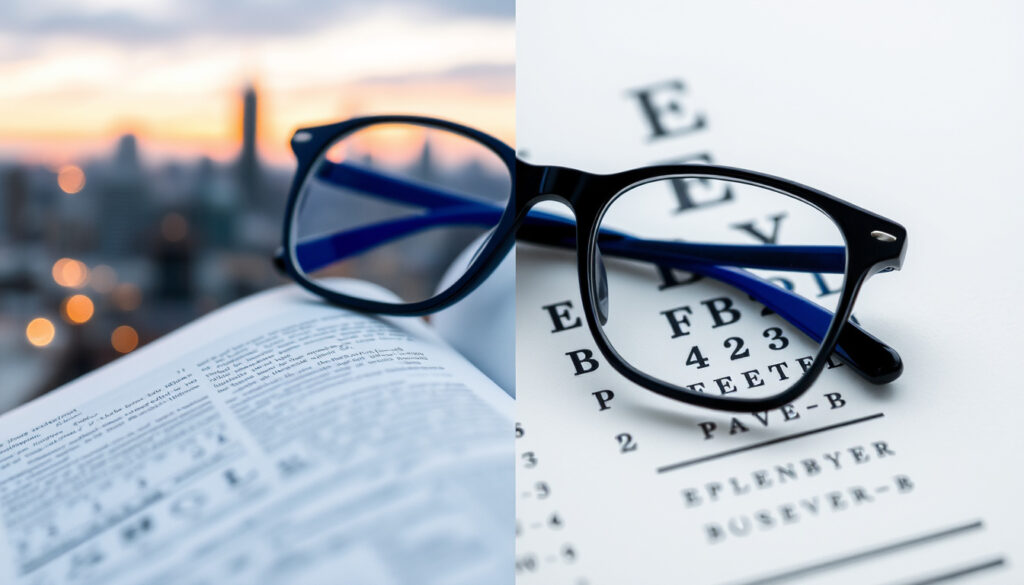
Long-Sighted vs Short-Sighted: Prescriptions, Symptoms & Treatments
A plus sign on your eyeglass prescription means long-sightedness, not short-sightedness. This guide decodes numbers like +0.25 and -0.50, explains how to read your prescription, and covers treatment options from glasses to surgery.
Global myopia prevalence: 28.3% of the world population (2020 estimate) ·
Global hyperopia prevalence: Approximately 10-20% of adults ·
Age of onset for long-sightedness: Often after age 40 due to presbyopia ·
Common driving restriction for short-sightedness: Visual acuity below 20/40 (6/12) requires corrective lenses ·
Prescription threshold for mild myopia: −0.25 to −0.50 diopters
Quick snapshot
- Myopia is measured in negative diopters (American Academy of Ophthalmology)
- Hyperopia is measured in positive diopters (AAO)
- Presbyopia is a natural age-related change after 40 (NHS)
- Reading glasses are positive lenses for near vision, not distance (Association of Optometrists)
- Exact global prevalence of undiagnosed hyperopia is unknown (PubMed Central study)
- Long-term effectiveness of myopia control methods (orthokeratology, atropine) still under study (PubMed Central study)
- Whether mild hyperopia in children always resolves without correction (PubMed Central study)
- NHS short-sightedness page last updated: 2017-10-23 (NHS)
- AAO prescription guide revised: 2023-04-18 (AAO)
- Children’s glasses FAQ updated: 2026-05-30 (Alder Hey NHS Foundation Trust)
- Increase in myopia control therapies for children
- Growing availability of multifocal contact lenses for presbyopia
- More AI-based autorefractors in high-street opticians for faster screening
Five key facts about the prevalence and thresholds that shape how we understand long-sighted vs short-sighted:
| Label | Value |
|---|---|
| Myopia prevalence | 28.3% globally (2020) |
| Hyperopia prevalence | ~10-20% of adults |
| Presbyopia onset | Around age 40-45 |
| Driving standard | 20/40 (6/12) visual acuity |
| Mild prescription threshold | +0.25 to +1.00 for hyperopia; −0.25 to −0.50 for myopia |
The implication: these thresholds determine whether you qualify for corrective lenses for driving or need glasses for daily tasks.
Is +0.25 short-sighted?
What does a +0.25 prescription mean?
- A plus sign (+) on the sphere (SPH) column of your prescription indicates hyperopia — long-sightedness, not short-sightedness (AAO).
- +0.25 diopters is the mildest measurable degree of long-sightedness. It means the eyeball is slightly too short or the cornea slightly too flat, causing light to focus just behind the retina (Association of Optometrists).
- Mild hyperopia often requires no correction for distance vision, but it can cause eyestrain during prolonged near work because the eye’s focusing muscle (ciliary muscle) works extra hard to compensate (Blackpool Teaching Hospitals NHS Foundation Trust).
How does +0.25 compare to other mild prescriptions?
- By contrast, a minus sign (−) indicates myopia. A value of −0.25 is the mildest measurable short-sightedness. The difference is fundamental: plus is long, minus is short (AAO).
- Pediatric guidelines classify low hyperopia as ≤ +2.00 D, moderate as +2.25 D to +5.00 D, and high as > +5.00 D (PubMed Central research). A +0.25 reading sits well inside the low range.
A +0.25 prescription means you are slightly long-sighted, not short-sighted. Most adults with this value won’t need glasses for everyday tasks, but they may notice that reading small print after a long day feels harder than it used to.
The implication: if someone tells you “+0.25 is short-sighted,” they are wrong. The plus sign locks the classification to hyperopia, and the number indicates how much correction the lens provides — not the severity of the eye condition itself.
How do you fix short and long-sightedness?
Glasses and contact lenses
- Myopia correction uses concave (diverging) lenses. These minus-power lenses spread light rays outward so the focal point lands on the retina instead of in front of it (NHS).
- Hyperopia correction uses convex (converging) lenses. Plus-power lenses bring light rays together to shift the focal point forward onto the retina (Association of Optometrists).
- Contact lenses work on the same optical principle but sit directly on the cornea, which can provide a wider field of clear vision (AAO).
Laser eye surgery (LASIK, PRK)
- LASIK reshapes the cornea using a femtosecond laser to create a flap, then an excimer laser sculpts the underlying tissue (AAO).
- PRK (photorefractive keratectomy) removes the outer corneal epithelium before reshaping — preferred for patients with thin corneas or dry eyes.
- Outcomes are well-documented: 96% of patients achieve 20/40 or better uncorrected vision after LASIK (PubMed Central meta-analysis).
Lens replacement surgery
- For patients over 45–50, lens replacement (refractive lens exchange) removes the natural lens and replaces it with an artificial intraocular lens (IOL) that corrects the refractive error (Association of Optometrists).
- This is the same procedure as cataract surgery, but performed before cataracts develop.
- Multifocal IOLs can correct both distance and near vision simultaneously, reducing the need for reading glasses.
Surgery is permanent. A patient who opts for laser correction for myopia may later develop presbyopia in their 40s and still need reading glasses. That is not a failure of the surgery — it is two separate conditions.
Why this matters: the choice between glasses, contacts, and surgery depends on age, prescription stability, corneal thickness, and personal tolerance for maintenance. There is no universal “best fix” for either condition.
Are reading glasses long or short-sighted?
Why reading glasses are for presbyopia, not hyperopia
- Reading glasses are positive (plus) lenses designed to compensate for presbyopia — the age-related loss of the eye’s ability to focus on near objects (Association of Optometrists).
- Presbyopia is caused by the lens inside the eye stiffening, not by the eyeball being too short. That distinguishes it from hyperopia, which is a refractive error of the eyeball shape.
- Many people confuse the two because both are corrected with plus lenses. But a person with hyperopia may still need a separate plus-powered reading addition once presbyopia sets in (NHS).
Difference between reading glasses and distance glasses
- Distance glasses correct refractive error so light focuses properly on the retina at far distances. Reading glasses only work for near vision (~30-40 cm).
- Over-the-counter reading glasses from a pharmacy have no distance correction. They are simply magnifiers (AAO).
- A person who is naturally short-sighted may still need reading glasses after age 40, because their distance myopia is separate from the near-focus failure of presbyopia (Blackpool Teaching Hospitals).
If you are short-sighted and buy over-the-counter reading glasses, you are still uncorrected for distance. You would be sharp up close and blurry at 5 metres — the exact opposite of what you need for driving.
The trade-off: reading glasses are not a substitute for a prescription. They are a single-purpose tool for near work, and they become necessary for nearly everyone over 45, regardless of their distance prescription.
Can I drive if I’m short-sighted?
Legal vision requirements for driving
- In the UK, the minimum standard is 20/40 (6/12) on the Snellen chart with both eyes open, with or without glasses (NHS driving advice).
- Drivers must also have a horizontal visual field of at least 120 degrees (Association of Optometrists).
- If your corrected visual acuity is 20/40 or better, you meet the legal standard. Below that, you must wear corrective lenses while driving. Some drivers need a “restriction code 01” on their licence — meaning “must wear corrective lenses” (UK Government website).
What to do if your vision doesn’t meet the standard
- If you fail the number plate test at 20 metres, you cannot drive until you obtain glasses or contacts that bring your acuity to the required level (NHS).
- A spectacle prescription of −1.00 diopters or stronger typically indicates uncorrected acuity below 20/40, so you would likely need lenses for driving (AAO).
- Laser surgery can remove the requirement for corrective lenses if post-surgery acuity meets the standard without glasses. But the DVLA must be notified, and a specialist may need to confirm the result (UK Government).
The implication: a short-sighted person with a mild prescription of −0.25 or −0.50 may pass the number plate test without glasses. Anyone with moderate myopia (−1.00 or worse) almost certainly needs lenses while driving.
What age does long-sightedness usually develop?
Hyperopia in children
- Farsightedness (hyperopia) can be present from birth. Many babies are born hyperopic because their eyeballs are short (Alder Hey NHS Foundation Trust).
- As the eye grows during childhood, mild hyperopia often self-corrects. By age 6–7, the eyeball length typically normalises (Blackpool Teaching Hospitals).
- But if the hyperopia is high (>+2.00 D), it may persist and require glasses to prevent squinting, eyestrain, or amblyopia (“lazy eye”) (PubMed Central pediatric guidelines).
Presbyopia after 40
- Presbyopia typically begins around age 40–45. The lens loses elasticity and can no longer change shape to focus on near objects (Association of Optometrists).
- Symptoms: needing to hold reading material at arm’s length, eye fatigue when reading, and headaches after close work.
- Presbyopia is universal — it happens to everyone, regardless of whether they were previously short-sighted, long-sighted, or had perfect vision (AAO).
When to see an optician
- The NHS recommends a full eye test every two years for all adults (NHS).
- Children should have their first comprehensive eye exam at age 3–4, or earlier if there is a family history of strabismus (squint) or amblyopia (Alder Hey NHS Foundation Trust).
- If you suddenly notice near vision becoming blurry after age 40, you likely have presbyopia — not worsening hyperopia.
A 45-year-old who was never long-sighted can still need reading glasses. That is not a new case of hyperopia — it is presbyopia. Mistaking the two leads to anxiety over whether your eyes are “getting worse” when you are actually experiencing a perfectly normal age-related change.
The pattern: long-sightedness in children usually resolves. Long-sightedness in adults over 40 is almost certainly presbyopia. The two conditions have different causes, different treatments, and different prognoses.
“Short-sightedness (myopia) is where the eyes focus on near objects clearly but distant objects are blurry.”
NHS (UK national health authority)
“Long-sightedness (hyperopia) is where the eyes can focus on distant objects clearly but struggle with close objects.”
American Academy of Ophthalmology (professional medical society)
“Long-sightedness can be described as the eye being too small or not powerful enough, which shifts focus behind the retina.”
Blackpool Teaching Hospitals NHS Foundation Trust (NHS paediatric service)
The evidence from both sides of the Atlantic is consistent: the fundamental difference is optical, not subjective. A prescription’s sign (+ or −) is the single most reliable indicator of whether you are long- or short-sighted.
Related reading: Ray-Ban Meta Glasses NZ: Buy, Prices & Law
mft.nhs.uk, youtube.com, alderhey.nhs.uk, nhs.uk, 111.wales.nhs.uk, moorfields.nhs.uk
Frequently asked questions
What is the main difference between myopia and hyperopia?
Myopia (short-sightedness) means the eyeball is too long or the cornea too steep, so light focuses in front of the retina — distance vision is blurry. Hyperopia (long-sightedness) means the eyeball is too short or the cornea too flat, so light focuses behind the retina — near vision is blurry.
Can you be both short-sighted and long-sighted at the same time?
Strictly speaking, no — your overall refractive error is either myopic or hyperopic. However, presbyopia (age-related near-focus loss) can develop on top of myopia, so a person can be distance-short and near-long simultaneously. That’s why bifocals or progressives exist.
Is long-sightedness more common in children or adults?
Hyperopia is very common at birth — most babies are hyperopic. As the eye grows, it usually self-corrects by age 6–7. In adults, “long-sightedness” after 40 is almost always presbyopia, not hyperopia.
Do I need glasses if I am slightly long-sighted?
Not necessarily. Many people with +0.25 to +0.75 diopters have no symptoms because the eye’s focusing muscle compensates. But if you experience eyestrain, headaches, or blurred near vision when tired, glasses can help.
What does astigmatism have to do with being short or long-sighted?
Astigmatism is a separate condition where the cornea is shaped more like a rugby ball than a football, causing blur at all distances. It can coexist with either myopia or hyperopia. Your prescription will show a cylinder (CYL) value if astigmatism is present.
How often should I get my eyes tested?
The NHS recommends every two years for most adults. Children should have their first exam at age 3–4. If you have diabetes, glaucoma in your family, or a sudden change in vision, test annually.
Can long-sightedness be reversed naturally?
No — refractive errors are structural: the eyeball shape or lens flexibility cannot be changed naturally. Corrective lenses, laser surgery, or lens replacement are the only proven interventions.
Related reading: Ray-Ban Meta Glasses NZ: Buy, Prices & Law — Explore how modern eyewear integrates prescription lenses with smart features.
More related posts
 West Auckland Internet Outage: Chorus Map & Vandalism Facts
 Parents Visitor Visa NZ 2025: Options, Costs & Eligibility
 Tung Tung Tung Sahur: Meaning & TikTok Meme Hi tory
 Number 1 Shoe Warehouse: Number One Shoes NZ Deals
 Things to Do in Whangamata: Beaches, Adventures & More
 Chicken Wrapped in Bacon: Baking Time, Name, and Serving Ideas
 Cavius Smoke Alarm NZ: Beeping Fixes & Buying Guide
 Cast of The Lincoln Lawyer TV Series – Full Season 4 Guide
