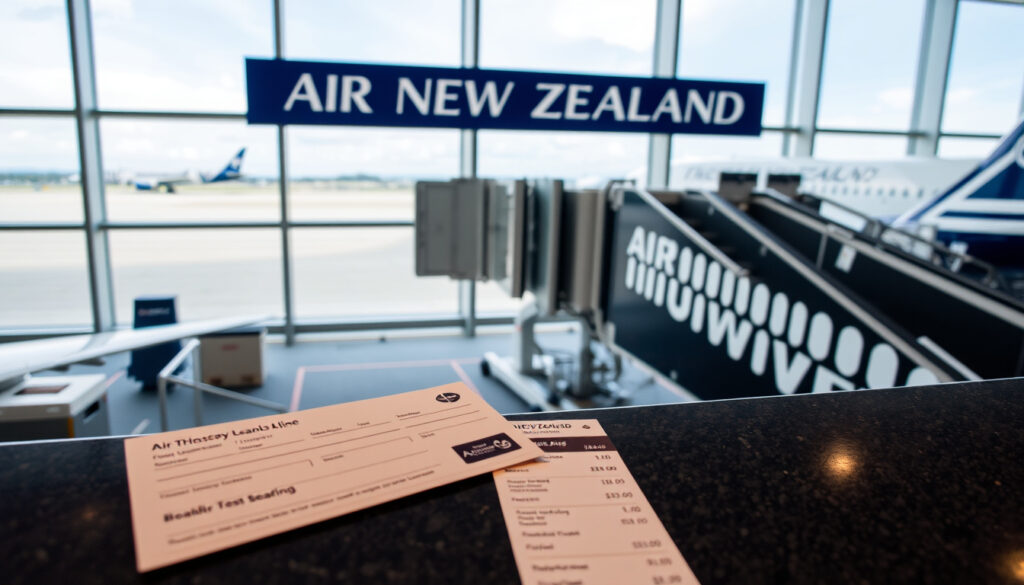
Air New Zealand Boarding Procedures: What You Need to Know
Standing at the gate with your boarding pass ready, the last thing you want is a last-minute surprise about your carry-on. Air New Zealand’s boarding procedures have become a frequent topic among travelers — not because they’re complicated, but because the rules are enforced more consistently than many expect. With a recent security incident prompting a procedural review and no major policy changes announced, here’s a fact-checked look at what actually happens from check-in to seat.
Check-in closure time: 90–120 minutes before departure ·
Recent procedural review date: February 2026 ·
Common boarding method: Group boarding (priority, zones)
Quick snapshot
- Check-in closes 30 min before domestic departures and 90–120 min before international flights (Air New Zealand (official check-in page))
- Economy carry-on limit is 7 kg, max dimensions 55×40×23 cm (Air New Zealand (carry-on policy))
- Bag drop closes 30 min domestic, 60 min international, 75 min from select ports (Air New Zealand Singapore (check-in FAQs))
- Whether the B787 boarding pattern differs meaningfully from other aircraft types in practice
- Enforcement consistency of carry-on weight limits across all fare classes and routes
- February 2026: Passenger boarded without a valid passport on a Fiji-bound flight, triggering an internal review (Aviation A2Z (aviation news outlet))
- Air New Zealand stated procedures were followed; no major rule changes announced as of early 2026
Six key facts, one pattern: boarding readiness depends on understanding three separate deadlines — check-in, bag drop, and gate closure — each with different lead times depending on your route and fare.
The table below lays out the key figures passengers need to know before arriving at the airport.
| Check-in closure (international) | 90–120 minutes before departure |
|---|---|
| Check-in closure (domestic) | 30 minutes before departure |
| Carry-on weight limit (economy) | 7 kg (typical, may vary by route) |
| Boarding groups | 4 zones (priority, zones 1–3) |
| Recent security incident date | February 2026 |
| Boarding method for B787 | Zone boarding (exact pattern not publicly detailed) |
The implication: each row represents a distinct deadline or allowance that can trip up even experienced travelers if overlooked.
How strict is Air New Zealand with carry-on?
Carry-on size and weight limits
- Economy passengers: one carry-on bag up to 7 kg plus one small personal item (Air New Zealand (official baggage page))
- Maximum dimensions: 55 cm × 40 cm × 23 cm, total linear dimensions up to 118 cm (Air New Zealand (carry-on specifications))
- A large laptop bag counts as your carry-on bag under current rules (Air New Zealand (baggage help))
- Premium Economy and Business Premier: two pieces of carry-on luggage included (Air New Zealand (Premium Economy page))
- Koru Gold, Koru Platinum, Koru Black, and Star Alliance Gold: two bags plus one small item (Air New Zealand (carry-on baggage))
Enforcement at boarding gate
Passengers report that cabin crew and gate agents regularly weigh and measure bags before boarding. A user on Reddit noted that the boarding method influences whether they choose to check a bag or use a sports bag as a carry-on (r/newzealand (community forum)). The airline’s official policy states that Economy includes one carry-on up to 7 kg, but enforcement urgency reportedly spikes on full flights.
At the gate, “personal item” means something small — a handbag or slim backpack. A stuffed tote or a full-size backpack that exceeds 7 kg will likely be flagged, even if it fits the bin.
Passenger experiences and complaints
Frequent complaints on travel forums center on inconsistency: some passengers report being weighed at the gate, others not. The airline’s baggage help page confirms that every passenger can bring at least two items on board — one carry-on and one personal item — but the key ambiguity is enforcement: the 7 kg limit is stated, but whether it’s measured depends on the crew and the flight load.
How does Air New Zealand do boarding?
Boarding zones and priority groups
- Zone 1 (Priority): Business Premier, Elite, Gold, and Silver members, plus passengers needing assistance
- Zone 2: Premium Economy, Koru members, and Star Alliance Gold
- Zone 3: Economy passengers seated in rows toward the rear
- Zone 4: Remaining economy passengers seated forward
This zone system is designed to reduce congestion in the aisle and speed boarding for aircraft with a single aisle or twin-aisle configuration. On the B787, the process follows the same zone logic, though exact patterns can vary by crew (Air New Zealand (long-haul experience)).
The pattern: your zone assignment directly dictates how much overhead bin space you’ll find available when you reach your seat.
Steps from gate call to seat
- Gate agent announces boarding zone and calls priority passengers.
- Passengers present boarding pass and passport (for international flights) at the gate.
- Gate agent scans pass; passengers proceed down the jet bridge or air stairs.
- Crew members greet at the aircraft door and direct passengers to their aisle.
- Carry-on bags are stored overhead or under the seat; cabin crew may recheck oversized or overweight items.
The trade-off: zone boarding is orderly, but if you’re in Zone 4 and overhead bins fill up, your carry-on may be gate-checked regardless of size.
A passenger in Zone 4 with a full-size carry-on faces the highest risk of gate-checking. Checking a bag at the counter costs nothing if you have a fare that includes it; gate-checking costs time and inconvenience.
What is the 45 minute rule at the airport?
Check-in cut-off times for domestic flights
The “45-minute rule” is one of the most misunderstood aspects of Air New Zealand’s procedures. For domestic flights within New Zealand, check-in closes 30 minutes before departure, not 45 (Air New Zealand (domestic check-in)). The 45-minute figure likely originates from baggage drop deadlines or from other carriers’ policies.
45-minute rule for baggage drop
Bag drop closes 30 minutes before domestic departures, 60 minutes before international departures, and 75 minutes before flights from Sydney, London Heathrow, all US airports, and all Canadian airports (Air New Zealand Singapore (check-in FAQs)). For the 45-minute threshold specifically, some sources cite it as the final boarding call for short-haul domestic turboprop flights on ATR72 and Q300 aircraft, where the flight itself may be under 45 minutes — during which only water and a snack are offered (Air New Zealand (domestic experience)).
Consequences of missing the deadline
Miss the check-in closure and you will not be boarded. For domestic flights, if you haven’t checked in by 30 minutes before departure, you lose your seat. For international flights, the window is wider — 90 to 120 minutes — but also inflexible. Passengers connecting to an international flight, needing special assistance, or travelling with children travelling alone must check in 60 minutes before domestic departure (Air New Zealand (domestic check-in)).
The pattern: the rules are tightest on departure, not on arrival. Missing the bag drop by two minutes means your bag doesn’t fly, even if you’re at the gate.
What baggage rules apply during Air New Zealand boarding?
Carry-on rules versus checked baggage
- Economy and The Works fares: one carry-on (7 kg) + one checked bag on certain fares
- Seat-only fares: one carry-on only, no checked baggage included (Air New Zealand (domestic experience))
- Checked bag weight limits vary by route; excess baggage fees apply over 23 kg per bag
Restricted items in carry-on include liquids in containers larger than 100 ml, sharp objects, and aerosols over a certain volume. Air New Zealand’s restricted items page confirms that liquids, aerosols, gels, and pastes must be in individual containers no larger than 100 ml, and up to two power banks per person are allowed provided each does not exceed 100 Wh.
Special items and excess baggage policies
Sports equipment, musical instruments, and medical devices follow separate rules. Prepaying for extra bags is cheaper than paying at the airport, and is allowed up to 90 minutes before an international flight and up to 30 minutes before a domestic flight (Air New Zealand (baggage help)).
Recent changes following security incident
In February 2026, a passenger boarded an Air New Zealand flight to Fiji without a valid passport. The airline conducted an internal procedural review and stated that “we are confident that established boarding procedures were followed” (Aviation A2Z (aviation news outlet)). No major baggage rule changes were announced following the review.
The February 2026 incident did not trigger new restrictions, but it may affect how rigorously passport checks are performed at the gate — especially for international flights where document scanning is already required.
How do Air New Zealand boarding procedures differ for international flights?
International check-in requirements
For international flights, check-in closes 90 or 120 minutes before departure, depending on the destination (Air New Zealand (international check-in guide)). Online and mobile check-in opens 24 hours before departure and closes 90 minutes before international flights (Air New Zealand Singapore (check-in FAQs)). Passport details must be entered during online check-in for most international routes.
Document checks and passport scanning
At the airport, international passengers must present a valid passport at check-in and may have additional document verification at the gate. The airline advises arriving well before check-in closes, especially when travelling with children or anyone needing special assistance.
Differences in boarding group assignment
Boarding groups for international flights follow the same zone system as domestic — priority, zones 2 through 4. However, on long-haul routes, premium cabins (Business Premier and Premium Economy) get earlier boarding. Passengers connecting from domestic to international services must allow extra time for bag drop and document checks.
The implication: international boarding requires more lead time and one additional layer of document verification, but the zone structure itself is consistent across the network.
Step-by-step: Air New Zealand boarding process
- Check in online — opens 24 hours before departure; enter passport details for international flights.
- Arrive at the airport — domestic: 45 minutes before; international: 2–3 hours before.
- Drop bags at the counter or self-service kiosk before bag drop deadline.
- Proceed through security and make your way to the departure gate.
- Listen for boarding call — gates typically open 30–45 minutes before departure.
- Present boarding pass and passport (international) at the gate.
- Board by zone — priority passengers first, then zones 2 through 4.
- Store carry-on overhead or under seat; gate agents may recheck oversized items.
- Settle in and follow crew instructions for departure.
The pattern: this sequence works for both domestic and international flights, but the timing windows differ significantly at steps 2, 3, and 6.
Timeline: Key events in Air New Zealand boarding procedures
- February 2026 — Passenger boarded Air New Zealand flight to Fiji without a valid passport, prompting an internal procedural review. The airline stated procedures were followed, and no major policy changes were announced (Aviation A2Z (aviation news outlet)).
- Ongoing — Carry-on enforcement continues at gate with regular weighing and measuring reported by passengers.
Upsides
- Clear zone system reduces aisle congestion
- Online check-in saves time for all passengers
- Generous carry-on allowance for premium passengers and status members
- Bag drop deadlines are published and consistent
Downsides
- Carry-on enforcement can feel inconsistent at the gate
- Zone 4 passengers risk overhead bin space running out
- International check-in deadlines are longer than many expect (90–120 min)
- A large laptop bag counts as the carry-on — no separate allowance
Confirmed facts vs what’s unclear
Confirmed facts
- Check-in closes 30 minutes before domestic departures and 90–120 minutes before international departures (Air New Zealand (domestic check-in))
- Air New Zealand conducted a review after the February 2026 incident and stated procedures were followed (Aviation A2Z (aviation news outlet))
- Economy carry-on limit is 7 kg, max dimensions 55×40×23 cm (Air New Zealand (carry-on policy))
- Bag drop closes 30 minutes domestic, 60 minutes international, 75 minutes from select ports (Air New Zealand Singapore (check-in FAQs))
What’s unclear
- Whether the B787 boarding method differs from other aircraft in practice
- Exact carry-on weight limit enforcement consistency for all fare classes
- Whether the February 2026 incident will lead to any future procedural changes
Quotes from travelers and the airline
“We are confident that established boarding procedures were followed.”
— Air New Zealand spokesperson, on the February 2026 Fiji incident (Aviation A2Z)
“The Air NZ boarding method will determine whether I check a bag or use a sports bag as a carry on.”
— Reddit user, r/newzealand (community forum)
For travelers weighing their options, the pattern is clear: if you’re in a seat-only economy fare and flying from a busy hub, the boarding zone you’re assigned affects whether your carry-on makes it to the cabin or gets gate-checked.
airnewzealand.com, airnewzealand.com, airnewzealand.com, airnewzealand.com, nine.com.au, airnewzealand.com, airnewzealand.eu, airnewzealand.com
Frequently asked questions
Does Air New Zealand offer priority boarding?
Yes. Priority boarding is available for Business Premier passengers, Elite, Gold, and Silver Airpoints members, and Star Alliance Gold members. They board in Zone 1.
Can I bring a personal item and a carry-on bag on Air New Zealand?
Yes. Every passenger can bring at least two items on board: one carry-on bag and one small personal item, such as a handbag or a slim backpack (Air New Zealand (baggage help)).
What happens if I miss the check-in deadline for an Air New Zealand flight?
If you miss check-in closure (30 min domestic, 90–120 min international), you will not be boarded. For domestic flights, missing the 30-minute deadline means your seat may be released.
Is there a difference in boarding for domestic vs international Air New Zealand flights?
The zone system is the same, but international flights require passport scanning at check-in and may have earlier closure times (90–120 minutes). Bag drop deadlines are also longer for international services (Air New Zealand (international check-in)).
How do I find my boarding group on Air New Zealand?
Your boarding group is printed on your boarding pass. It will show a zone number (Zone 1–4) or “Priority”. Passengers with premium fares and status members are assigned lower zone numbers.
What should I do if my carry-on is too heavy at the Air New Zealand gate?
You may be asked to check the bag at the gate. Prepaying for a checked bag online is cheaper than paying at the airport. You can prepay extra bags up to 30 minutes before domestic flights and 90 minutes before international flights (Air New Zealand (baggage help)).
Are there any recent changes to Air New Zealand boarding rules in 2026?
As of early 2026, no major boarding rule changes have been announced following the February 2026 incident. The airline reviewed its procedures and confirmed they were followed, but no policy updates were issued (Aviation A2Z (aviation news outlet)).
For the traveler flying economy on a full flight, the choice is clear: check the bag at the counter, or risk gate-checking and waiting at the carousel on arrival.
Related reading: Air New Zealand Airpoints Guide · Can You Carry Liquids on Domestic Flights NZ? Rules
More related posts
 Photoelectric Smoke Alarms NZ: Rules, Comparisons & Top Picks
 Those Who Wish Me Dead: Plot, Cast, Reviews & Where to Watch
 NYC to DC Train Times: Fares, Schedules & Best Routes 2025
 Happy Mother’s Day Wishes: Heartfelt Messages & Quotes
 Flights Auckland to Wellington: Times, Prices, Train vs Drive
 LG 65 Inch TV: Best Models, Prices & Reviews Ireland
 Mince Pie Recipe NZ: Savory Kiwi Mince & Cheese Pie
