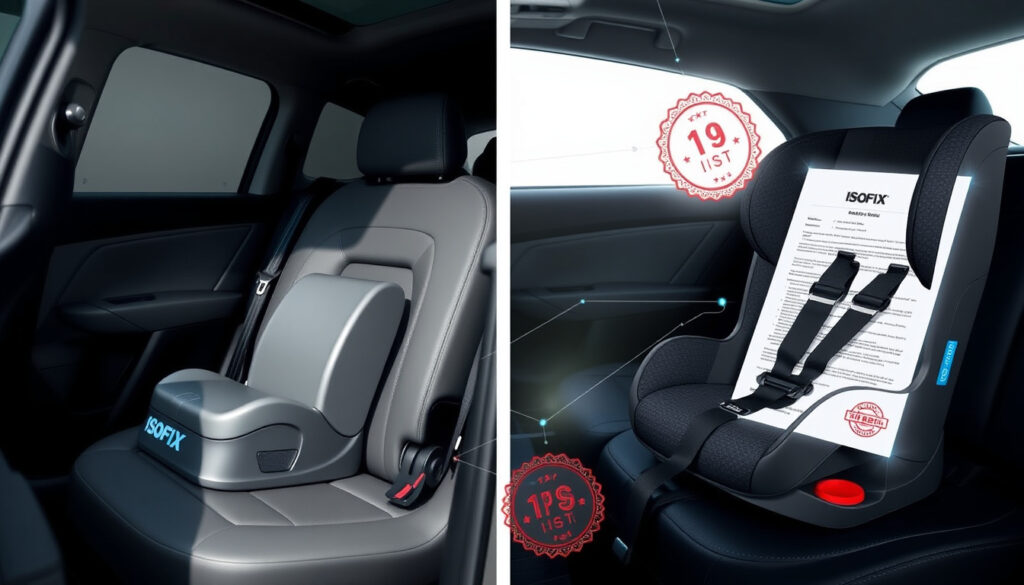
Maxi-Cosi Car Seats: i-Size vs ISOFIX 2026 Legal Facts
Choosing a car seat for a small child often feels like a maze of acronyms, and “i-Size” and “ISOFIX” are the two you’ll meet most. The first time you hear that ISOFIX isn’t strictly a legal requirement in every vehicle, it can be a genuine surprise — you’d assume the safest system would be mandatory. This article clarifies exactly what the law says about ISOFIX and takes a close, fact-checked look at how the Maxi-Cosi range fits into the current i-Size landscape, which is defined under UN/ECE Regulation No 129.
Key Facts at a Glance
- ISOFIX is the physical attachment system; i-Size is a safety regulation (UN R129) that often uses ISOFIX points but adds stricter requirements.
- ISOFIX is not a blanket legal requirement for all passenger cars, but if a seating position is i-Size approved, the car must have the ISOFIX anchorages.
- EU Regulation No 14 confirms that ISOFIX reduces incorrect installation risk compared to seat belts—a primary reason i-Size is seen as a safety step forward.
Regulation: UN/ECE R129 (i-Size) · Anchorage: ISOFIX (Reg. 14) · Alternative: Seat belts · Applicability: i-Size positions mandatory in new car models
We’ll dissect the technicalities behind the EU Regulation No 14, examine why i-Size is generally considered safer, and give you a candid snapshot of Maxi-Cosi’s offerings, including their strengths and a few acknowledged caveats. Whether you’re comparing the latest models or just trying to find a seat that fits your car, the following research-backed breakdown (drawn from official EU regulations and manufacturer FAQs) gives you the clarity you need before handing over your cash.
Before we get to the Maxi-Cosi specifics, it’s worth understanding that ISOFIX is an installation method. It involves two rigid anchor points built into the car’s frame, which clip onto a child seat’s base. This contrasts with using a vehicle’s seat belt to hold the seat in place—a method that is more prone to human error during installation.
The Legal Twist: What the Regulation Text Actually Says
The truth, per the EUR-Lex UN/ECE Regulation No 14 text (Tier 1 source), is more subtle. The regulation does not demand every car seat position be fitted with ISOFIX. However, it mandates that any seating position designated by the manufacturer as “i-Size suitable” must be equipped with ISOFIX anchorages that meet specific dimensional and strength requirements. This distinction—between a universal legal requirement and a conditional one—is what creates the confusion.
In short, ISOFIX isn’t universally mandatory on all seats, but the moment a car maker wants to claim an i-Size position, the ISOFIX hardware becomes obligatory. This is a legal distinction that many buyers find confusing, but it’s crucial: you don’t choose ISOFIX vs i-Size; you choose whether a seat complies with the older R44 standard or the newer R129 (i-Size) standard.
Maxi-Cosi’s range illustrates this perfectly. Their range includes models like the Pearl Pro and Mica, which are designed around this newer regulation. These seats are explicitly marketed as i-Size compliant, meaning they are engineered to work with the ISOFIX anchorages found in cars that offer i-Size positions.
Why i-Size is Seen as the Safer Choice
Traditional ISOFIX seats often require the car seat to be tethered, which leaves room for user error. The i-Size regulation addresses this by mandating a support leg and a five-point harness for most models, reducing the chance of incorrect installation. The Maxi-Cosi Germany i-Size FAQs explain that i-Size was introduced alongside the older ECE R44 as a new safety standard, not just an alternative. It adds requirements for side-impact protection and a stricter crash test protocol.
It just means the new models, like the ones Maxi-Cosi sells, are often a blend of better energy absorption and easier setup—which is why they’re recommended in independent tests.
| Feature | i-Size (R129) | Traditional ISOFIX (R44) |
|---|---|---|
| Installation | Support leg is mandatory for most i-Size models | Top tether or support leg optional, varies |
| Crash Test | Must pass side-impact and rear-impact tests | Primarily frontal and rear tests |
| Fitment | Based on child height | Based on child weight |
| Error Indicators | Visual/audible click indicators standard | Not always present |
What this means for you: if you’re buying a high-end Maxi-Cosi i-Size seat, you’re buying into a system designed for minimal error. The installation is less forgiving to get wrong, which is a significant safety advantage in the real world where many seats are installed incorrectly.
Practical Considerations and the Reality of Installation
While the law says many cars are suitable, the reality of installation can vary. ISOFIX anchorages are usually located between the backrest and the seat cushion, but not all cars have visible guides. Some manufacturers hide them under a flap or require you to push the seat cushion forward. This can make attaching the seat’s connectors more fiddly, especially in compact cars.
But if your vehicle doesn’t have exposed ISOFIX points and the seat requires a top tether, you might find that the tether hooks don’t align with the car’s rear shelf anchors leading to more time on your knees. Always cross-reference your car’s manual with the car seat’s fitment list.
What about the headrest adjustment? It’s not just a cosmetic head pillow; it’s part of the safety system. An i-Size seat must be reclined while in the base, and Maxi-Cosi has a dial on the base to do this. This recline is not just for comfort; it ensures the child’s head stays in the protected zone during a collision.
Let’s be candid about the catch. The specifications for i-Size seats are set by the EU, but the EUR-Lex UN/ECE Regulation No 14 text notes that seating positions must accommodate a specific “support-leg assessment volume” and certain ISO fixture sizes. This means not every ISOFIX-equipped car will fit every i-Size seat, even if both are compliant. This is where Maxi-Cosi’s Familyfix 5 base shines—it’s a single base that fits multiple seats, so if you plan on two kids, you only buy one base.
You’ll only find out if the combination works by checking the official vehicle list which is usually published in the car’s manual or on the manufacturer’s website. A seat that fits poorly in one car might be a perfect fit in another.
Frequently Asked Questions
Is ISOFIX a legal requirement, or is it optional?
It’s not mandated globally for every vehicle. Per EU Regulation No 14, ISOFIX becomes a legal requirement only when a seating position is designated as ‘i-Size’. If the seat position isn’t marked i-Size, there’s no legal obligation for the anchor points to exist.
Can I use a Maxi-Cosi i-Size seat in an older car?
Yes, you can, provided the car has ISOFIX anchorages and is listed as compatible in the seat’s vehicle list. Many older cars (post-2006) have ISOFIX points but may not have i-Size marked positions. That doesn’t necessarily preclude fitment; it just means you must verify with the manufacturer’s fitment tool or manual. For non-i-Size seats, the safest setup is to follow the manual exactly; if the seat is i-Size approved, it often includes a support leg which adds protection.
Is Maxi-Cosi a good car seat?
Maxi-Cosi’s top models frequently score well in ADAC tests, but no single brand wins every size class. The brand is consistently reliable in crash tests and offers a wide range of seats, making it a solid choice for most parents. However, the best seat is the one that fits your car and your child correctly.
How long can babies be in a Maxi-Cosi car seat?
Babies should not be in a car seat for longer than 2 hours at a time without a break, according to NHS guidelines. This is a positioning and airway safety concern, not a structural one. The seat itself is safe for the duration of a car journey, but a newborn’s airways can be compressed if the seat is used outside of the vehicle or for extended periods with poor recline.
The Future of Child Seat Regulations
The future of car seat safety is anchored in the ISOFIX system, and Maxi-Cosi has bet heavily on i-Size. The trend is clear: side-impact protection is getting stricter, and the integration of the seat with the car’s own airbag and crash-avoidance systems is on the horizon. Some manufacturers are even exploring integrated airbags in child seats, though that’s still in the research phase.
Yet, the faithful takeaway is this: a top-tier Maxi-Cosi seat is only as good as your car’s ISOFIX points. Before you purchase, verify your car’s age and features against the official UN R129 compliance list, and always, always read the part of the car manual about child seat anchorage. The safest seat on the market is the one that is installed correctly every single time.
More related posts
 5 Second Rule Game: Rules, How to Play & Questions
 Shaver Shop Near Me – Store Locator, Hours & Directions
 Minecraft Movie Box Office: Hit or Flop? Gross & Milestones
 How to Get Rid of Fruit Flie in Kitchen: Fa t DIY Trap
 Bring Her Back Movie: Is It Scary? Plot & Grapefruit Meaning
 Westland Fiordland Heavy Rain: Orange Warnings and Climate Facts
 How to Reduce Cholesterol: Diet and Lifestyle Tips
 Nelson Things to Do: Free & Budget-Friendly Picks
