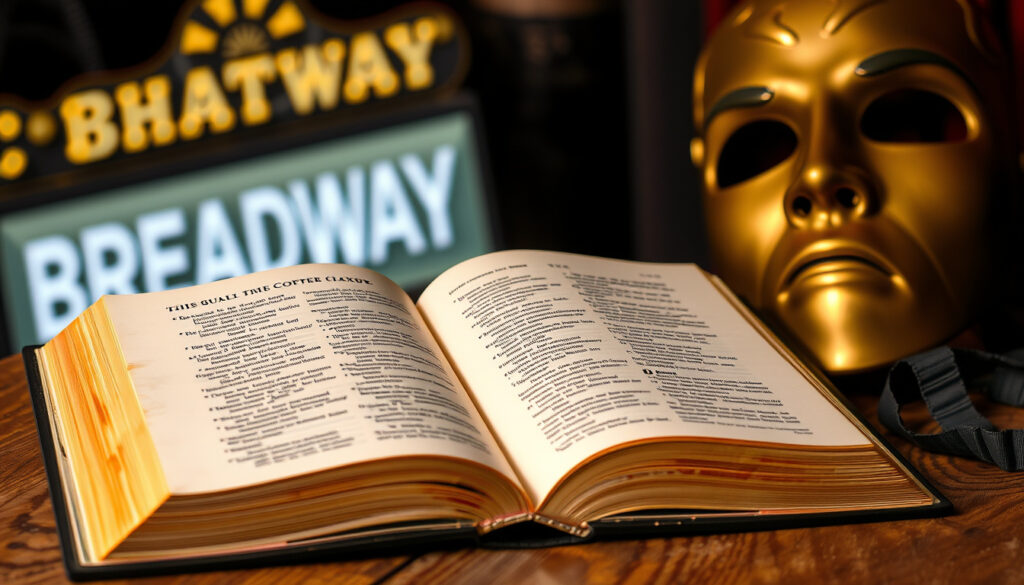
The Book of Mormon: Sacred Text & Broadway Musical
There’s a name that appears on the cover of a sacred scripture and on the marquee of a Broadway theater—and they are not the same thing. The Book of Mormon serves as a central text for millions of Latter-day Saints (read more: The Book of Mormon (LDS scripture)), while a satirical musical with the same name (see The Book of Mormon (Broadway musical)) has become one of the most awarded productions in theater history. This article explains what the religious book actually says, how it differs from the Bible, why many Christians do not accept it, and how the musical adaptation came to life.
Publication year of the Book of Mormon: 1830 ·
Languages translated into: 115+ ·
Copies distributed (estimated): over 192 million ·
Tony Awards won by the musical: 9 ·
Church membership worldwide (approx.): 17 million
Quick snapshot
- The Book of Mormon was first published in 1830 (Wikipedia article).
- The musical opened on Broadway in 2011 and won 9 Tony Awards (Official Broadway musical site).
- LDS church expects sexual abstinence before marriage (LDS Church official website).
- The exact historical population of the civilizations described in the Book of Mormon is not supported by mainstream archaeology (ReligionFacts website).
- Whether the musical offends LDS members is subjective and varies. (ReligionFacts website)
- 1823: Joseph Smith reports angel Moroni’s visit.
- 1830: First publication of the Book of Mormon.
- 2011: Premiere of The Book of Mormon musical.
- Continued debate over archaeological evidence for the Book of Mormon’s historicity.
- The musical continues its run and international tours.
- LDS church maintains its doctrinal position while adapting to cultural shifts.
Five key facts, one pattern: the Book of Mormon exists in two distinct worlds—one sacred, one satirical—and each has its own origin, purpose, and audience.
| Attribute | Religious Text | Musical |
|---|---|---|
| First published/premiered | 1830 | 2011 |
| Author/creator | Joseph Smith (translator) | Trey Parker, Matt Stone, Robert Lopez |
| Purpose | Sacred scripture, testament of Jesus Christ | Satirical entertainment, commentary on religion |
| Audience | Latter-day Saints and investigators | General theatergoers, fans of comedy |
| Cultural impact | Core identity for 17 million members | 9 Tony Awards, global tours |
The implication: the same name points to two completely different products—one treated as divine revelation, the other as a deliberately provocative Broadway show.
What is the Book of Mormon mainly about?
The Book of Mormon is a record of God’s dealings with ancient inhabitants of the Americas, according to Latter-day Saint belief. It is considered another testament of Jesus Christ alongside the Bible (FAIR Latter-day Saints website). The narrative covers approximately 600 BCE to 421 CE and includes the writings of prophets such as Nephi, Mormon, and Moroni.
Summary of the Book of Mormon narrative
- It begins with a family leaving Jerusalem around 600 BCE and traveling to the Americas.
- It describes the rise and fall of two major civilizations: the Nephites and the Lamanites.
- Central to the book is a visit by Jesus Christ to the Americas after his resurrection.
Key figures and events
- Lehi and Nephi: early prophets who lead the migration.
- Mormon: the prophet-historian who compiled the record.
- Moroni: the last prophet who buried the plates and later appeared to Joseph Smith.
Why this matters: the Book of Mormon provides the foundation for LDS theology and identity, but its historical claims remain unverified by mainstream archaeology.
Do Mormons believe in Jesus?
Yes. Latter-day Saints believe Jesus Christ is the Son of God, the Savior of the world, and the central figure of both the Bible and the Book of Mormon (LDS Church official website). They affirm his Atonement, Resurrection, and Second Coming.
LDS view of Jesus Christ
- Jesus is a separate being from God the Father (distinct persons within the Godhead).
- His Atonement covers all humanity, but salvation requires faith, repentance, and ordinances.
- The Book of Mormon contains explicit teachings about Jesus, including his post-resurrection visit.
Differences from mainstream Christian theology
- Mainstream Christianity holds to the Trinity (one God in three persons); LDS teaches three separate beings.
- LDS doctrine includes the possibility of exaltation—becoming like God—which many Christians reject.
- The Book of Mormon is considered additional scripture, while most Christians see the Bible as closed.
Latter-day Saints call themselves Christians and center their worship on Jesus, but their view of the Godhead and additional scripture puts them outside the Nicene Creed tradition that defines mainstream Christianity.
The trade-off: affirming Jesus while adding extra-biblical revelation creates a theological gap that many traditional Christians cannot bridge.
How is the Book of Mormon different from the Bible?
The Bible is a compilation of ancient Near Eastern texts composed over centuries, while the Book of Mormon claims to be a record of ancient Americans translated by Joseph Smith from golden plates (Encyclopaedia Britannica).
Origin and translation
- The Bible: multiple authors, languages (Hebrew, Aramaic, Greek), transmitted through manuscript tradition.
- The Book of Mormon: claimed translation from “Reformed Egyptian” via seer stones, published in 1830.
Geographical setting
- Bible: Middle East (Israel, Egypt, Mesopotamia, etc.).
- Book of Mormon: the Americas (specific locations not identified by LDS church).
Doctrinal additions
- The Book of Mormon introduces unique doctrines: baptism for the dead (implied), three degrees of glory, and the idea that humans can become gods.
- It also includes the concept of a “Great Apostasy” followed by a restoration through Joseph Smith.
Textual claims
- The Book of Mormon claims to be a translation of an ancient record, but no original plates have been publicly examined.
- Linguistic and archaeological evidence for the Book of Mormon’s civilizations is lacking, according to mainstream scholars.
The pattern: the Bible has broad historical and archaeological corroboration; the Book of Mormon relies on religious belief and lacks external verification.
Why don’t Christians accept the Book of Mormon?
Mainstream Christianity does not accept the Book of Mormon as scripture for several reasons. The most significant is the principle of sola scriptura—the belief that the Bible alone is the inspired word of God (Wikipedia article).
Theological objections
- The Book of Mormon contradicts the doctrine of the Trinity by presenting God the Father, Jesus Christ, and the Holy Ghost as three separate beings.
- It adds conditions for salvation (e.g., ordinances like baptism by immersion) that many Christians consider unnecessary.
Historical and archaeological concerns
- No evidence of the large-scale wars, horses, steel, or wheat described in the Book of Mormon has been found in pre-Columbian America.
- Critics argue that the text contains anachronisms and ideas that reflect 19th-century America.
Sola Scriptura principle
- Most Christian denominations hold that the biblical canon is closed; no new revelation is accepted.
- The Book of Mormon claims to restore lost truths, which implies the Bible was insufficient—a claim most Christians reject.
For Latter-day Saints, the Book of Mormon is a second witness of Jesus; for traditional Christians, it is a human invention that departs from apostolic teaching. The gap is not about evidence alone—it is about the authority of the canon.
The catch: both sides claim the same Bible and the same Jesus, but cannot agree on whether God has spoken again after the first century.
What is the most controversial Mormon belief?
Several LDS doctrines generate controversy, but polygamy (plural marriage) remains the most discussed. The practice was introduced by Joseph Smith and continued under Brigham Young until the Manifesto of 1890 officially ended it (Wikipedia article).
Polygamy (plural marriage)
- Early LDS leaders, including Joseph Smith, practiced polygamy in secret.
- The practice was officially discontinued in 1890, but splinter groups still practice it.
Exaltation and becoming gods
- LDS doctrine teaches that faithful members can become “joint-heirs with Christ” and eventually become gods themselves (see Doctrine and Covenants 132).
- This is often summarized as “as man is, God once was; as God is, man may become.”
Baptism for the dead
- LDS church performs proxy baptisms for deceased individuals in temples, based on 1 Corinthians 15:29.
- This practice has drawn criticism from Jewish groups and others who see it as disrespectful.
Historically black priesthood ban
- From the 1850s until 1978, the LDS church barred Black men from the priesthood and Black couples from temple marriage.
- The ban was lifted in 1978, but its legacy remains a sensitive topic.
The implication: these doctrines are not just academic—they shape how outsiders view the LDS church and how members navigate their faith in a pluralistic society.
What is The Book of Mormon musical about?
The musical is a satirical comedy that follows two LDS missionaries, Kevin Price and Arnold Cunningham, as they attempt to preach in a Ugandan village (Broadway.com (theatre guide)). Created by the team behind South Park and Robert Lopez, it premiered on Broadway in 2011.
Plot summary
- Elder Price is a confident, idealistic missionary; Elder Cunningham is awkward and prone to fabrication.
- In Uganda, they encounter villagers struggling with HIV/AIDS, famine, and a local warlord.
- Elder Cunningham adapts LDS doctrine by incorporating pop culture references to make it more appealing, leading to humorous and irreverent scenarios.
Cultural impact
- The musical won 9 Tony Awards, including Best Musical.
- It has been performed globally and remains one of the longest-running shows on Broadway.
- It sparked discussions about religious satire, freedom of speech, and the line between parody and offense.
Awards and reception
- 9 Tony Awards, 1 Grammy for Best Musical Theater Album.
- The show has been praised for its humor and musical numbers, but also criticized by some religious groups.
- The LDS church responded with a measured statement, noting that the musical is a parody and not an accurate representation of their beliefs.
The musical is a deliberate satire of organized religion, but it also pokes fun at itself. Audiences who know the actual Book of Mormon will recognize the inside jokes; those who don’t still get a laugh-out-loud story about cultural collision.
Why this matters: the musical has introduced millions of people to the existence of the Book of Mormon as a religious text, often for the first time—for better or worse.
How do Mormon rules affect relationships?
LDS church teachings on chastity, marriage, and sexuality create a distinct framework for relationships. The church expects sexual abstinence before marriage and fidelity within marriage (LDS Church official website).
Chastity and physical intimacy
- Sexual relations are permitted only between a man and a woman who are legally married.
- Masturbation, pornography, and homosexual behavior are considered violations of the law of chastity.
- Couples are advised to avoid situations that could lead to temptation.
Marriage age and practices
- The church encourages marriage at a young age, but not before 18. Missionaries typically marry after their missions (age 20+ for men, 19+ for women).
- Marriage to a fellow member is strongly encouraged; interfaith marriages are discouraged.
- Temple marriage (sealing) is considered essential for exaltation.
LGBTQ stance
- The LDS church opposes same-sex marriage and teaches that same-sex attraction is not a sin but acting on it is.
- LGBTQ members can remain in good standing if they are celibate.
- In 2019, the church reaffirmed its opposition to same-sex marriage and clarified that children of same-sex couples cannot be baptized until they are 18.
The pattern: the LDS church prescribes a high standard of sexual morality that can be challenging for members, especially in a secular culture. For LGBTQ members, the tension is particularly acute.
Confirmed facts
- The Book of Mormon was first published in 1830 (LDS Church official scripture site).
- The musical won 9 Tony Awards.
- LDS church expects sexual abstinence before marriage.
- Polygamy was practiced and officially ended in 1890.
- The priesthood ban for Black members was lifted in 1978.
What’s unclear
- Whether the civilizations described in the Book of Mormon existed historically.
- The exact location of the events described.
- How the musical will be received by future generations of Latter-day Saints.
- The authorship of the Book of Mormon is disputed, with non-LDS scholars attributing it to Joseph Smith rather than ancient prophets.
- Whether the musical offends LDS members varies and is subjective.
“The Book of Mormon is a volume of holy scripture comparable to the Bible. It is a record of God’s dealings with ancient inhabitants of the Americas and contains the fulness of the everlasting gospel.”
— ChurchofJesusChrist.org (LDS Church official scripture site)
“The musical follows two Latter-day Saints missionaries who are sent to a remote village in Uganda, where they face a variety of challenges and learn valuable lessons about faith and friendship.”
“The Book of Mormon is a comedy that takes shots at organised religion, consumerism, the economy, and musical theatre itself.”
For the 17 million Latter-day Saints who revere the Book of Mormon as scripture, the musical is a source of both amusement and discomfort. For the millions more who have seen the show, it is often their only exposure to the text. The choice is clear: either engage with the original book as a religious document, or enjoy the parody as entertainment—but the two should not be confused.
en.wikipedia.org, mormonhandbook.com, de.wikipedia.org, en.wikipedia.org, es.wikipedia.org
Frequently asked questions
What is the origin of the Book of Mormon?
According to LDS belief, Joseph Smith translated the Book of Mormon from golden plates that he received from the angel Moroni in 1827. The book was first published in 1830 in Palmyra, New York.
Do Mormons use the Book of Mormon instead of the Bible?
No. Latter-day Saints use both the Bible and the Book of Mormon as scripture. They believe the two books complement each other and both testify of Jesus Christ.
How long is the Book of Mormon?
The Book of Mormon contains 15 books (similar to chapters) and about 270,000 words in English. It is roughly the same length as the New Testament.
Is The Book of Mormon musical accurate to LDS doctrine?
No. The musical is a satirical parody that exaggerates and invents elements for comedic effect. The LDS church has stated that it does not represent their beliefs.
Are there any movies about the Book of Mormon?
There are no major Hollywood films about the Book of Mormon. The LDS church has produced some short films and animated videos, and independent filmmakers have made documentaries.
Can I read the Book of Mormon online for free?
Yes. The full text is available on the official LDS church website at scriptures.churchofjesuschrist.org, and also on sites like Project Gutenberg.
What are the main criticisms of the Book of Mormon?
Critics point to the lack of archaeological evidence for the civilizations described, anachronisms, and the claim that Joseph Smith produced the text in the 19th century based on his own ideas.
Where can I watch The Book of Mormon musical?
The musical is not available on streaming services. It is performed live on Broadway in New York, on tour across the US and UK, and in some international productions. Official tickets are sold at ticketmaster.com and the show’s website.
More related posts
 Southland Times Death Notices – Guide to Latest Invercargill Obituaries
 Morning Prayer to Start the Day: Simple Steps and Examples
 How to Install Cabinet Handles: Step-by-Step Guide
 NZD to CNY Exchange Rate: Live Rates, Forecast & Tips
 Cast of The Family Next Door (2025) – Full List & Characters
 Unichem Passport Photos Price in NZ: Costs & Options
 Barrel Leg Jeans NZ: Who Can Wear Them, Styling & Best Brands
 Brigette Lundy-Paine – Career Net Worth and Personal Life
